Anthracite coal in Pennsylvania — the Schuylkill County and Southern Field story
Listen to this article · 6 min
0:006:03
Read by a synthetic voice, generated from the text of this article. Hear the whole archive on the Listen page.
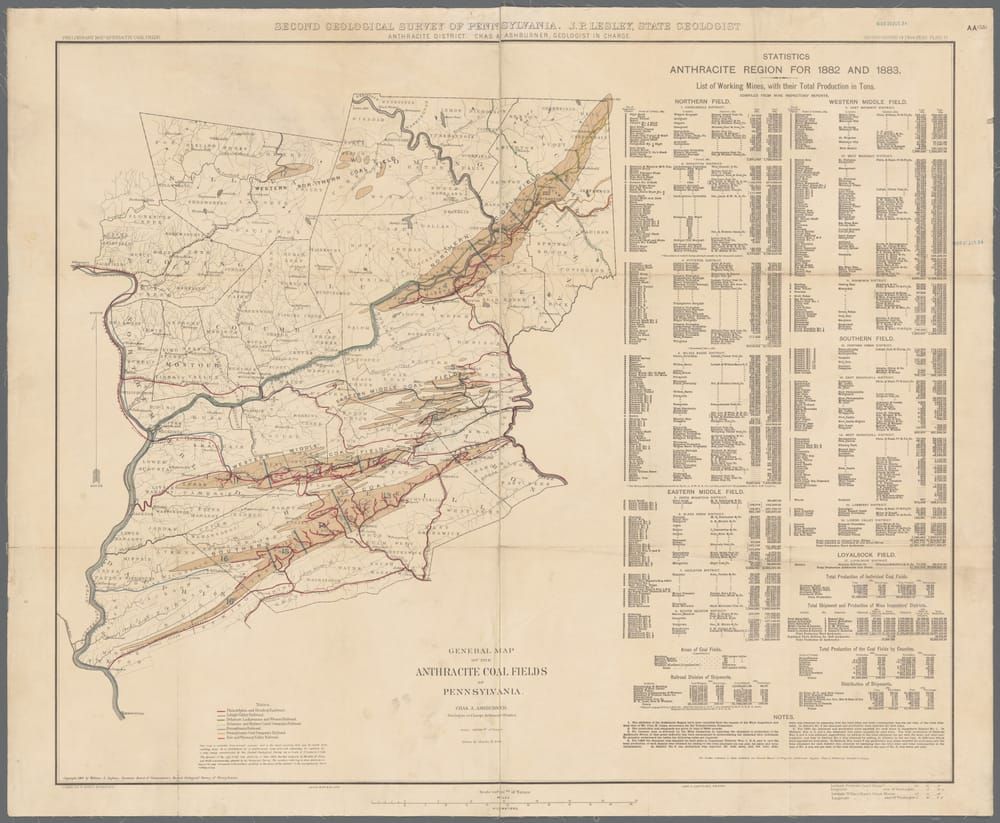
Anthracite is the hardest natural grade of coal: by the ASTM standard, more than eighty-six percent fixed carbon and less than about ten percent volatile matter. About 95 percent of all economically minable anthracite reserves in the United States lie in eastern Pennsylvania, in four geographically distinct coal fields covering roughly 484 square miles — the Northern (Wyoming), Eastern Middle, Western Middle, and Southern fields. Schuylkill County sits across the Southern Field and the southern half of the Western Middle Field, and the borough of Pottsville is the historic capital of the Southern Field.
The four Pennsylvania anthracite fields
The four fields are separated by ridges of the folded Appalachian mountains. From north to south:
- Northern Field (the Wyoming Field) — Lackawanna and Luzerne counties. The largest single deposit; anchored by Scranton and Wilkes-Barre. Effectively ended as a deep-mining district after the 1959 Knox Mine Disaster.
- Eastern Middle Field — eastern Luzerne and parts of Carbon and Schuylkill counties; anchored by Hazleton.
- Western Middle Field — northern Schuylkill, Columbia, and Northumberland counties; anchored by Shenandoah, Mahanoy City, and Ashland.
- Southern Field — southern Schuylkill and parts of Dauphin counties; anchored by Pottsville, with mining patches at Saint Clair, Minersville, Port Carbon, and across the Sharp Mountain ridge into the Western Middle Field.
Schuylkill County, in other words, straddles two of the four fields. The town pages for Pottsville, Saint Clair, Minersville, Port Carbon, Ashland, Shenandoah, Mahanoy City, and Tamaqua all sit on or directly above anthracite-bearing measures.
The beginning of the trade
Anthracite was known to colonial-era settlers but was widely considered too hard to ignite in the open hearths and stoves of the early Republic. Commercial use only became practical in the 1810s, with the invention of the upright stove and the slow-burning grate; commercial shipments from the Pennsylvania fields began around 1820, when the Lehigh Coal & Navigation Company began shipping anthracite down the Lehigh River from Mauch Chunk to Philadelphia.
Who first found the coal here is a separate question, and an older one. Schuylkill County’s traditional answer is the hunter Necho Allen, whose campfire is said to have set an outcrop of the Broad Mountain alight about 1790 — a story the county’s histories have carried since 1866, and the book that first printed it called tradition.
The Schuylkill Navigation — navigable from Mount Carbon to Philadelphia in 1825 and extended to Port Carbon in 1828 — opened the Southern Field at Pottsville to the Philadelphia market and effectively founded the towns of Port Carbon, Pottsville, Schuylkill Haven, and Saint Clair as transshipment and mining settlements. By 1840 the canal had been joined by the Philadelphia & Reading Railroad, whose Philadelphia–Reading main line opened in December 1839 and was extended to Pottsville in 1842 — a route that still runs along the Schuylkill River; by the 1870s the Reading and its subsidiary the Philadelphia & Reading Coal and Iron Company (organized in 1871) controlled the bulk of the Southern Field’s output.
Peak and decline
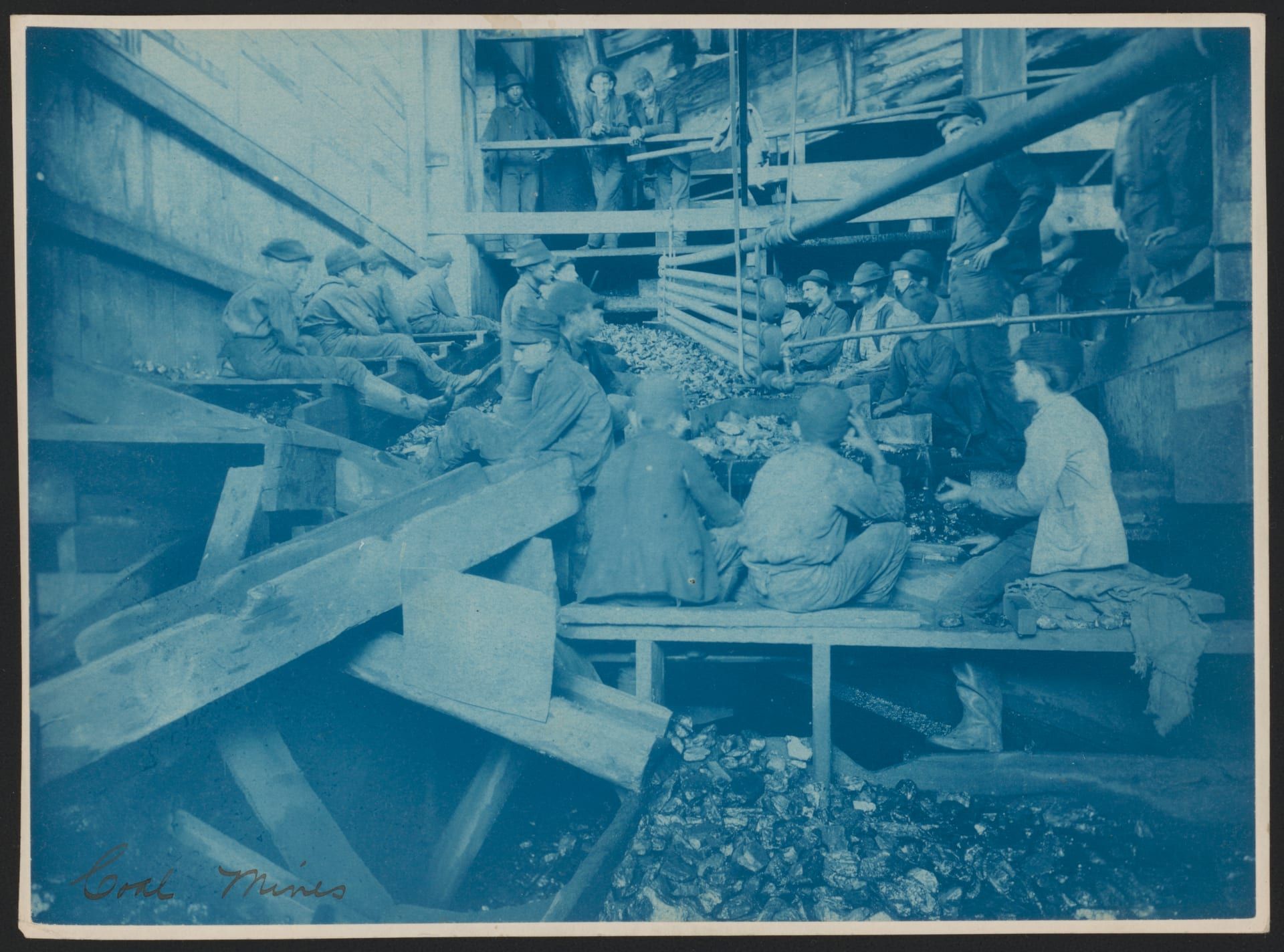
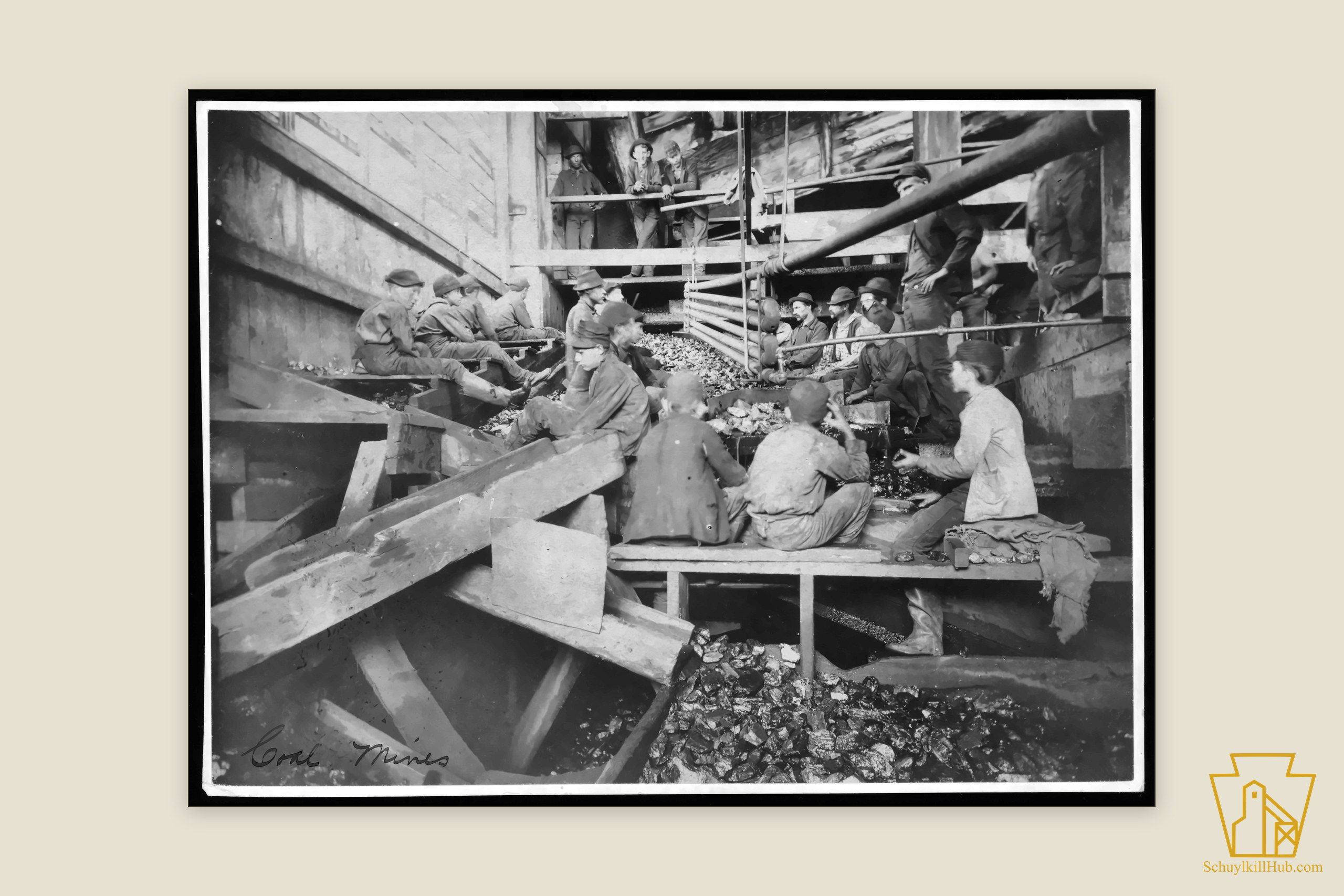
U.S. anthracite production peaked in 1917 at roughly 100 million short tons, almost all of it from Pennsylvania and a substantial fraction of it from the Southern and Western Middle fields in Schuylkill County. Employment in the anthracite industry peaked slightly earlier — at roughly 180,000 workers across the four fields in 1914 — with workforces drawn first from Welsh and Irish immigrants and then, from the 1880s onward, from Slovak, Polish, Lithuanian, and Ukrainian migrants. The Schuylkill County towns took on the character they still carry today during these years — multi-parish Catholic neighbourhoods organized by language, a labor culture built around the breaker boy, the foreman, and the mule driver.
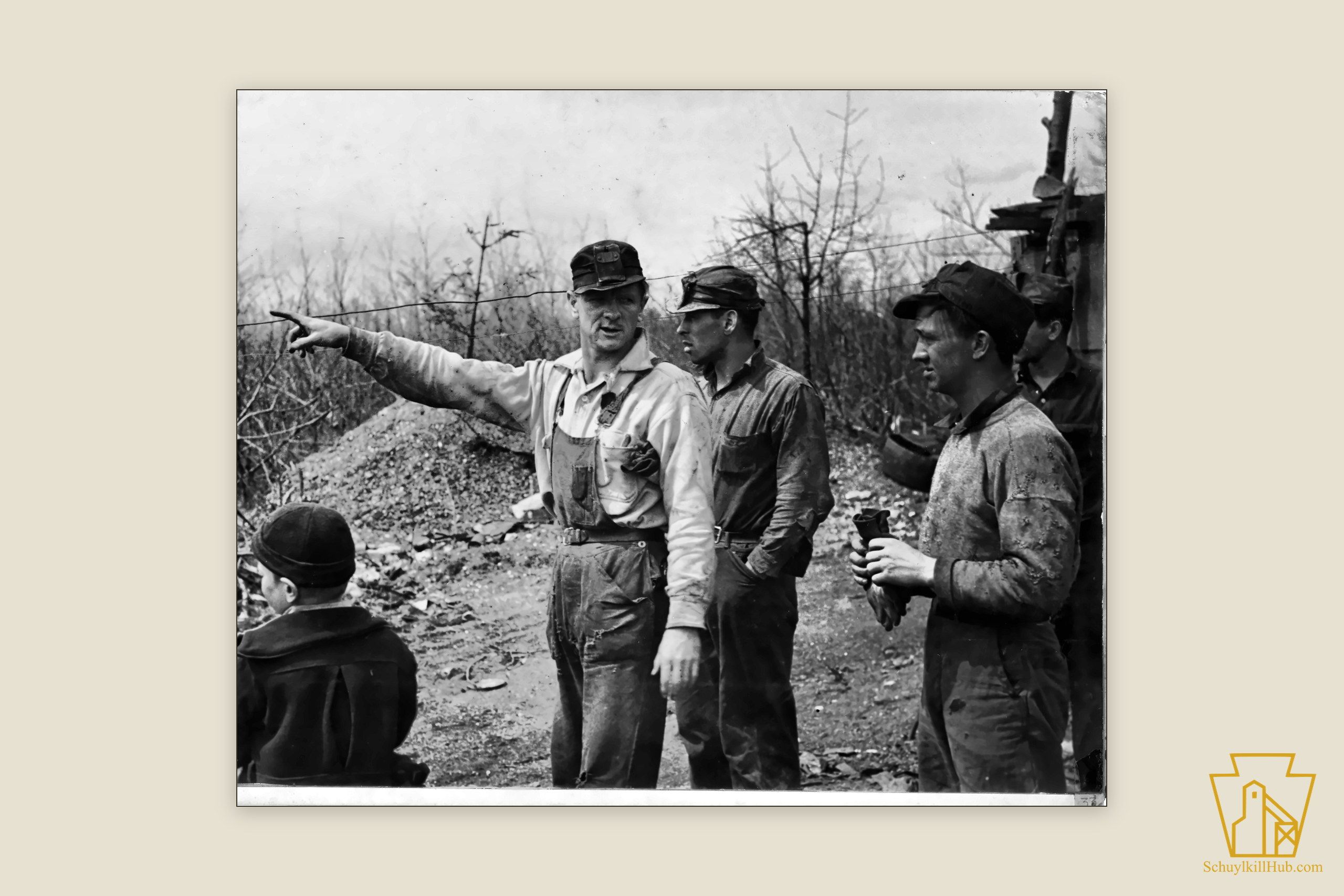
Output declined steadily through the rest of the twentieth century as home heating shifted to fuel oil and natural gas, and as the Pennsylvania deep mines became progressively more difficult and dangerous to work. The 1959 Knox Mine Disaster, which flooded much of the Northern Field after a mining operation cut through the bed of the Susquehanna River, effectively ended deep mining as a major industry in that field. Schuylkill County saw a slower decline, with surface (“strip”) mining and culm-bank reclamation continuing into the present.
The anthracite industry’s social legacy
The industry’s labor record left an outsized cultural and political footprint. The workforce itself was an immigrant succession: skilled Welsh and English colliers of the first coal wave, the famine-era Irish day laborers beneath them, and, from the 1880s, the Slavic and Italian “new immigration.” The Workingmen’s Benevolent Association (founded 1868 by the St. Clair labor leader John Siney) was an early industrial union of anthracite miners. The 1902 anthracite coal strike — a five-month walkout in which the United Mine Workers under John Mitchell faced down the railroad-owned operators — was settled by federal arbitration under President Theodore Roosevelt and is conventionally identified as a turning point in the federal government’s relationship with organized labor. The Molly Maguires trials of 1876–1879 (see the dedicated page) were tried in the Schuylkill County and Carbon County courts and remain among the most contested episodes in American labor history.
What survives
The Southern Field has not produced anthracite at scale for several decades, but the visible industrial fabric of the trade — railroad cuts, culm banks, breaker foundations, the steeply pitched rows of mine-patch housing — remains a defining feature of the Schuylkill County landscape. The Schuylkill canal route, the Reading Railroad mainline, the Pottsville & Mahantongo grade through Mahanoy Plane, and the rebuilt breaker at the Pioneer Tunnel in Ashland are among the surviving anchors.
Related
People: Necho Allen and the Discovery of Anthracite
Towns: Pottsville, Ashland, Shenandoah, Tamaqua, Mahanoy City, Minersville, Port Carbon, Saint Clair
From the archive
Historic maps and photographs from the Schuylkill Hub archive, each available as an archival print.
Sources
- Wikidata: anthracite (Q182458)
License: CC0 - Wikidata: Coal Region — Pennsylvania (Q5137767)
License: CC0 - J. H. Beers & Co., Historical and Biographical Annals of Schuylkill County, Pennsylvania (1916), Vol. I · 1916
License: public-domain - Library of Congress, Chronicling America: Weekly Miners' Journal (Pottsville, Pa.) 1873-1909, LCCN ca09000023
License: public-domain - Anthony F. C. Wallace, St. Clair — 'Immigrants in the coal region' (APS exhibit)
License: reference - MarkerQuest — John Siney historical marker, St. Clair
License: reference - Samuel Harries Daddow and Benjamin Bannan, Coal, Iron, and Oil; or, the Practical American Miner (Pottsville, 1866), p. 120 — the earliest printing of the Necho Allen tradition, given there as "the first traditional account" · 1866
License: public-domain
Frequently asked
- What is anthracite?
- Anthracite is the hardest natural variety of coal. By the ASTM standard, it contains more than 86% fixed carbon (dry, mineral-matter-free basis) and less than about 10% volatile matter — the highest fixed-carbon content of any coal grade — and burns with a clean blue flame producing little smoke or ash.
- Where is anthracite found in the United States?
- About 95% of all economically minable anthracite reserves in the United States are in Pennsylvania, concentrated in four geographically distinct fields: the Northern (Wyoming) Field around Scranton and Wilkes-Barre; the Eastern Middle Field around Hazleton; the Western Middle Field around Shenandoah, Mahanoy City, and Ashland; and the Southern Field around Pottsville. The four together cover roughly 484 square miles.
- When did Pennsylvania anthracite mining begin?
- Commercial anthracite shipments from the Pennsylvania fields began around 1820. The first sustained downstream shipments were made by the Lehigh Coal & Navigation Company from Mauch Chunk (now Jim Thorpe). The Schuylkill Canal — navigable from Mount Carbon near Pottsville to Philadelphia by 1825, and extended to Port Carbon in 1828 — opened the Southern Field to the Philadelphia market.
- When did anthracite mining peak?
- U.S. anthracite production peaked in 1917 at roughly 100 million short tons, almost all of it from Pennsylvania. Output declined steadily through the rest of the twentieth century as home heating shifted to fuel oil and natural gas; the deep-mining industry effectively ended after the Knox Mine Disaster of 1959 flooded the Northern Field, though strip mining continues today.
- What is the Coal Region?
- "Coal Region" is the long-standing local name for the Pennsylvania anthracite-producing counties — chiefly Schuylkill, Carbon, Luzerne, Lackawanna, Northumberland, and Columbia. The term is in everyday colloquial use and is recognized as an informal region in Wikidata (Q5137767).