The Molly Maguires in Pennsylvania's anthracite coal region
Listen to this article · 5 min
0:005:03
Read by a synthetic voice, generated from the text of this article. Hear the whole archive on the Listen page.
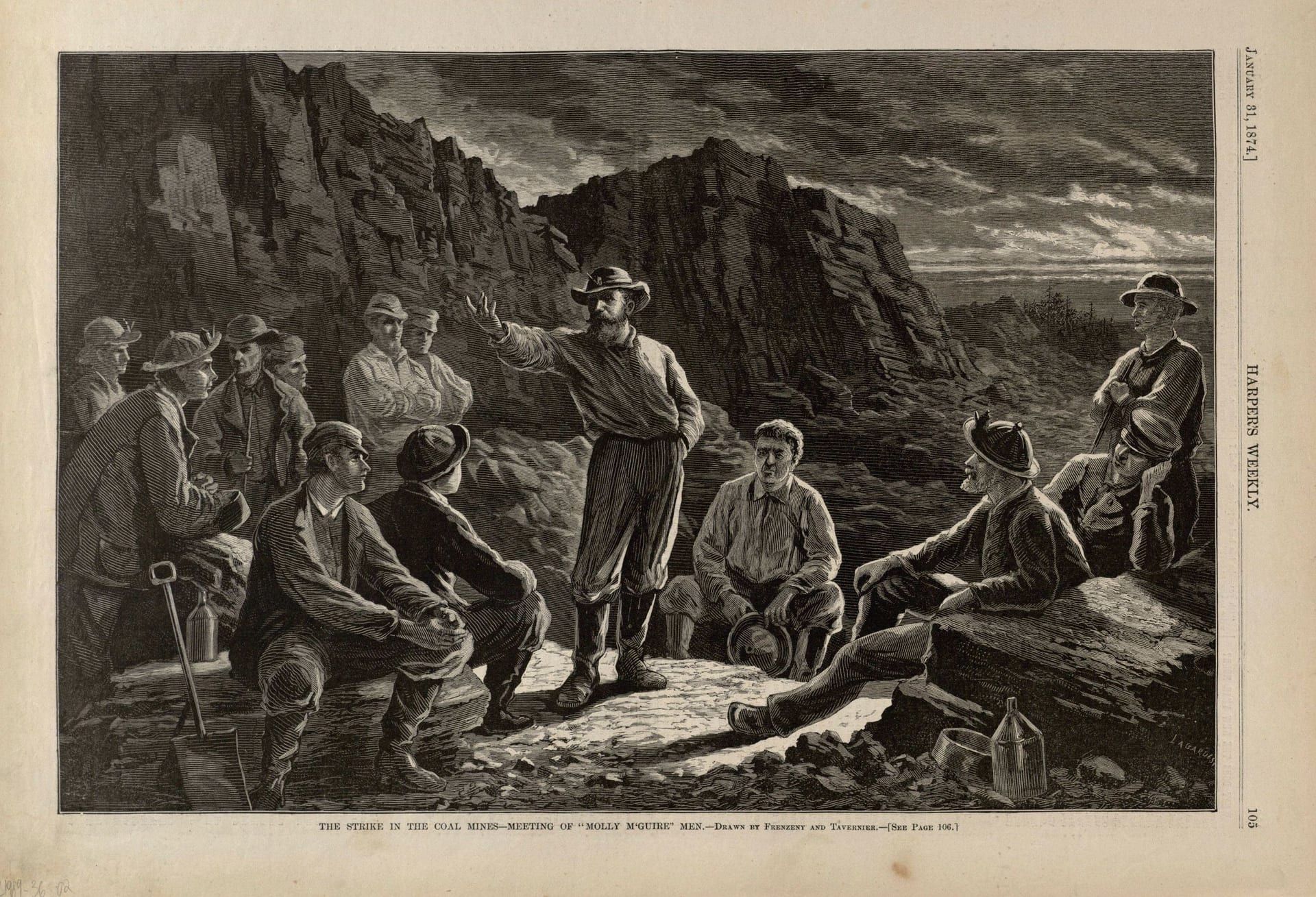
The Molly Maguires were an Irish-American secret society active in Pennsylvania’s anthracite coal region from roughly the early 1860s through the late 1870s. The organization is most often associated with Schuylkill, Carbon, Columbia, Northumberland, and Luzerne counties — the counties of the four anthracite coal fields of north-eastern Pennsylvania — and overlapped substantially with the Ancient Order of Hibernians (AOH), a Catholic Irish fraternal society. The name was taken from a similar agrarian-secret-society movement that had been active in pre-Famine Ireland.
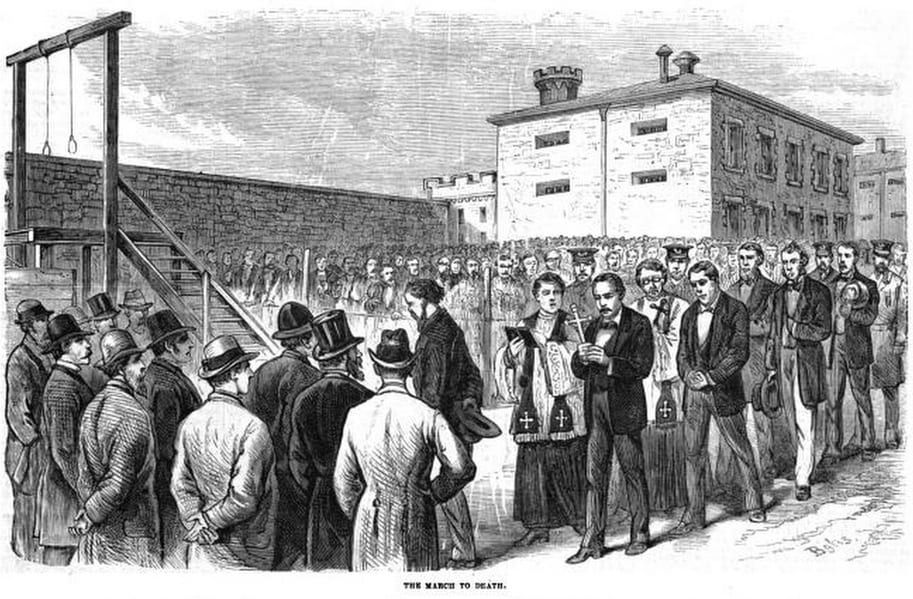
The Mollies’ best-known legacy is the wave of twenty executions between 1877 and 1879, including ten in coordinated hangings at two prisons on June 21, 1877 — the day remembered as “Black Thursday” and “the Day of the Rope.”
The anthracite coal field as a setting
By the early 1870s, the Southern Anthracite Field — most of which lies in Schuylkill County — was dominated by the Philadelphia & Reading Coal and Iron Company, the mining subsidiary organized in 1871 by the Philadelphia & Reading Railroad under its president, Franklin B. Gowen. Gowen set out to break both the Workingmen’s Benevolent Association (the miners’ union) and the Mollies in a single campaign.
The Irish-Catholic miners who made up much of the workforce had limited political and economic recourse. Mine-patch wages were paid in scrip, redeemable at the company store; the towns themselves — Mahanoy City, Shenandoah, Tamaqua, Girardville — were largely company-owned. The years between 1862 and 1875 saw a sequence of mine bosses, foremen, and policemen shot or beaten under circumstances the local press and the Coal & Iron Police attributed to the Molly Maguires.
The Pinkerton infiltration
In 1873, Gowen hired the Pinkerton National Detective Agency of Chicago to penetrate the organization. The Pinkertons assigned the Irish-born detective James McParland (operating under the alias James McKenna), who made Shenandoah his headquarters and worked across the surrounding patches at Mahanoy City and Girardville. McParland spent roughly two and a half years embedded among the Schuylkill County miners — drinking, working, and ultimately taking initiations into the AOH — and produced the detailed reports that became the prosecution’s spine at the trials that began in 1876.
The trials were tried in the Schuylkill County Court of Common Pleas in Pottsville (and, for the Carbon County defendants, in Mauch Chunk). The juries were typically Pennsylvania-German rather than Irish; defense counsel objected that Catholic Irishmen were systematically excluded.
June 21, 1877: ten hangings in one day
On June 21, 1877, ten convicted defendants were hanged in coordinated executions at two prisons:
- Six men at the Schuylkill County Prison in Pottsville
- Four men at the Carbon County Prison in Mauch Chunk (renamed Jim Thorpe in 1954)
Contemporary newspapers — including the Miners’ Journal of Pottsville — covered the day in detail; the Pottsville coverage describes large crowds outside the prison walls and a heavy presence of the Coal & Iron Police. The day is variously called Black Thursday or the Day of the Rope in later accounts.
A second round of hangings followed through 1879, including the execution of John Kehoe — the so-called King of the Mollies and a former state-convention delegate of the AOH — at the Schuylkill County Prison on December 18, 1878. Kehoe was posthumously pardoned by Governor Milton Shapp in 1979, a century and a year after his death.
Aftermath and historiography
After the executions, the Workingmen’s Benevolent Association collapsed; the Reading Railroad and the Coal & Iron Company consolidated their hold over the Southern Anthracite Field; and political organization among the region’s Irish-Catholic community pivoted into the more public, less clandestine institutions of the AOH lodges, the parish church, and — by the 1890s — the United Mine Workers of America.
Modern historiography has been sharply divided on what the Molly Maguires were. The contemporary prosecution and the company press cast them as an organized terrorist conspiracy; later labor historians have argued they were a much looser network of resistance whose alleged organizational structure was overdrawn by McParland’s reports and Gowen’s prosecutors. The clandestine nature of the organization — and the fact that the surviving documentary record is largely the work of its prosecutors — make a definitive answer difficult.
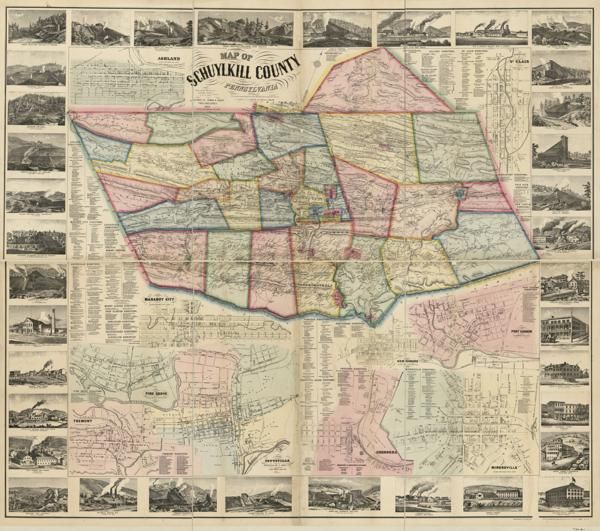
What is unambiguous is the geography. The Molly Maguire story unfolded almost entirely on the streets, in the mine patches, and at the courthouse and prison of Schuylkill County, Pennsylvania, and at the neighbouring courthouse and prison in Carbon County — and the Schuylkill County Prison block in Pottsville and the Old Jail in Jim Thorpe remain physical anchors of the case to this day.
Related
People: Alexander Campbell (1833–1877), John ("Black Jack") Kehoe (1837–1878)
Towns: Pottsville, Mahanoy City, Tamaqua, Shenandoah
From the archive
Historic maps and photographs from the Schuylkill Hub archive, each available as an archival print.
Sources
- Wikidata: Molly Maguires (Q399701)
License: CC0 - J. H. Beers & Co., Historical and Biographical Annals of Schuylkill County, Pennsylvania (1916), Vol. I · 1916
License: public-domain - Library of Congress, Chronicling America: Weekly Miners' Journal (Pottsville, Pa.) 1873-1909, LCCN ca09000023
License: public-domain - Library of Congress, Chronicling America: search results, "Molly Maguires," Pennsylvania, 1875–1879
License: public-domain
Frequently asked
- Who were the Molly Maguires?
- The Molly Maguires were an Irish-American secret society active in Pennsylvania's anthracite coal region during the 1860s and 1870s. The name was taken from a similar agrarian-secret-society movement in Ireland. In the anthracite region the organization overlapped substantially with the Ancient Order of Hibernians, a Catholic fraternal society.
- How many Molly Maguires were executed?
- Twenty alleged Molly Maguires were hanged in Pennsylvania between 1877 and 1879. Ten of them were hanged on a single day — June 21, 1877 — at two prisons: six at the Schuylkill County Prison in Pottsville and four at the Carbon County Prison in Mauch Chunk (now Jim Thorpe).
- When were the Molly Maguires hanged?
- The largest single day of executions was June 21, 1877 — sometimes called "Black Thursday" or "the Day of the Rope" — when ten men were hanged in coordinated hangings at Pottsville (Schuylkill County) and Mauch Chunk (Carbon County). Additional executions followed at the same two prisons and at the Columbia County prison in Bloomsburg through 1879.
- Where were the Molly Maguires executed?
- Six were hanged at the Schuylkill County Prison in Pottsville on June 21, 1877; four were hanged the same day at the Carbon County Prison in Mauch Chunk (now Jim Thorpe), Pennsylvania. The Carbon County Prison still stands and operates as the Old Jail Museum.
- What was the role of the Pinkertons?
- Franklin B. Gowen, president of the Philadelphia & Reading Railroad — which controlled the Philadelphia & Reading Coal and Iron Company subsidiary that Gowen had organized in 1871 — hired the Pinkerton National Detective Agency to infiltrate the organization. The Pinkerton detective James McParland (operating under the alias James McKenna) made Shenandoah his headquarters from 1873 to 1876 and provided the prosecution's principal witness testimony at the trials that followed.