First coal wave (1820s–1870s)
The Irish of Schuylkill County, Pennsylvania — Famine Migration & the Coal Patches
Listen to this article · 8 min
0:008:28
Read by a synthetic voice, generated from the text of this article. Hear the whole archive on the Listen page.
The famine-driven Catholic Irish who dug Schuylkill County’s coal — their patches, parishes, and fraternal life. The Molly Maguires, the county’s most famous episode, are introduced briefly here and treated in depth on their own page. Markers: verified · confirmed · corrects a common error · open/caution/legend.
Overview
No group is more bound up with Schuylkill County’s identity than the Catholic Irish. Driven out of Ireland by the Great Famine, the Irish arrived in the 1840s–60s as the bottom tier of the coal economy: not the skilled contract miners (those were Welsh and English), but the day-wage laborers beneath them, living in the outlying “patches,” crushed by the company store and the “bobtail check,” and despised by a nativist Protestant establishment. Out of that pressure came a decade of violence and a notorious prosecution — the Molly Maguires — that hanged twenty Irishmen and made the county nationally infamous.
This profile is about the Irish community — its migration, work, faith, and institutions. The Molly Maguires episode is introduced briefly below and covered in depth on its own page: The Molly Maguires. The standard scholarly works are Kevin Kenny’s Making Sense of the Molly Maguires (Oxford, 1998) and Anthony F. C. Wallace’s St. Clair (1987).
Sources: Kevin Kenny, Making Sense of the Molly Maguires (Oxford UP); Wallace, St. Clair — “Technology and the Molly Maguires” (APS).
The famine Irish in the coal patches
The Irish entered an economy already structured against them. As Wallace documents, the Welsh and English came with mining skill and “maneuver[ed] rapidly into supervisory positions,” while the famine Irish arrived “financially and physically devastated… ill equipped for work in the mines… more likely to live in the patches than towns, and more likely to work as laborers than skilled miners.” This was the occupational ceiling: the ethnic hierarchy and the workplace hierarchy were the same hierarchy.
The instruments of exploitation were concrete and well documented for the region:
- The “bobtail check” — a pay envelope marked with a curling line (“the snake”) meaning no wages due: rent, the company store, blasting powder, tools, and blacksmithing had eaten the entire wage.
- The company store and scrip — workers paid in mine scrip spendable at full value only at the company “pluck-me” store, which would not redeem it for cash; independent traders bought it at a 10–30% discount.
- Docking — coal was weighed before the miner was paid, and a fixed percentage deducted as presumed rock, with no neutral checkweighman.
Mining itself was, in Wallace’s phrase, “a disaster-prone industry,” and near Pottsville roughly a quarter of the workforce were children aged 7–16, mostly “breaker boys” picking slate. Over all of it lay nativism: Benjamin Bannan, editor of the influential Miners’ Journal, used his paper from the late 1850s to brand the largely Democratic Irish Catholic vote a threat and Irish violence a menace — once enumerating “fifty murders in Schuylkill County between 1863 and 1867,” only a handful actually attributable to Irish conspirators. The Civil War draft sharpened the conflict twice over. In October 1862, armed miners centered on Cass Township shut down collieries and stopped a train carrying drafted men under the state militia draft — the county’s draft resistance of 1862, over within a week without troops entering the mining districts; Curtin chiefly credited the presence of Bishop Wood. Resistance flared again under the federal Enrollment Act: in July 1863, as New York City’s draft riots burned, Cass Township miners again moved to block conscript trains — though, Wallace stresses, Irish military service was in fact proportionate to other groups.
Sources: Wallace — Technology and the Molly Maguires; ADP RethinkQ — coal company scrip / bobtail check; Wallace — Immigrants; Shankman — “Draft Resistance in Civil War Pennsylvania” (PMHB, 1977).
Where in Ireland they came from
Origins within Ireland mattered. Most of the famine-era St. Clair Irish came “largely from Counties Donegal and Mayo” — the Irish-speaking, famine-devastated western counties. A crucial distinction: the pre-famine Irish came from the “less-impoverished southern and eastern counties, particularly Laois (Queens County) and Kilkenny,” where many had prior coal-mining experience; these “Kilkenny men” obtained skilled jobs like the Welsh and English and “associated less frequently with other Irish emigrants.” The fault line ran along skill and region of origin — producing Irish-versus-Irish tension, not merely Irish-versus-Welsh. Mark Bulik’s The Sons of Molly Maguire (2015) traces this transatlantic strand to specific families such as the McGeehan clan of County Donegal.
Sources: Wallace — Immigrants; Mark Bulik, The Sons of Molly Maguire (Fordham UP).
The Catholic Church: the anchor of Irish life
The Church was the central institution of Irish communal life. The Irish parishes — St. Mary’s in St. Clair (distinct from the German St. Boniface, the two communities keeping even separate burial grounds), St. Canicus in Mahanoy City (“the Irish church in town,” dedicated July 1866, where John and Mary Ann Kehoe married), and Holy Rosary at Mahanoy Plane — were the spiritual and social core. The diocese had been built out under St. John Neumann (bishop to 1860, canonized 1977), whose parish-building served the famine Irish. The hierarchy was also “resolutely opposed to the Molly Maguires on theological and social grounds”: Archbishop James Frederic Wood of Philadelphia issued a pastoral condemnation of secret societies (dated January 19, 1864). (The documented instrument is the pastoral condemnation; the sweeping “excommunication + no burial” framing comes from popular sources and should be corroborated against Kenny.)
Sources: Mahanoy Area Historical Society — Molly Maguires; Wallace — Immigrants.
The Molly Maguires, in brief
The Molly Maguires have their own dedicated page — The Molly Maguires — and a separate in-depth study. This is a short orientation only.
In Kenny’s framing, the Mollies were “the last of the long line of rural secret societies that began with the Whiteboys” (also called Ribbonmen) — enforcing a rough folk-justice in rural Ireland and carrying that tradition to the coalfields. The violence cannot be separated from labor: after the first effective miners’ union (the Workingmen’s Benevolent Association, founded 1868 by John Siney) was broken in the mid-1870s and the “Long Strike” of 1875 ended in defeat, a second wave of killings filled the vacuum.
The destruction of the Mollies was engineered by Franklin B. Gowen, president of the Philadelphia & Reading, who hired the Pinkerton agency — its agent James McParlan infiltrated the Ancient Order of Hibernians under an alias. The accused were arrested by Gowen’s private Coal & Iron Police, prosecuted by company attorneys, and convicted largely on McParlan’s testimony plus plea-bargained informers, before juries from which no Irish Catholic was ever allowed to sit. Twenty Irishmen were hanged in all; on “Black Thursday,” June 21, 1877, ten were hanged in a single day — six at Pottsville and four at Mauch Chunk, among them Alexander Campbell. John “Black Jack” Kehoe — Girardville high constable and keeper of the Hibernian House tavern, cast as “King of the Mollies” — was hanged at Pottsville on December 18, 1878, and posthumously pardoned by Governor Milton Shapp in 1979; see the biography of John Kehoe.
Kenny’s verdict, the scholarly standard, rejects both the “terrorist” and “martyr” readings: the violence was real, rooted in a genuine Irish folk-justice tradition, but met by a corporate-driven, ethnically biased prosecution that exaggerated the organization’s coherence and almost certainly hanged innocent men. The full story — the labor context, the trials, the Wiggans Patch massacre, and the historiography — is told on the dedicated page.
Sources: Kenny, Making Sense of the Molly Maguires; Mahanoy Area Historical Society — Molly Maguires; Kehoe Foundation — John Kehoe.
Institutions, identity, and legacy
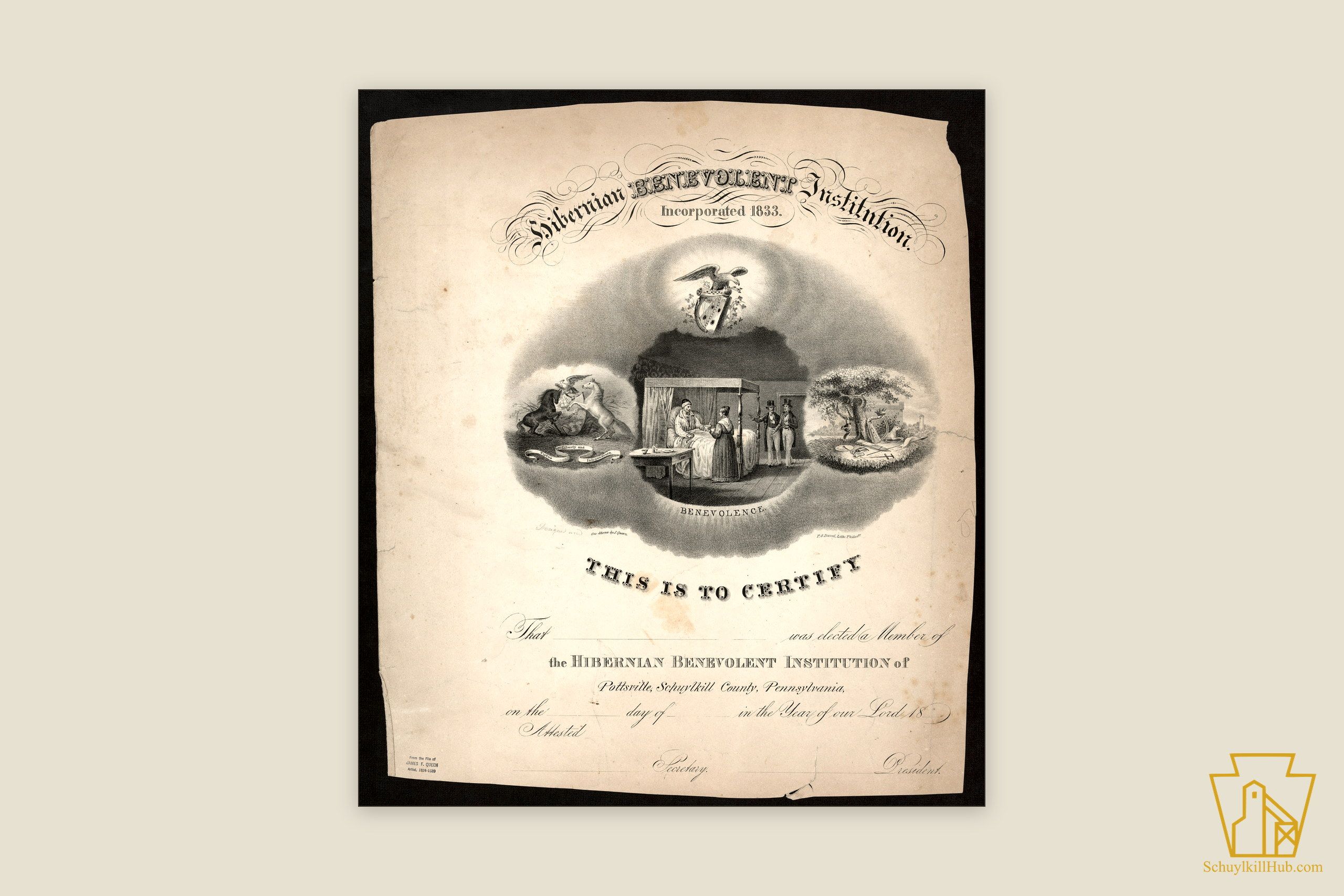
The defining Irish fraternal institution was the Ancient Order of Hibernians, founded in America in 1836 with an early Pottsville division. Tarred by the prosecution’s claim that “the Mollies and the AOH were one and the same,” the order severed its early lodges from its history after 1877 — but it survived, and annual tributes are held at Kehoe’s grave. The community had a paper of its own as well: the Emerald Vindicator (Pottsville, 1874–1889), the English-language voice of the county’s Catholic Irish in the Molly Maguire era. The Irish parishes (St. Canicus, Holy Rosary, St. Mary’s) and the St. Patrick’s Day parades remain markers of Irish identity in the county. Kehoe’s Hibernian House still stands in Girardville, owned and operated by his descendants (his great-grandson opens it for tours and events); a Molly Maguire Monument (a Zenos Frudakis sculpture) was dedicated in Mahanoy City in 2010; and the 1979 pardon stands as the symbolic civic reversal.
Sources: Kehoe Foundation — John Kehoe; Hibernian House (Kehoe descendants’ site); Mahanoy Area Historical Society — Molly Maguires.
Open questions
- The demographic geography of the Irish patches (Wiggans Patch, Shoemaker’s Patch, Mahanoy Plane) from census and parish records.
- The post-1877 Irish community — recovery, the rebuilt AOH, parish growth, and 20th-century Irish identity — via newspapers.com and parish histories.
- The exact mechanism of Archbishop Wood’s condemnation (pastoral letter vs. the popular “excommunication/burial” framing), to be fixed against Kenny.
From the archive
Historic maps and photographs from the Schuylkill Hub archive, each available as an archival print.
Sources
- Kevin Kenny, Making Sense of the Molly Maguires (Oxford UP)
License: reference - Wallace, St. Clair — 'Technology and the Molly Maguires' (APS)
License: reference - Wallace, St. Clair — Immigrants (APS)
License: reference - ADP RethinkQ — coal company scrip / bobtail check
License: reference - Mark Bulik, The Sons of Molly Maguire (Fordham UP)
License: reference - Mahanoy Area Historical Society — Molly Maguires
License: reference - Kehoe Foundation — John Kehoe
License: reference - Hibernian House (Kehoe descendants' site)
License: reference
Frequently asked
- Why did the Irish come to Schuylkill County?
- Driven out of Ireland by the Great Famine, the Catholic Irish arrived in the 1840s–60s to work the anthracite coalfields — but as the bottom tier of the economy: not the skilled contract miners (those were Welsh and English), but the day-wage laborers beneath them, living in the outlying 'patches.'
- What was the 'bobtail check'?
- A pay envelope marked with a curling line — 'the snake' — meaning no wages were due: rent, the company store, blasting powder, tools, and blacksmithing had eaten the entire wage. It was one instrument of an exploitation system that also included company scrip and 'docking.'
- Who were the Molly Maguires?
- A loose strand of Irish rural retributive-justice tradition — descended from the Whiteboys/Ribbonmen — blamed for a wave of coalfield killings in the 1860s–70s. A corporate-run prosecution hanged twenty Irishmen, ten on 'Black Thursday,' June 21, 1877. They are covered in depth on their own page; this profile only introduces them.
Related
Towns: Pottsville, Mahanoy City, Girardville, Saint Clair
Related peoples: Welsh
People: John ("Black Jack") Kehoe (1837–1878), Alexander Campbell (1833–1877), John Siney (1831–1880)