The Pottsville Police Department — from the borough high constable to the Bureau of Police
Listen to this article · 15 min
0:0015:25
Read by a synthetic voice, generated from the text of this article. Hear the whole archive on the Listen page.
Pottsville has been policed as long as it has been a borough — and no single founding date tells the story honestly. The men who have kept the city’s peace enter the record in layers: a high constable elected at the borough’s first election in May 1828; watchmen hauling Saturday-night offenders to “the lock-up” in the 1840s; a paid borough force under a named chief of police by 1871; a city police department from the first weeks of city government in 1913–14; and, since May 21, 1966, the Bureau of Police, created by city ordinance, which still keeps about two dozen sworn officers on Pottsville’s streets from the City Hall it has occupied since 1937. This is that whole line traced from the records — station houses included, from the Goforth Street lock-up to 401 North Centre — pausing, as the department’s own memorials have, at the name of Patrolman Morgan E. Skidmore, killed in the line of duty on April 16, 1928. It is a history worth telling plainly, out of plain gratitude.
A high constable and a lock-up
Pottsville was incorporated on February 19, 1828, under the wordy corporate name “the burgess and inhabitants of the town of Pottsville, in the county of Schuylkill.” At the first borough election, held at the house of John Weaver on Monday, May 7, 1828, the voters chose a chief burgess, an assistant burgess, a clerk, five councilmen — and Daniel Hill, high constable: the first law-enforcement officer of a boom town the 1830 census would count at 2,464 people. For its first decades the borough got by on that one elected office and the night watch.
What policing looked like in practice, the Miners’ Journal recorded in October 1845, in a sketch of a payday Saturday night the public historian Jake Wynn has transcribed: “If a person will walk through the town an hour or so after the stores are closed, he will be apt to see one of the watchmen dragging a fellow off to the lock-up. More than one such case usually occurs on Saturday night.” The watchmen and their lock-up — its early location has not survived in the sources we can reach — were what a canal-and-anthracite boom town could afford: not a department, but a night watch, walking a town whose beer houses the Journal thought “unfortunately too many.”
The county around it was harder to police than the borough. Schuylkill County’s disorder in the 1860s ran far enough beyond local means that in 1867, at the urging of a committee of fifty county citizens, the legislature erected a criminal court with special jurisdiction over Schuylkill and two neighboring counties, and passed what Munsell’s county history calls “a special police law” alongside it. Pottsville’s own arrangements grew more slowly: Boyd’s 1867 directory still lists only a high constable at the head of borough law enforcement, though its resident pages already carry men plainly working the streets — “police,” “night police” — for pay.
The borough force and the Goforth Street station
By 1871 the borough had something it had never had before: a chief of police. Boyd’s directory for that year lists George M. Smith, chief of police, at 213 Mahantongo Street; Anthony Herbert holds the office in the 1875–76 edition, James W. Shaw in 1879–80. Then come two tenures long enough to shape an institution. David C. Pritchard, a Civil War veteran, whom the directories list as chief from 1885 into the mid-1890s; and Hiram S. Davies, who follows him from 1897 through the end of the borough itself in 1913. The 1895–97 directory prints the whole force — Chief Pritchard and eight men, among them Hiram S. Davies, Charles Graeff, John M. Shuvlin, and Zaccur P. Madara — a roster whose names keep resurfacing in this story: Davies became the next chief; Graeff and Shuvlin died as city sergeants, remembered by the men who served under them; Madara, another Civil War veteran, put in what the county history records as twenty-five years on the borough force and later sat on the borough council. His son Walter would serve the city force for decades more, badge No. 6.
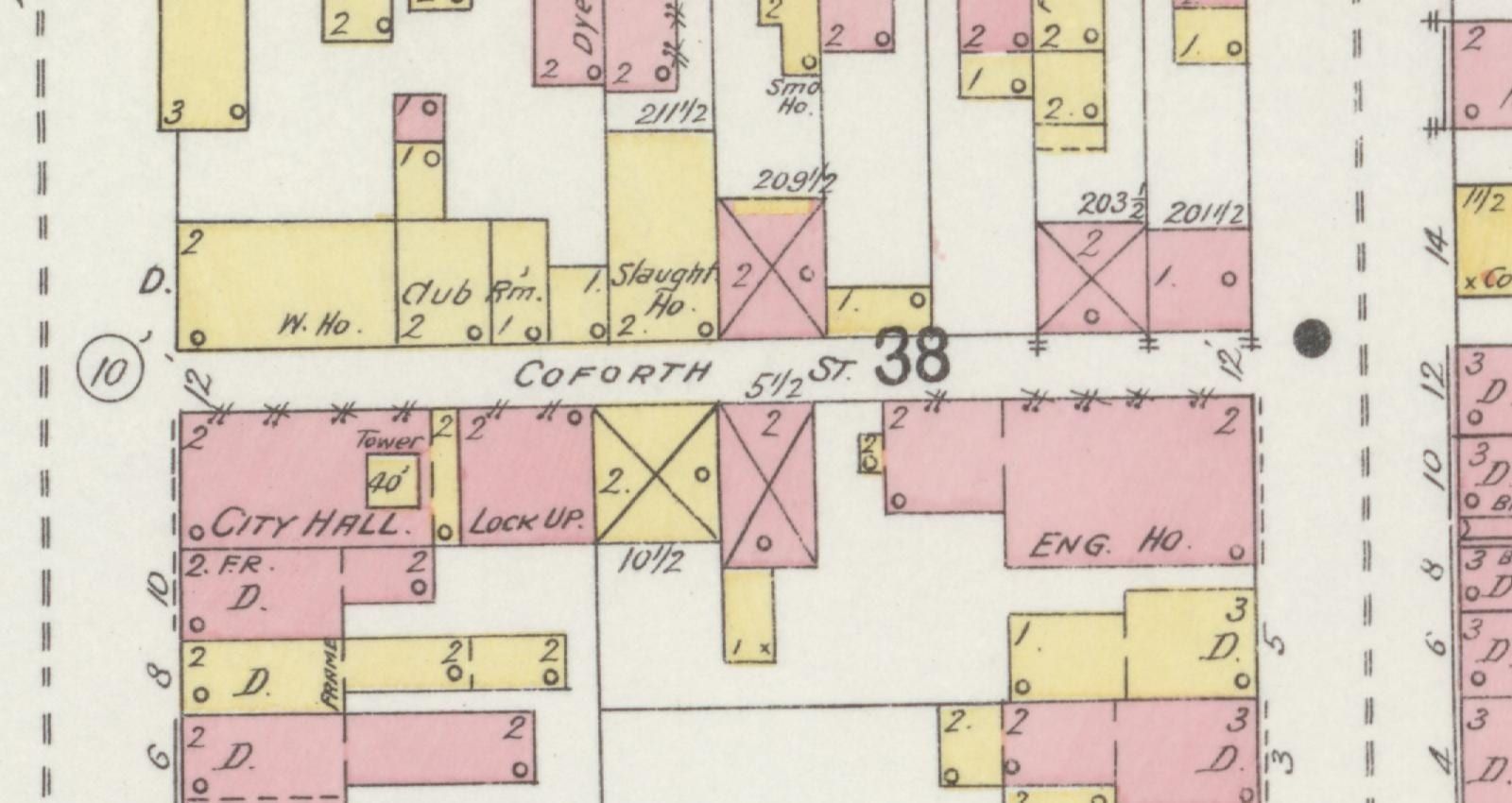
The borough force had a station of its own by the mid-1880s. The Sanborn fire-insurance map of June 1885 already draws a police station, engine houses, and the borough lock-up on the little street running from Second to Third just below Market — then called Division Street; by the 1889–90 edition, Boyd’s directory lists the police station on “Goforth Avenue,” the lane’s later name; and the April 1896 Sanborn sheet letters the brick municipal hall there “CITY HALL,” with a forty-foot tower on “Coforth” Street, its lock-up adjoining and a fire-engine house on the same row. Boyd’s directories place “Pottsville Borough Hall” at Third and Goforth, and the chief of police’s office in it, for the next four decades; the same building sheltered the quarters of the Humane Hose Company’s lineage of volunteer firefighters. When the city finally left in 1937, the Pottsville Republican wrote that the old hall “had been used for city and borough purposes for considerably more than a half century.”
June 1877: special police at the county prison
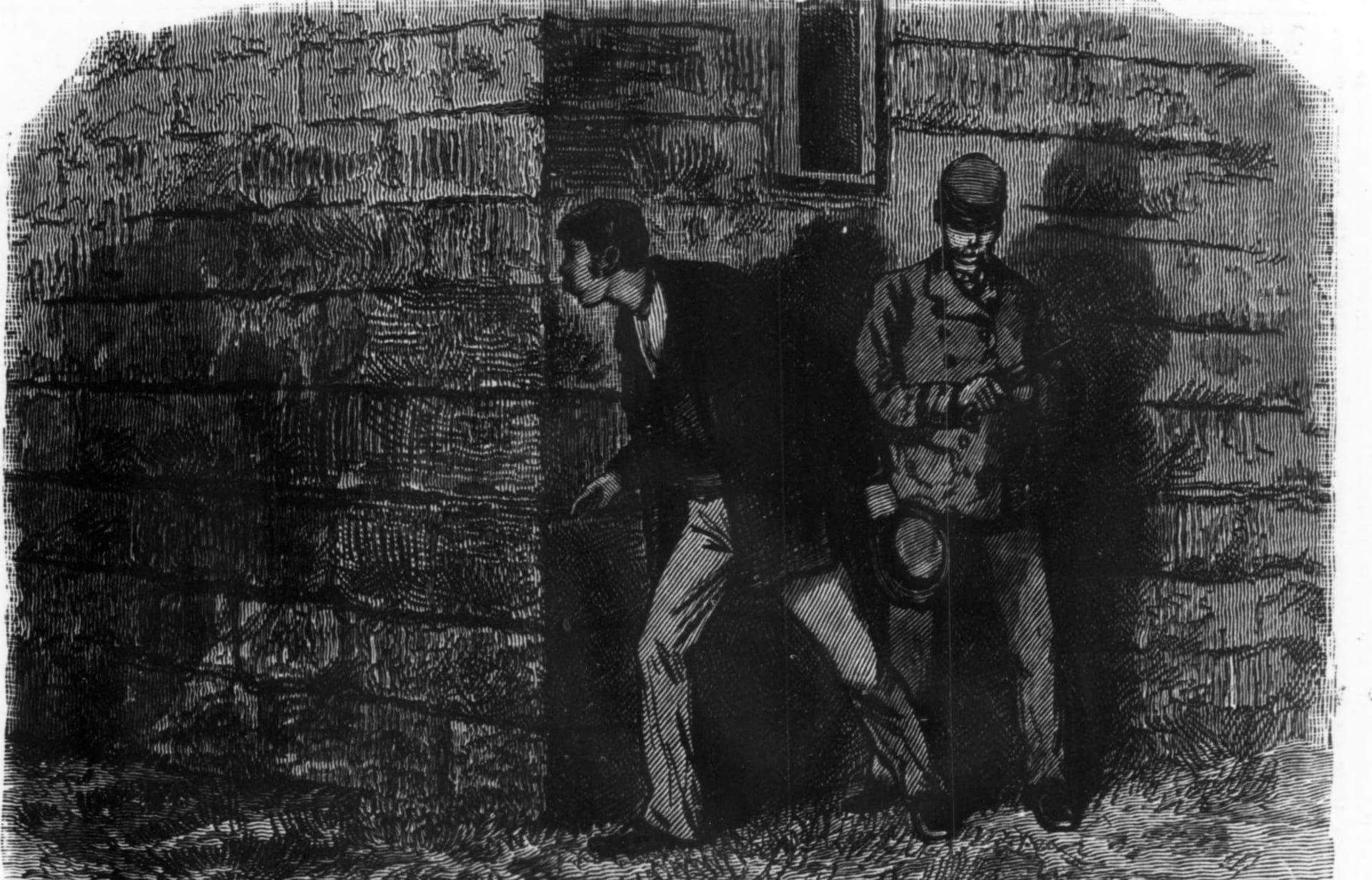
The most photographed week in nineteenth-century Pottsville law enforcement did not, strictly speaking, belong to the borough police at all. The hangings of six condemned Molly Maguires on June 21, 1877, were a county affair, carried out under Sheriff Werner inside the Schuylkill County Prison on Sanderson Street. But the borough braced with the county: fearing a rescue attempt from the mining patches, the authorities commissioned special policemen for the emergency, and Frank Leslie’s Illustrated Newspaper of June 30, 1877 pictured two of them standing guard beneath the prison’s wall — on a full page of sketches that also carried a portrait of policeman Benjamin F. Yost of Tamaqua, shot down in the discharge of his duties two years earlier, in a case at the heart of the trials. Yost’s face on that page is a reminder of what wearing a borough badge in 1870s Schuylkill County could cost.
The era’s other armed forces deserve careful separation from the city’s own story, because sloppy histories run them together. The arrests that broke the Molly Maguires were made by the Coal & Iron Police — a company-paid private constabulary in the service of the railroad and colliery interests, whose story belongs to the county’s Irish history. The Pennsylvania State Police, created in 1905 — “first uniformed state police force of its kind in the nation,” as its state historical marker puts it — was a state agency whose first four troop barracks, in 1906, were placed at Greensburg, Punxsutawney, Wilkes-Barre, and Reading: not Pottsville. Neither force was the Pottsville police, though their beats crossed: when the 1862 draft drew armed resistance in the coal towns, when strikes turned violent in 1875 and 1877, the answer came from sheriffs, soldiers, and company police, while the borough’s handful of officers kept walking their own streets.
A city force
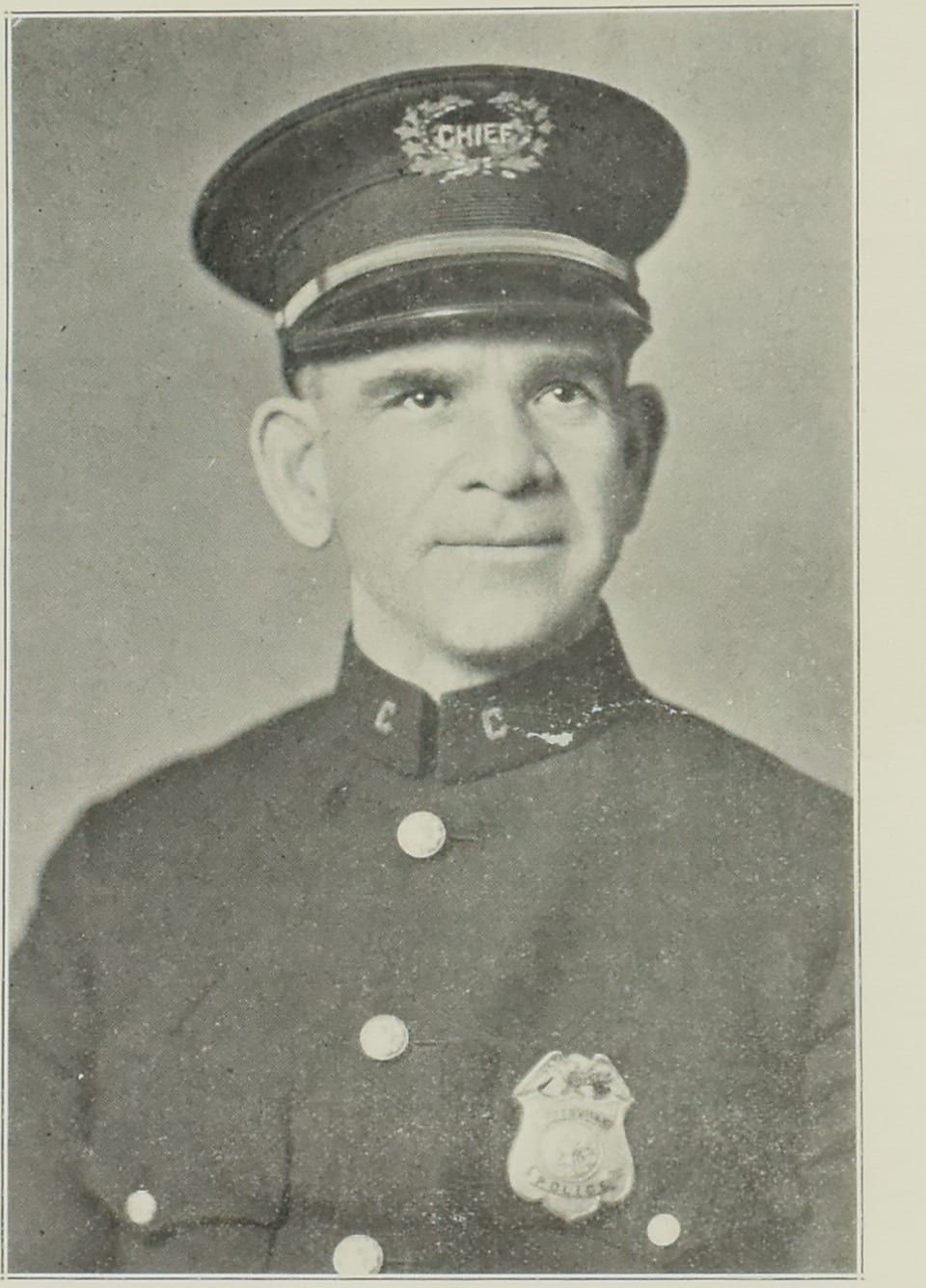
Pottsville’s city charter arrived on March 22, 1911, but the city government itself began operating on December 1, 1913 — and one of its first acts was to put policing on a new footing. On January 1, 1914, James W. Hoepstine Jr. was appointed chief of police, the county history of 1916 recording him as “the first incumbent of that office” under the new government. Hoepstine was a Pottsville résumé in one man: twenty-one years with the Philadelphia & Reading Coal & Iron Company, chief of the fire department in 1904–05, a Spanish-American War lieutenant and National Guard captain. Under the commission government the force answered through a Department of Public Safety, and the chiefs turned over with the administrations — Hoepstine through the 1910s, James B. Moyer by 1922, and from about 1926 Fred M. Dewald, a blacksmith’s-trade patrolman who had joined as a special officer in 1914 and worn badge No. 4. The mayor who promoted Dewald, LaMar L. Pritchard, was himself a son of David Pritchard, the old borough chief — the force’s short history already folding back on itself.
We can hear this force describe itself, because in 1927 it published a remarkable little book. The Police Historical Book of Pottsville — part civic manual, part portrait album, sold to advertisers from Pomeroy’s to the Mount Carbon Brewery — opens with a plea for “promoting the proposition of Cooperation” between citizens and police, and argues for something the force did not yet have: a police pension fund. Its history essay remembers the borough era with affectionate precision: in the gas-lamp days “the policemen carried little ladders and a torch, and it was their duty to see to it that the street lights were lit and extinguished again in the morning,” while the drunk cart everyone called the “Black Maria” handled Saturday night. Its portraits are the force of 1927 entire: Chief Dewald; Sergeant Edward Scott, on the job since March 16, 1903, presented with two dozen carnations on his twenty-fourth anniversary; Sergeant Albert Smith, a former miner hired in 1908 “with Hiram S. Davies as the chief of police here”; Silas Collins, the motorcycle policeman since August 1925; Nicholas DeRose, three years a state trooper before he joined; and the rest of a roster still small enough to know by name. Around the time the book appeared, the department was instituted as Pottsville Lodge No. 44 of the Fraternal Order of Police; the book’s late-1930s sequel credited that alliance with lifting “the dread of want” from aging officers — the very protection the 1927 foreword had pleaded for. Neighboring departments, Schuylkill Haven’s first among them, enrolled under the Pottsville lodge.
Patrolman Morgan E. Skidmore
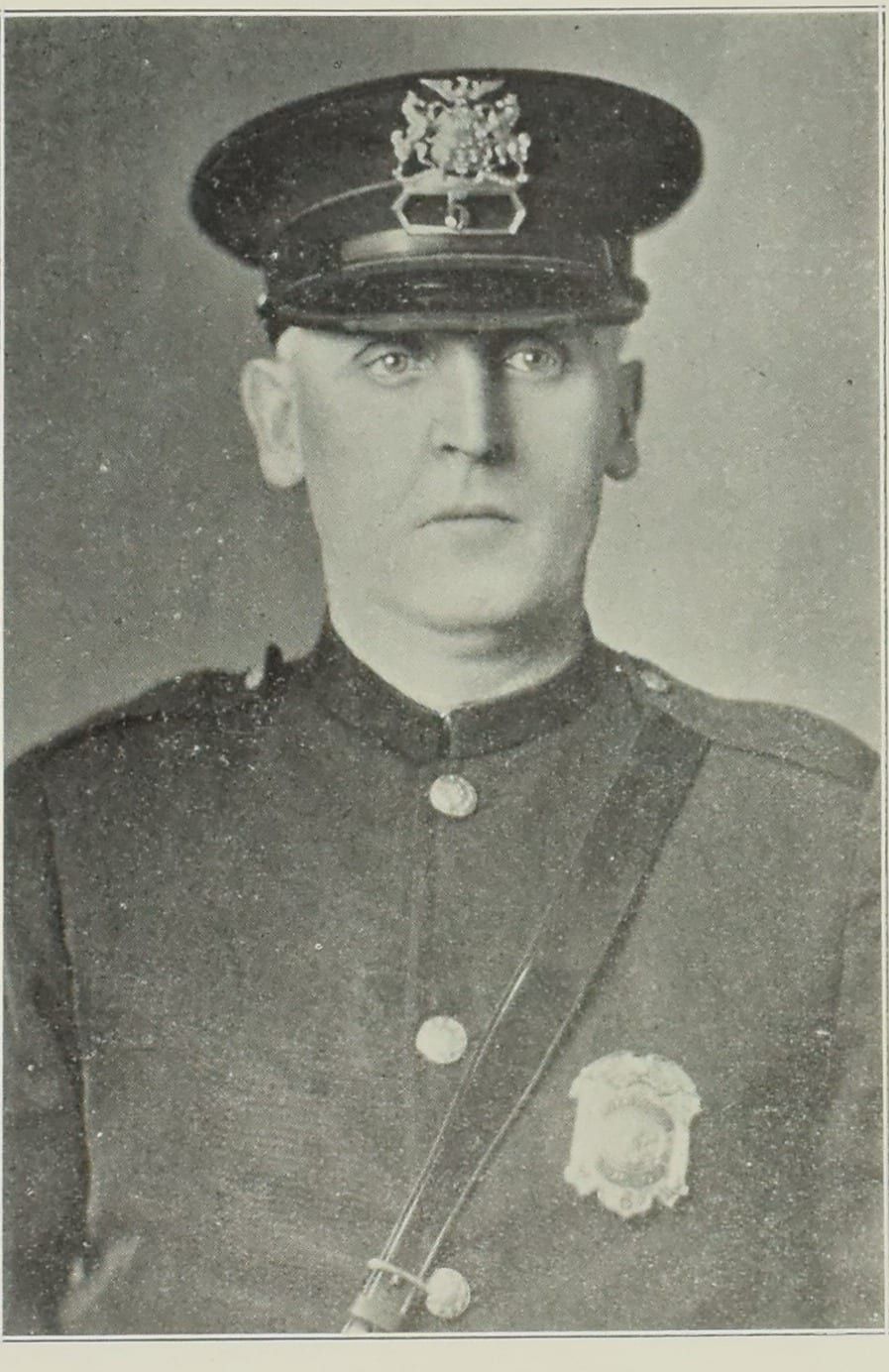
One of the portraits in the 1927 book shows a broad-faced patrolman in a high-collared tunic, badge on his breast: Morgan E. Skidmore, a Pottsville native who had joined the force in 1915 and worked the Fifth Ward, the beat the book frankly calls the city’s “rough” district. He was married, the father of one child, in his twelfth year of service when the book went to press.
On the morning of April 16, 1928, Chief Dewald sounded the police horn — the three-blast signal that summoned the force — and Skidmore answered it. He went to a house at 425 Minersville Street to arrest a suspected chicken thief; the suspect fired through a window and struck him in the back. He died that day, aged 49; a man was arrested after a chase the same morning and charged with murder. Mayor Pritchard’s tribute, printed on the Republican’s front page that evening, kept returning to the sound that had summoned him: Skidmore “answered the call, following the sounding of the police horn by Chief of Police Dewald. It may be truthfully said that he answered his last call. Those three shrill blasts of the police horn sent Patrolman Skidmore to his death.”
Three days later the force buried him. Pottsville Lodge No. 44 met in the council chamber, and at 1:30 the order was given: “In their uniforms, minus the overcoat and without arms,” the Republican reported, “the police started on their sad mission, one which they have never been called upon to perform” — the officers marching two abreast behind Chief Dewald, with the mayor and every member of the city council at the services. Skidmore remains the department’s only line-of-duty death on the Officer Down Memorial Page — a singular sacrifice, carried in the department’s own memorials. When the police book was reissued about a decade later, its In Memoriam roll called the roll of the 1927 force already gone — Skidmore first, and by then Sergeants Smith and Scott, Officers Blankenhorn and Miller, and Chief Dewald himself — over a newspaperman’s verse for “the cop on the corner.”
A home of its own
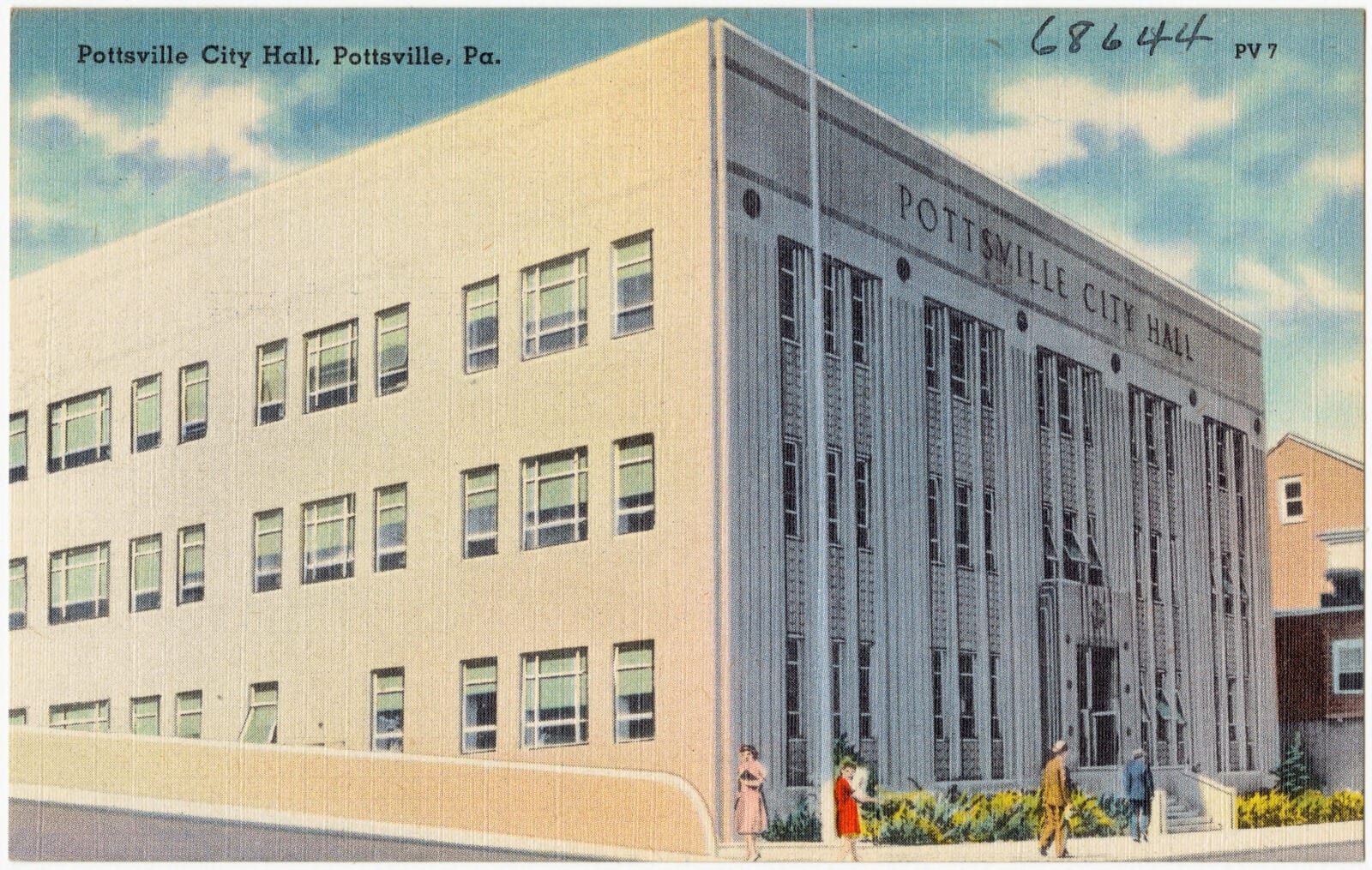
The old Goforth Street hall outlived its dignity long before the city left it. Relief came from the New Deal: between April 1936 and March 1937 the Public Works Administration built Pottsville a new City Hall at 401 North Centre Street — an $82,636 federal grant toward a total cost of $205,060, the cornerstone dated 1936. The city moved in on Thursday, April 15, 1937, the Republican reporting a three-story building “120 feet square” in Indiana sandstone, Mayor Claude A. Lord personally conducting friends through the marble-and-aluminum lobby off Centre Street.
Lord — who had taken office on January 1, 1934, and found, by his own account, a police department of “fourteen men enrolled and two substitutes” — had made the police floor his particular project. In the reissued police book he described the result with unconcealed pride: nearly half the first floor given to the chief’s offices, a teletype room, the sergeant’s office, and the police court, with a gymnasium, locker rooms, an ordnance room, and “a revolver and rifle range the entire length of the building” in the basement — and a rejuvenated force of thirty-five men, “completely and uniformly equipped,” with two motorcycles and two automobiles. His chief from 1935 was Leo Deegan — in 1927 the book’s promising young patrolman, a World War veteran and one-time boxer who had joined the force in May 1924. Like Dewald before him, Deegan had risen from the patrol ranks — a habit the department would show again.
The Bureau of Police
The department’s present legal shape dates to May 21, 1966, when Ordinance No. 72-66 created the Bureau of Police as Article 131 of the city’s newly codified ordinances — today Article I of the city code’s chapter on bureaus, whose first section still reads, in its entirety: “The direction, supervision and control of the Bureau of Police shall be vested in the Mayor.” The composition section as amended provides for a chief, two captains, and up to thirty patrolmen, with sergeants and corporals advanced by competitive civil-service examination — the professionalized frame around a force that remains, as it always has been, a neighbor-sized institution.
Its habits have proved durable. The bureau still works under a Fraternal Order of Police collective-bargaining agreement, nearly a century after Lodge No. 44 was instituted; there is still a motorcycle patrol, a century on from Silas Collins first kicking one to life; and the habit of raising leaders from within showed again on October 25, 2022, when, in the council chambers at City Hall, John R. Morrow — hired as a Pottsville patrolman in November 1991 — was sworn in as chief of police in succession to the retiring Richard Wojciechowsky, while three other officers were promoted the same day, captain, sergeant, and corporal, every one from within. Morrow’s retirement was announced in November 2024, after 33 years of service, but January 2026 council records still listed him as chief. The bureau counts twenty-two to twenty-three sworn officers by the city’s own 2026 pages, organized into patrol and criminal divisions with bike, motorcycle, and drug-investigation assignments — keeping the peace of the county seat from the same sandstone building Mayor Lord opened in 1937.
Nearly two centuries separate Daniel Hill’s election at John Weaver’s house from the bureau’s roster today, and the through-line is easy to miss for being so ordinary: one high constable in 1828, nine officers in 1895, thirty-five under Mayor Lord in the late 1930s, two dozen today — a few dozen of the city’s own people, at most, standing between Pottsville and its worst nights. They lit the lamps, walked the wards, answered the horn. One of them did not come home. The county remembers, and is grateful.
Related
People: Claude A. Lord (1889–1954)
Towns: Pottsville
Sources
- Munsell, History of Schuylkill County (1881) — the Pottsville municipal-organization chapter (the 1828 incorporation and first borough election), the Molly Maguire chapters, and the 1867 criminal-court and special-police legislation · 1881
License: public-domain - Boyd's Directory of Pottsville, Tamaqua, Mahanoy City, Ashland, and Minersville (1867) — the Pottsville borough-government roster (high constable; no chief of police) and resident listings of night police · 1867
License: public-domain - Boyd's Directory of Pottsville (1871–1872) — George M. Smith, chief of police · 1871
License: public-domain - Boyd's Pottsville Directory (1875–1876) — Chief of Police Anthony Herbert; High Constable Stephen Rogers · 1875
License: public-domain - Boyd's Pottsville Directory (1879–1880) — Chief of Police J. W. Shaw · 1879
License: public-domain - Boyd's Pottsville Directory (1889–1890) — Chief David C. Pritchard and the first directory listing of the police station on Goforth Avenue · 1889
License: public-domain - Boyd's Directory of Pottsville (1895–1897) — the full borough police roster under Chief Pritchard, the police station on Goforth Alley, and Pottsville Borough Hall at Third and Goforth · 1895
License: public-domain - Boyd's Directory of Pottsville (1897–1898) — Chief of Police Hiram S. Davies · 1897
License: public-domain - Boyd's Directory of Pottsville (1926–1928) — Chief of Police Fred M. Dewald; City Hall at 12 North Third Street · 1926
License: public-domain - J. H. Beers & Co., Historical and Biographical Annals of Schuylkill County (1916) — the James W. Hoepstine Jr. biography (appointed chief of police January 1, 1914) and the Zaccur P. Madara biography (twenty-five years on the borough force) · 1916
License: public-domain - Police Historical Book of Pottsville, Schuylkill County, Penna. (Pottsville Police Department, 1927; digitized with a late-1930s sequel edition) — forewords, city officers, the 'Evolution of the Police Department' essay, and the officer biographies and portraits, Patrolman Morgan E. Skidmore's among them · 1927
License: public-domain - Frank Leslie's Illustrated Newspaper, June 30, 1877, p. 292 — 'Special policemen on guard at the Pottsville jail' and 'Policeman Benjamin F. Yost, of Tamaqua, Pa.,' on the plate 'Pennsylvania.—The place of imprisonment of the Molly Maguire murderers' · 1877-06-30
License: public-domain - Frank Leslie's Illustrated Newspaper, July 7, 1877 — the execution-day account (Sheriff Werner's charge of the June 21 hangings at the Pottsville jail-yard) · 1877-07-07
License: public-domain - Sanborn-Perris Map Co., Insurance Maps of Pottsville, Pennsylvania, April 1896, sheet 4 — the City Hall, lock-up, and engine house on 'Coforth' (Goforth) Street (Library of Congress, Sanborn Maps Collection) · 1896
License: public-domain - Sanborn Map and Publishing Co., Insurance Maps of Pottsville, Pennsylvania, June 1885, sheet 4 — the police station, engine houses, and lock-up drawn on the lane then named Division Street (Library of Congress, Sanborn Maps Collection) · 1885
License: public-domain - Pottsville Republican (Evening Republican), April 16, 1928, p. 1 — 'Robbery Suspect Fires Bullet Thru Window Into Back Of Officer' and Mayor Pritchard's tribute, via Newspapers.com · 1928-04-16
License: publisher - Pottsville Republican, April 18, 1928, p. 2 — the continuing investigation, via Newspapers.com · 1928-04-18
License: publisher - Pottsville Republican, April 19, 1928, p. 9 — 'Police Pay Tribute,' the funeral of Patrolman Skidmore, via Newspapers.com · 1928-04-19
License: publisher - Pottsville Republican, April 16, 1937, p. 8 — 'New City Hall Now Occupied,' via Newspapers.com · 1937-04-16
License: publisher - Officer Down Memorial Page — Patrolman Morgan E. Skidmore, Pottsville Police Department (end of watch April 16, 1928; the department's only listed line-of-duty death)
License: reference - Living New Deal — City Hall, Pottsville, PA (Public Works Administration, April 1936 – March 1937)
License: reference - Tichnor Bros. postcard, 'Pottsville City Hall, Pottsville, Pa.' (Boston Public Library, Digital Commonwealth — no known copyright restrictions)
License: reference - City of Pottsville Code, Chapter 9, Article I — Bureau of Police (adopted May 21, 1966, by Ordinance No. 72-66 as Article 131 of the 1966 Code), eCode360
License: reference - Pennsylvania Historical & Museum Commission — incorporation dates for Schuylkill County municipalities (borough of Pottsville, February 19, 1828; city charter March 22, 1911; city government December 1, 1913)
License: reference - ExplorePAHistory — Pennsylvania State Police state historical marker ('first uniformed state police force of its kind in the nation'; first barracks Greensburg, Punxsutawney, Wilkes-Barre, Reading)
License: reference - Jake Wynn, 'Saturday Night in Pottsville, 1845' (Wynning History, October 12, 2024) — transcribing the Miners' Journal of October 1845 · 2024-10-12
License: reference - Jake Wynn, 'Special Police and the Molly Maguire Executions, June 1877' (Wynning History, June 18, 2025) · 2025-06-18
License: reference - City of Pottsville — Police (the bureau's page: sworn strength and structure; checked July 2026)
License: reference - City of Pottsville — 'Bureau of Police' recruitment sheet (23 full-time sworn officers; Patrol and Criminal Divisions; checked July 2026)
License: reference - Skook News, 'Pottsville Swears in New Chief of Police, Captain, Sergeant, and Corporal' (October 25, 2022) · 2022-10-25
License: publisher - 'City names new police chief,' Republican-Herald, October 21, 2022 (via Yahoo News) — John R. Morrow, hired as a patrolman in November 1991 · 2022-10-21
License: publisher - 'After 33 years, Pottsville police chief Morrow chooses to retire,' Republican-Herald, November 25, 2024 (via Yahoo News) · 2024-11-25
License: publisher - City of Pottsville — City Council reorganization agenda, January 5, 2026 (Police Department: Chief John Morrow) · 2026-01-05
License: reference
Frequently asked
- When was the Pottsville Police Department founded?
- No single date covers it honestly, so the record is worth laying out. Pottsville elected its first law officer — high constable Daniel Hill — at the borough's first election on May 7, 1828. Watchmen patrolled the borough by the 1840s, and by 1871 the directories list a chief of police, George M. Smith, at the head of a paid borough force. The city force dates from the city government's first weeks: Pottsville's city government began operating December 1, 1913, and James W. Hoepstine Jr. was appointed chief of police on January 1, 1914. The Bureau of Police in its current legal form was created May 21, 1966, by Ordinance No. 72-66.
- Who was Pottsville's first chief of police?
- The earliest chief the record names is George M. Smith, listed as chief of police in Boyd's 1871–72 directory of the borough. The first chief of the city force was James W. Hoepstine Jr., a former city fire chief and Spanish-American War officer appointed January 1, 1914 — the county history published two years later called him the first incumbent of that office.
- Has a Pottsville police officer been killed in the line of duty?
- One — Patrolman Morgan E. Skidmore, a Pottsville native who joined the force in 1915. On the morning of April 16, 1928, he answered the police call horn and went to a Minersville Street address to arrest a suspected chicken thief; he was shot through a window, in the back, and died that day, aged 49. He is the department's only line-of-duty death listed on the Officer Down Memorial Page. Three days later his fellow officers, in uniform and without arms, marched two abreast behind Chief Dewald to his funeral.
- Where has the Pottsville police department been headquartered?
- In the borough's first decades the record names only a lock-up. The June 1885 Sanborn map already draws a police station, engine houses, and the borough lock-up on the little street between Second and Third just below Market — then called Division Street, later Goforth Avenue — and by 1889 the directories list the police station on Goforth Avenue; the police stayed on the lane as its brick hall, forty-foot tower and all, became the Borough Hall and then City Hall, at 12 North Third Street. In April 1937 the city moved into the present City Hall at 401 North Centre Street, a Public Works Administration building with police quarters built into its first floor, and the bureau has been there ever since.
- Did the Pottsville police carry out the Molly Maguire executions?
- No. The hangings of June 21, 1877 took place at the Schuylkill County Prison on Sanderson Street — a county matter, under the sheriff. Pottsville's contribution to keeping order that week was special policemen commissioned for the emergency, pictured by Frank Leslie's Illustrated Newspaper standing guard outside the prison wall. The arrests that led to the trials were made by the Coal & Iron Police, a company-paid private force serving the railroad and colliery interests — an entirely different body from the borough's own small police force, and one worth keeping distinct from it.
- How large is the Pottsville police force today?
- The city's own pages in 2026 put the Bureau of Police at twenty-two to twenty-three sworn officers, organized into patrol and criminal divisions with bike, motorcycle, and drug-investigation assignments. Under the 1966 ordinance the bureau answers to the mayor, and its sergeants and corporals are promoted by competitive civil-service examination.