The Schuylkill County draft resistance of October 1862
Listen to this article · 19 min
0:0018:36
Read by a synthetic voice, generated from the text of this article. Hear the whole archive on the Listen page.
In the last week of October 1862, the Union war effort briefly stopped working in western Schuylkill County. Miners — many of them Irish immigrants — marched from colliery to colliery shutting down work, mustered under arms, and stopped a railroad train so that drafted men could not be carried away to Harrisburg. Governor Andrew Curtin telegraphed the War Department that thousands were in arms and asked for regular troops; a battery of artillery entrained at Philadelphia. Then, within a week, it was over — without a bayonet used, through what the governor himself chiefly credited to the presence of Bishop Wood, and, if a famous memoir is to be believed, through a quiet fiction about a filled quota that reached from a Pottsville newspaper office to Abraham Lincoln himself. It stands among the earliest episodes of organized, armed resistance to a Union draft, nine months before the New York City draft riots made “draft riot” a household phrase — and it is far less well known, in part because it ended with one accidental death rather than a burning city.
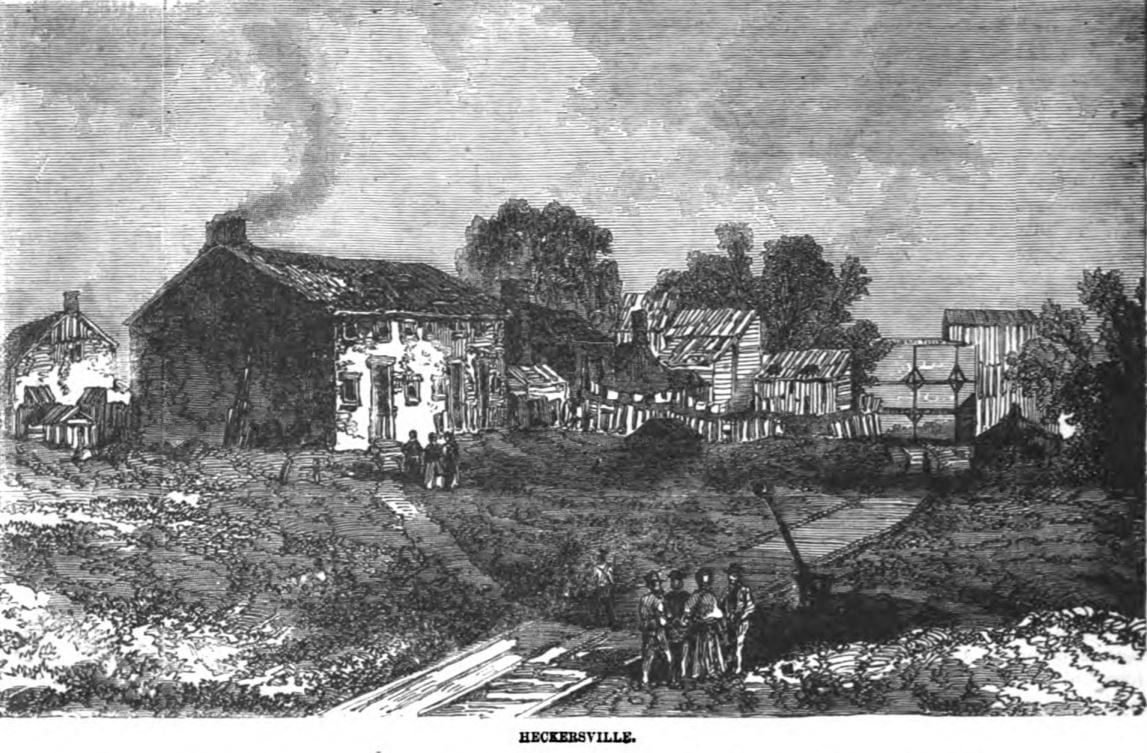
The center of the resistance was Cass Township, the mining district northwest of Minersville, with the patch village of Heckscherville described in the contemporary press as the headquarters of the disaffected; the storm reached Tremont, New Castle Township, Ashland, and the collieries between. What follows is the episode as the documents of that week actually tell it — the telegrams in the Official Records, the Philadelphia papers’ dispatches, and the two memoirs that supplied the legend.
Six days in October
The chain of documented events is short and dense. On October 16, 1862, the names were drawn in Pennsylvania’s militia draft — a state draft, under the federal Militia Act of July 1862, to fill the quota that volunteering no longer met. Schuylkill County’s quota was sixteen hundred men.
On Tuesday, October 21, the Philadelphia Inquirer reported, “a great number of the colliers in Schuylkill county” were “stopped in their operations by a band of miners, who perambulated the roads and insisted upon all the employes joining them” — a moving strike, colliery to colliery, whose declared object was “to resist the impending draft.” The rioters, the paper said, were “nearly all armed with bludgeons, guns, pieces of iron, swords and every other variety of weapon.”
On Wednesday, October 22, Governor Curtin’s first telegram reached Secretary of War Edwin Stanton at 2:30 in the afternoon: “The draft is being resisted in several counties of the State. In Schuylkill County I am just informed that 1,000 armed men are assembled, and will not suffer the train to move with the drafted men to this place. I wish ample authority to use my troops in the State … to crush this effort instantly.” Stanton answered the same evening, authorizing “the regular force, the Anderson Cavalry, and any other military force in your State,” and putting Major-General John E. Wool’s Middle Department at Curtin’s call.
On Thursday, October 23, Curtin wired again at 12:15 p.m., in the message that fixed the episode’s scale in the record: “Notwithstanding the usual exaggerations, I think the organization to resist the draft in Schuylkill, Luzerne, and Carbon Counties is very formidable. There are several thousands in arms, and the people who will not join have been driven from the county. They will not permit the drafted men, who are willing, to leave, and yesterday forced them to get out of the cars.” He asked for a thousand regulars; Stanton had none to give, and referred the request to the general-in-chief. By 3:20 p.m. Curtin was reduced to asking whether he could at least borrow General Andrew Porter, “now here, to command troops to suppress the insurgents? I have no officer.” That night a Philadelphia battery of light artillery under Captain Spencer Miller took the cars at West Philadelphia for Harrisburg, and Wool himself was ordered up from Baltimore.
On Friday, October 24, Wool reported after meeting Curtin: “I have ordered a section of artillery to report to him without delay, with ammunition,” plus an infantry regiment of Pennsylvania volunteers on call. “He wants regular infantry. I have none to give him, and have no troops that have been under fire.” That same day a wire from Pottsville was already telling another story: “The difficulties among the coal miners in Schuylkill county in regard to the draft have been adjusted. All is now quiet. The men generally are resuming work, which has been suspended for the last two days.”
On Saturday, October 25, Curtin wrote Stanton formally: “The riots in Schuylkill County have ceased for the present.” And on Monday, October 27, he sent the sentence that named what had actually ended the affair: “The decision and promptness, but more the presence of Bishop Wood, who kindly went up when requested, has relieved us all. I will retain the artillery a day or two.”
No troops entered the mining valleys, and no shot was exchanged between soldiers and miners.
A note on dates. The one death and most of the vivid detail come from a letter the Inquirer published on October 27, written from Tremont on the 25th. The scholarly literature has occasionally compressed this chronology — Arnold Shankman’s 1977 survey of Pennsylvania draft resistance places the train incident at Tremont on October 16 with a crowd of 1,000 — but the dispatches Shankman himself cites run from October 22 to 27, and Curtin’s “yesterday forced them to get out of the cars,” sent October 23, puts the train episode on or about the 22nd, with the colliery stoppages beginning the 21st. October 16 was the day the names were drawn.
How large was it, really?
Every number in this story was reported by someone with reasons to enlarge or shrink it, and the documents preserve the whole gradient. Curtin’s first report said 1,000 armed men at the train. The Inquirer’s first report estimated “at least three thousand men … engaged in the affair.” Curtin’s second telegram said “several thousands in arms” — prefaced, remarkably, by “notwithstanding the usual exaggerations.” A Harrisburg wire that ran in papers from Philadelphia to Portland, Maine, made it “over five thousand rioters … armed with guns, pistols and other weapons,” who “assert that they will fight desperately.” No count came from anyone who walked through the crowds; the numbers grew with each day’s retelling, and the governor knew it even as he repeated them.
What the resisters actually held was not a body count but a chokehold, and contemporaries saw it plainly. “The miners threaten to offer the Government of the State either the alternative of not drafting or of remaining entirely unsupplied with coal from this region,” the Inquirer reported. The threat had teeth: “Since the origin of the disturbance the receipts of coal in this city, from Schuylkill county, at Richmond, have been about one half less than usual, and yesterday about one third only of the usual amount was received.” Anthracite heated the cities of the Northeast; a war economy could not ignore the county that mined it. It is a labor historian’s point — made most fully in Grace Palladino’s study of the anthracite region’s Civil War — that this episode belongs to the history of workplace power as much as to the history of the draft, and the region’s earlier strikes ran continuously into it: the Inquirer’s correspondent noted that Heckscherville was already a place “where the services of the Pennsylvania Militia were required some time since, on the occasion of a strike for higher wages.”
What the miners did — and did not do
The Tremont correspondence, written October 25 while events were still warm, preserves details that complicate the word “riot.” The resisters organized like what they were — a workforce. “On Thursday and Friday the miners stationed boys along the railroad lines to give notice of the approach of any troops.” Faced with the prospect of soldiers, the correspondent judged the terrain itself was on the miners’ side: it “would have been utterly impossible, under any circumstances, for soldiers either to have captured or conquered the men who were so well informed of the secrets of every mountain pass and valley” — a judgment the governor seems to have shared, for “the Governor … did not send an armed force into the valley.”
And the strikers protected the mines they were idling. “During the continuance of the troubles just narrated, no injuries were inflicted on the collieries. The pumps were kept in action, and the decrease in the amount of coal shipped to market was less than was expected.” An anthracite mine left unpumped drowns; keeping the pumps manned while stopping the coal was the difference between a demonstration and destruction, and the men knew it. The correspondent’s own summary cut against the panic of the wires: “The miners, as a class, are quiet and orderly, and it is only when urged by master spirits that they become quarrelsome.”
The week’s one death was inside the movement, not in front of it. “On Thursday some of the ring-leaders were assembled at Coal Castle” — a patch in New Castle Township — when, “either in the excitement of the moment or while under the influence of strong drink, a rifle was discharged, the ball from which entered the body of one of the men, causing instant death.”
There was also a darker communal edge. The correspondent reported that after a church in Cass Township had been broken open and robbed about two weeks earlier — the Catholic majority “much incensed” — the trouble revived the grievance, and “the Protestants, with scarcely an exception, found it necessary to leave the township and desert their property.” He added, carefully, that there was “no good reason for supposing that these Protestants in any way favored the draft.” Curtin’s blunter version went to Stanton: “the people who will not join have been driven from the county.” Not every attempt to widen the movement worked: a committee that went to Ashland on Friday evening “to swear the miners not to labor” failed — “on this (Saturday) morning the collieries were all at work.”
The grievances underneath
The Inquirer’s correspondent — no friend of the resistance — conceded that part of its case was simply true: “There is reason to believe that some of the complaints in regard to the enrollment in Schuylkill county are well founded. The Deputy Marshals, in some instances, are said to have taken the tax duplicates, and enrolled both living and dead men. Four dead men are drafted in one township.” Enrollment lists copied from tax rolls, in a county of transient mine labor, could summon the dead.
A second grievance was the rumor — “obtained a general currency, although doubtless without any basis in fact,” the correspondent wrote — “of the introduction of negro labor into the region.” In the month after the preliminary Emancipation Proclamation, Democratic politics ran hard on that fear. The correspondent’s rebuttal was an economic one: mining “requires long practice and a skillful hand, a single false blow of the pick often destroying the labor of months, and carrying dismay and death to those beneath the surface.”
And a third channel of resistance was entirely lawful. A citizens’ committee took the enrollment complaints to two prominent Democratic lawyers — Francis W. Hughes of Pottsville and Charles R. Buckalew — “who advised them not to resist the draft on account of the alleged informalities, but to test [its] constitutionality afterwards on a writ of habeas corpus. This course will be pursued.” Others consulted Curtin himself, who “does not [appear] to be certain whether the drafted men can [be taken] out of the State.” The governor’s own doubts went deeper still: in his October 25 letter to Stanton he observed that the law “provided” penalties for drafted men who disobeyed, “but there is no act authorizing them to be forcibly impressed,” and suggested courts-martial as the only workable instrument. The state that had wired for a thousand regulars was privately conceding it lacked clear legal power to drag a single conscript to camp.
The Church, not the bayonet
What Curtin credited with ending the affair was a churchman’s tour. Bishop James F. Wood of Philadelphia — whose diocese then covered the coal region — arrived at Pottsville on Wednesday, October 22, “and despatches were immediately sent to the clergy throughout the disaffected regions, requesting their attendance.” The most vivid scene in the whole record belongs to the priest of Tremont, who the day before had “addressed a large concourse of miners at ‘New Mines,’” explaining “the necessity of preserving the Union, and enforcing the Laws.” Then: “He went in the midst of the crowd and illustrated some of his remarks in such a forcible manner that one or two of the would-be rioters, who were disposed to be insolent, were overawed.”
The Pottsville conference between the bishop and his clergy was private, but its instructions were reported plainly: the priests were “to preach on Sunday upon the evils of resisting the constituted authorities of the land, and it was understood that the threat of excommunication was to be used against those who were still determined to be troublesome.” By the time those Sunday sermons could be preached, work was already resuming — the Pottsville wire had pronounced the difficulties “adjusted” on Friday — so the sermons were the follow-through, not the turning point; what the record documents is the in-person work of the bishop and his priests during the week itself. How much it counted for is the governor’s own judgment rather than a provable mechanism: Curtin’s October 27 telegram credited “more the presence of Bishop Wood,” and he said he would retain the artillery “a day or two.”
The McClure story: a quota filled on paper
The chronology above stands on records made that week. The most famous part of the story does not. It was told thirty years later by Alexander K. McClure — the Republican power-broker who, at Lincoln’s and Curtin’s personal request, had organized and run the 1862 draft for the whole state — first in Abraham Lincoln and Men of War-Times (1892), then more fully in Old Time Notes of Pennsylvania (1905).
In McClure’s telling, when Cass Township’s conscripts refused the call and “drove other conscripts violently from the depot,” Stanton twice ordered the draft enforced “at the point of the bayonet,” and two regiments reached Pottsville. Fearing what a collision would mean, McClure — at Curtin’s direction — sent Lincoln a cipher dispatch and waited. No answer came that night. At breakfast the next morning he found Assistant Adjutant-General Townsend, just arrived, with a message the officer said he did not himself understand: “Say to McClure that I am very desirous to have the laws fully executed, but it might be well, in an extreme emergency, to be content with the appearance of executing the laws; I think McClure will understand.”
McClure understood. He summoned Benjamin Bannan — editor of the Pottsville Miners’ Journal and the county’s draft commissioner — and explained that a district’s draft could lawfully be revoked if its quota proved already filled by volunteers credited elsewhere. Bannan asked the only question that mattered — “How can it be done? How can the laws even appear to have been executed?” — went home on the next train, and returned the following evening “with a large number of affidavits regularly executed before a justice of the peace or notary public, proving on their face that the quota of Cass Township had been filled by volunteers.” McClure revoked the township’s draft on the spot. “I have never made inquiry into the method of obtaining those affidavits,” he wrote in 1892; by 1905 he was blunter — “all connected with its execution were entirely satisfied that the affidavits were fictitious” — and blunter still about the necessity: it averted “an open, desperate and bloody conflict in the heart of our great Commonwealth.” Stanton, he insisted, never knew.
The story deserves both respect and suspicion, and the record supplies grounds for each. In its favor: McClure was not a bystander but the draft’s administrator; the Official Records confirm the frame — Stanton’s aggressive authorizations, the troops and artillery put at Curtin’s call, the sudden stand-down, the artillery “retained a day or two” and never used; and the Philadelphia reports show the commissioner’s office actively postponing and improvising that same week. Against it: the quota story has exactly one source. No affidavit, no revocation order, no War Department record corroborating the Lincoln message has surfaced; Townsend and Bannan left no version of their own; and Lincoln’s now widely quoted line about “the appearance of executing the laws” descends entirely from McClure’s two printings, which do not even agree verbatim — the 1892 version presents it as a quoted message, the 1905 version as a paraphrase, and the word “fictitious” appears only in the later book. Wherever the truth sits, McClure’s own coda is worth keeping: it was “not the exact truth,” he admitted, that the draft was executed everywhere else — Philadelphia came up some three thousand men short of its quota, and evaded the consequence by other means. Cass Township’s paper quota was not the only elastic number in Pennsylvania’s 1862 draft.
One more caution about the memoirs. McClure wrote that in 1862 the “Molly Maguires were then just approaching the zenith of their criminal power” in Cass Township, with thirteen unpunished murders behind them. That is a claim written after the 1870s trials had made the Molly Maguires a national byword, projected backward. None of the 1862 reports quoted on this page — the telegrams, the wires, the Tremont correspondence — uses the phrase at all. The October resistance was open, collective, and mass; whatever secret-society thread ran through the coal region’s later violence, calling the 1862 crowds “Molly Maguires” is the memoirists’ vocabulary, not the documents’.
1862 was not 1863
Popular retellings blend this episode into the national draft-riot story, and the blending obscures both halves. The 1862 resistance was against Pennsylvania’s militia draft under the Militia Act of July 1862 — a state-run draft for nine months’ service. The notorious $300 commutation clause (“rich man’s war, poor man’s fight”) belonged to the federal Enrollment Act of March 1863, a different law administered by a different bureaucracy. Men of means in 1862 escaped by furnishing substitutes; the resentments were real, but they were not yet the resentments of 1863.
The county’s quota was never comfortably met. Contemporary reporting doubted the sixteen hundred would be raised at all, since “in townships where the draft has already taken place, the victims immediately absconded” — and statewide, Pennsylvania’s adjutant-general conceded in early November that about a quarter of the drafted men had not been delivered, with no force adequate to deliver them.
Under the Enrollment Act, resistance in the coal region resumed and hardened. Shankman’s survey records enrolling officers in Schuylkill County shot at and threatened in 1863, a provost marshal — Charlemagne Tower of Pottsville — reporting that his agents could not work without troops, and payroll books seized from mining companies to reconstruct the very lists the community refused to supply. Anthony F. C. Wallace’s account of the region likewise describes Cass Township Irish miners moving mine to mine to block conscript trains in the summer of 1863, in the same July weeks the New York City draft riots burned. That harsher, longer confrontation — and the years of labor violence and prosecution that followed — belongs to its own story. The week in October 1862 was something distinct: the moment the coal region first weighed its labor, its terrain, and its faith against the war state — and the state, for all its telegrams and its artillery, never sent a soldier into the valleys.
Related
People: Benjamin Bannan (1807–1875)
Towns: Pottsville, Tremont, Minersville, Ashland
Sources
- The War of the Rebellion: Official Records of the Union and Confederate Armies, Series I, Vol. XIX, Part II, pp. 468–469, 473–474, 480, 489–490, 500 — the Curtin–Stanton–Halleck–Wool dispatches of October 22–27, 1862 (Government Printing Office, 1887) · 1862
License: public-domain - The Philadelphia Inquirer, October 24, 1862, p. 8 — "Resistance to the Draft—Stoppage of Collieries" and the Harrisburg special despatch of October 23, via Newspapers.com · 1862-10-24
License: publisher - The Philadelphia Inquirer, October 27, 1862, p. 4 — "Troubles in Schuylkill County — The Resistance to the Draft — Intercession of the Catholic Priests," special correspondence datelined Tremont, October 25, via Newspapers.com · 1862-10-27
License: publisher - New York Herald, October 25, 1862, p. 1 — reprints of the Philadelphia Press and Philadelphia Inquirer reports of October 24, with the Pottsville wire "The Difficulties with the Coal Miners Adjusted" (Library of Congress, Chronicling America) · 1862-10-25
License: public-domain - Portland Daily Press, October 25, 1862, p. 3 — the syndicated Harrisburg wire, "Riot among the Miners" (Library of Congress, Chronicling America) · 1862-10-25
License: public-domain - Memphis Daily Appeal (published at Grenada, Miss.), November 5, 1862, p. 2 — Confederate-press reprint of the Tremont correspondence (Library of Congress, Chronicling America) · 1862-11-05
License: public-domain - Alexander K. McClure, Abraham Lincoln and Men of War-Times (1892), pp. 71–74 — the earliest printed version of the Cass Township quota story · 1892
License: public-domain - Alexander K. McClure, Old Time Notes of Pennsylvania (1905), Vol. I, ch. XLIX, pp. 537–550 — the fuller retelling, with the "fictitious" affidavits · 1905
License: public-domain - Alexander K. McClure, Old Time Notes of Pennsylvania (1905), Vol. II, pp. 431–432 — McClure's retrospective on Cass Township and the draft · 1905
License: public-domain - Arnold Shankman, "Draft Resistance in Civil War Pennsylvania," Pennsylvania Magazine of History and Biography, Vol. 101 (April 1977), pp. 190–204 · 1977
License: publisher - Jake Wynn, "Revolutionary Disloyalty: Coal Miners' Rebellion in Schuylkill County, 1862" (Wynning History) · 2017
License: reference - Jake Wynn, "Miners' Revolt in PA Challenged the Draft" — the McClure episode (Wynning History) · 2018
License: reference - Douglas Harper, "The Northern Draft of 1862," with the transcribed Pennsylvania correspondence (Slave North)
License: reference - Anthony F. C. Wallace, "St. Clair — Technology and the Molly Maguires" (American Philosophical Society exhibit) — the July 1863 Cass Township train-blocking
License: reference - Grace Palladino, Another Civil War: Labor, Capital, and the State in the Anthracite Regions of Pennsylvania, 1840–1868 (Fordham University Press edition)
License: reference
Frequently asked
- What was the Schuylkill County draft resistance of 1862?
- In late October 1862, miners across western Schuylkill County — Cass Township at the center, with Heckscherville described as the headquarters — marched colliery to colliery, stopped work, and prevented a train from carrying drafted men to Harrisburg. Governor Curtin telegraphed Washington for troops and artillery was readied, but the affair ended within about a week without troops entering the mining districts; Curtin himself chiefly credited the presence of Bishop James F. Wood, and contemporary reporting documents the Catholic clergy working among the miners that same week.
- Was it the first armed resistance to the Union draft?
- It was among the earliest mass, armed episodes — nine months before the New York City draft riots of July 1863 — but "first" is stronger than the record supports. The October 1862 militia draft met trouble in several Pennsylvania counties and in other states the same season; Schuylkill County's resistance was the episode serious enough to bring a governor's appeal for federal troops.
- Did anyone die in the 1862 draft resistance?
- One death is recorded in the contemporary reports, and it was accidental: at Coal Castle on Thursday, October 23, a rifle discharged — "either in the excitement of the moment or while under the influence of strong drink," the Philadelphia Inquirer's correspondent wrote — killing one of the men instantly. No deaths came from any clash with troops, because no clash ever happened.
- Is it true that Lincoln let Schuylkill County's draft quota be quietly written off?
- That story rests on a single source: the memoirs of Alexander K. McClure, who ran the 1862 draft in Pennsylvania and wrote decades later that, on a private hint from Lincoln that the law need only "appear to have been executed," commissioner Benjamin Bannan produced affidavits — which McClure said all involved knew were fictitious — showing Cass Township's quota already filled. The official telegrams confirm the troops, the timing, and the stand-down, but no government record corroborates the quota story itself.
- Why did the miners resist the draft in 1862?
- The contemporary reports describe several grievances layered together: reported irregularities in the enrollment (one township's lists were said to include four dead men), fear — stoked by rumor — that emancipation would send freed Black laborers into the mines, wage grievances continuous with earlier strikes, and anti-war Democratic politics. The miners also held obvious leverage: within days, Philadelphia's coal receipts had fallen by half.
- What happened after October 1862?
- The militia draft went forward — Schuylkill County's quota was 1,600, and contemporary reporting doubted it would be filled, since drafted men "immediately absconded" in some townships. Citizens' committees pursued legal challenges rather than force. Under the federal Enrollment Act of 1863, resistance in the county flared again, and enrolling officers there needed troops — a harsher, longer confrontation than the week in October 1862.