Civic Buildings · Built 1936–1937
Pottsville City Hall
Pottsville City Hall at 401 North Centre Street — the 1936–37 Public Works Administration municipal building by D. H. Grootenboer, occupied April 15, 1937, and still the seat of city government and its Bureau of Police.
Listen to this article · 8 min
0:008:04
Read by a synthetic voice, generated from the text of this article. Hear the whole archive on the Listen page.
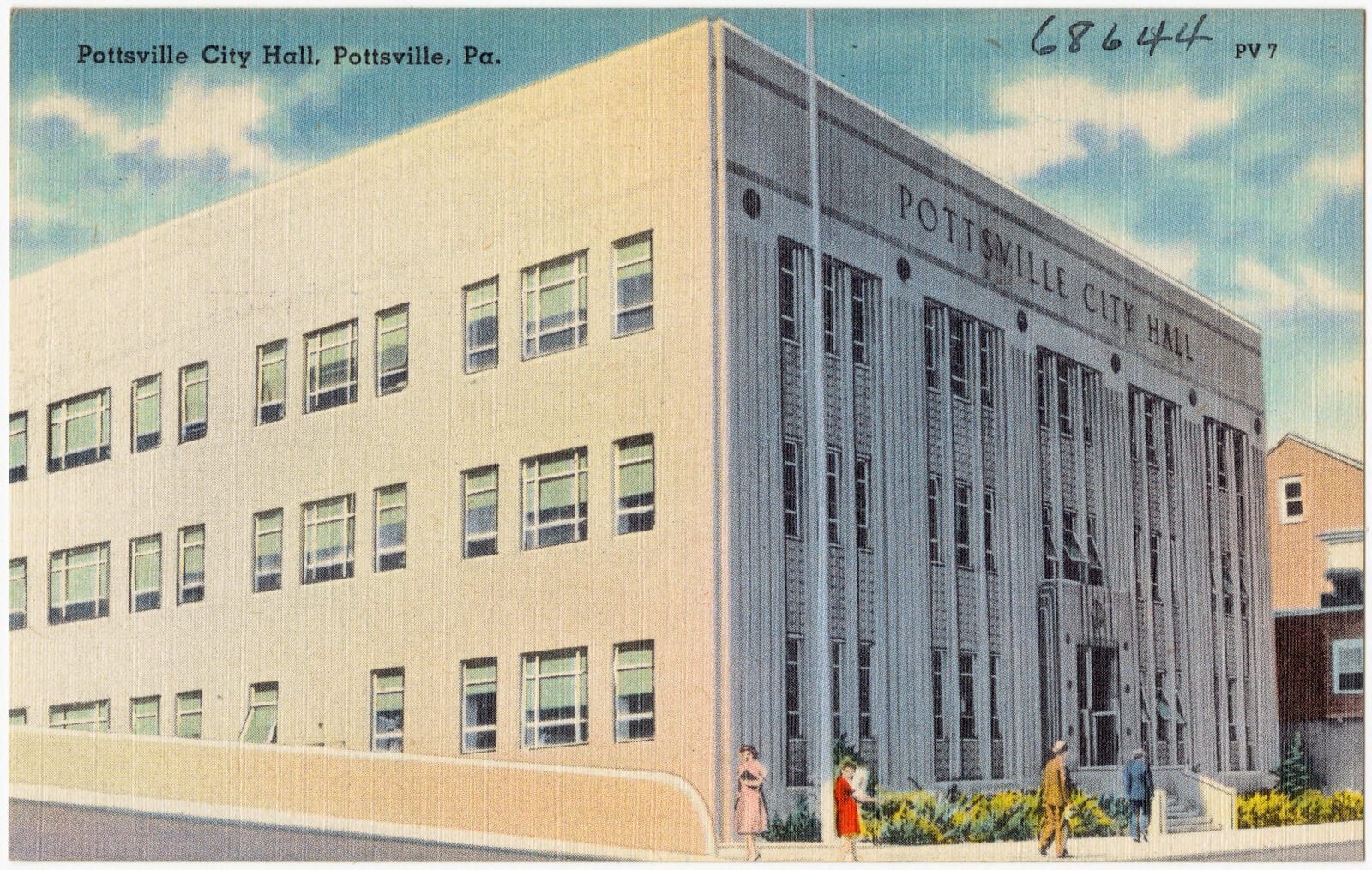
Pottsville City Hall, at 401 North Centre Street, is the three-story Indiana-sandstone municipal building the Public Works Administration built for Pottsville between April 1936 and March 1937 — an $82,636 federal grant toward a $205,060 total cost. The city government moved in on April 15, 1937, and it is there today: the building remains the seat of city government, and the city’s police have been headquartered on its first floor from the first day. The plans were in the charge of the architect D. H. Grootenboer, of the Grootenboer-Knoblock firm, by the contemporary account of the Pottsville Republican.
The old hall on Goforth Avenue
The building Pottsville left behind in 1937 had backed into city service sideways. The borough’s first public hall proper — the Town Hall of 1841, which stood on the 300 block of Centre Street and hosted everything from Masonic lodges to a Mexican War company’s headquarters — burned on March 19, 1876, taking a lodge’s regalia with it, “no insurance.” What replaced it as the seat of local government was not a purpose-built hall but the fire companies’ quarters on a little lane between Second and Third Streets just below Market: a brick hall at what became 12 North Third Street, dated 1871 by the historic district’s 1982 survey and described there as “originally fire hall” — the quarters of the lineage that ran from the Pottsville Fire Co. of 1833 to the Humane Hose Co.
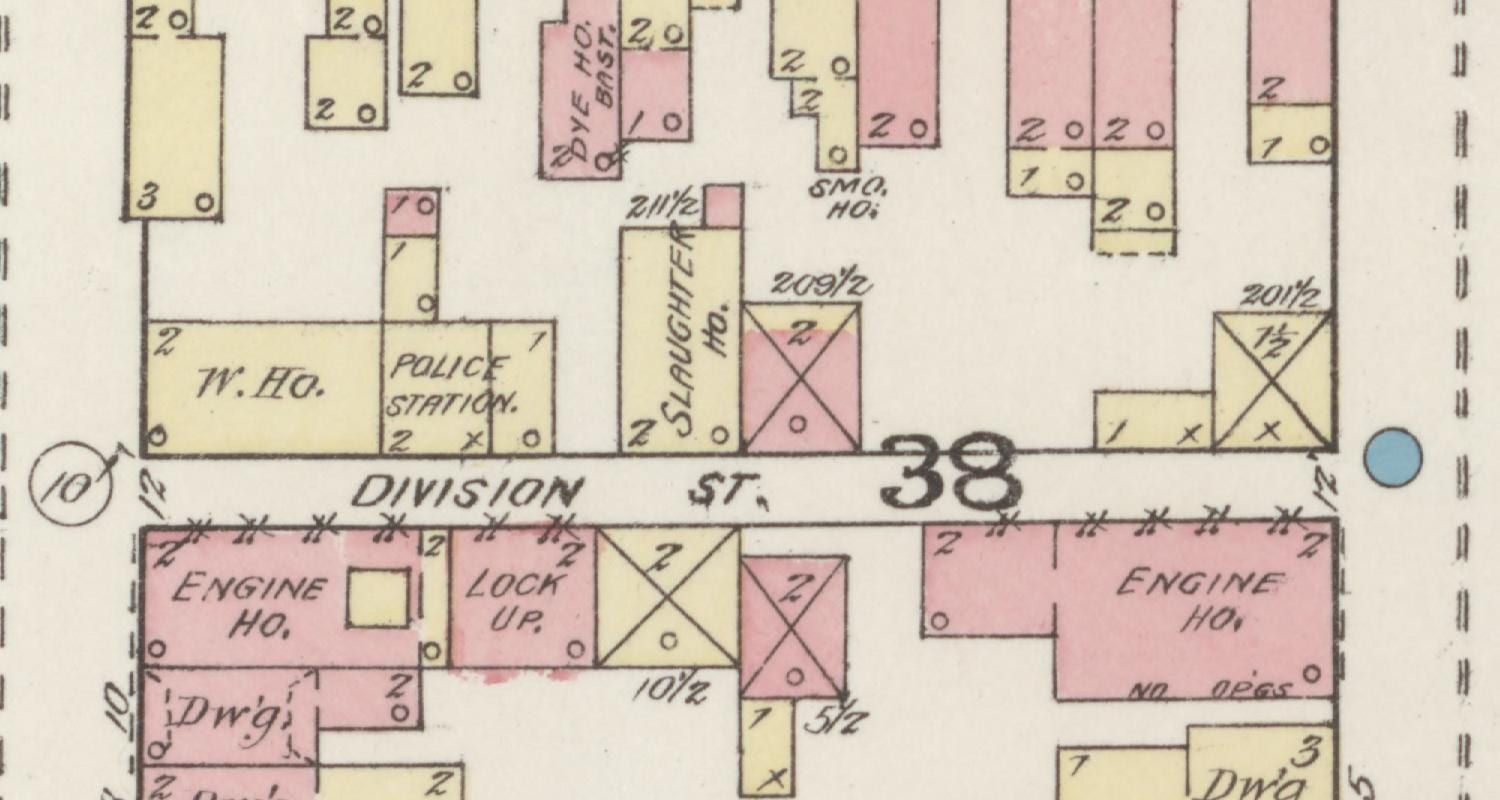
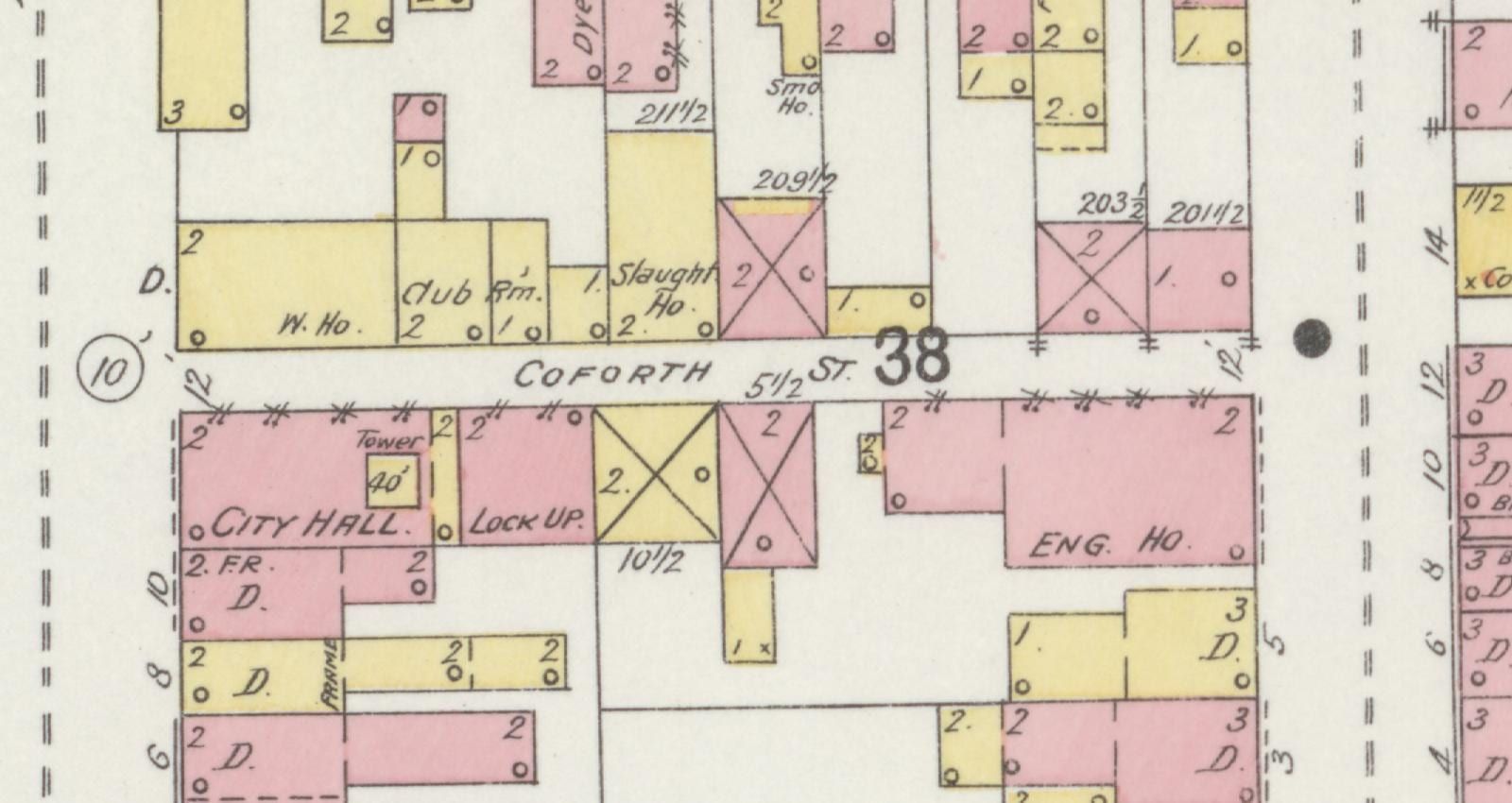
The June 1885 Sanborn map draws the row along the lane — then labelled Division Street — with two engine houses and the borough lock-up on its south side and a frame police station across the way. By the 1889–90 directory the lane has its lasting name, Goforth Avenue, and the police station is listed on it; by 1895 Boyd’s lists “Pottsville Borough Hall, 3d c Goforth al”; and the April 1896 Sanborn sheet letters the building “CITY HALL,” forty-foot tower and all. It carried the city through four decades more — the Republican reckoned in 1937 that it “had been used for city and borough purposes for considerably more than a half century” — while its fire-hall bones showed to the end: the engine house shared the row the whole time, and the fire company’s successors kept their quarters in the building until the city itself moved out.
A PWA project
Relief from the old hall came from the New Deal. The Public Works Administration carried Pottsville’s new city hall as docket PA W1280, and the project ran on federal terms from the start. When the construction bids ran past the estimates in March 1936, City Engineer George H. Steidel and Architect D. H. Grootenboer — “of the Grootenboer-Knoblock architectural firm in charge of the plans of the municipal building,” as the Republican put it — went before PWA officials at Harrisburg carrying a council resolution that asked the agency to approve the contract for the lowest bidders as submitted. Construction began that April on the west side of North Centre Street at Laurel Boulevard, a block up from the Centre Street Grammar School.
The cornerstone was laid on Friday afternoon, October 16, 1936, in a ceremony a shower could not dampen. The steel skeleton was up, the concrete laid, and the lower story held its first assembly — clergy, officials past and present, three former mayors among them — made happier, the paper noted, by a PWA check representing “more than half the federal cash allocation,” received just hours before, that guaranteed uninterrupted progress. Finished, furnished, and equipped, the Republican wrote, the building would represent an investment of more than $200,000.
Moving in, April 1937
Council’s acceptance came at its last session in the old Third Street building: on the night of April 13, 1937, it formally accepted the new city hall as completed “except for some minor matters” — and voted to borrow up to $10,000 toward the contractors’ final payment, since the PWA would not release the last of its grant while a cent of debt stood against the building.
Two days later, on Thursday, April 15, 1937, the city moved. “New City Hall Now Occupied,” the Republican reported the next evening: Mayor Claude A. Lord personally conducted friends and citizens through a building “of three stories and 120 feet square, constructed of Indiana sandstone,” trimmed in Tennessee marble and aluminum, with a terrazzo-floored vestibule off Centre Street and a lobby whose marble walls were banded in aluminum. The first floor held the mayor’s suite, the treasurer, the assessor, and the police department; the council chamber and the city’s boards had their quarters on this floor and the second; the basement was the police department’s — of which more below. Mrs. Helen Bartsch, the new switchboard operator, spent the day acquainting herself with the modus operandi before her official duties began on Friday.
Council held its first stated session in the new municipal chamber on May 11 — opened with prayer, a first in the city’s municipal history — and put on record its thanks to the businessmen who had furnished the building: L. Hummel’s Sons furnished the mayor’s private room and reception room gratis, with Pomeroy’s, Liner’s, Sears Roebuck, Benesch’s, and the Capitol Furniture Co. among the other donors, so that the only furnishing cost to taxpayers was the council chamber itself. The Garden Club of Pottsville was thanked for the evergreens placed at either side of the entrance.
”$200,000 City Hall Dedicated”
The formal dedication came on Thursday, May 27, 1937 — a noonday luncheon of the three service clubs, then a street parade to the new municipal building, then the exercises themselves. The federal government sent the orator of the day: Colonel Horatio B. Hackett, Assistant Administrator of the PWA, who told the crowd he knew this section well. City Clerk G. A. Berner read a sketch of nearly two centuries of local history into the record, and the Republican’s front page that evening carried the banner “POTTSVILLE’S $200,000 CITY HALL DEDICATED” over a photograph of the main lobby.
The police floor
The police floor was Mayor Lord’s particular project. Writing in the reissued Police Historical Book, Lord — who had taken office in 1934 and found a department of “fourteen men enrolled and two substitutes” — described the quarters built into the new hall: nearly half the first floor given to the chief’s offices, a teletype room, the sergeant’s office, and the police court, with a gymnasium, locker rooms, an ordnance room, and “a revolver and rifle range the entire length of the building” in the basement, serving a rejuvenated force of thirty-five men. The department’s whole story — from the borough’s high constable of 1828 to today’s bureau — runs through this building’s first floor.
Seat of city government
The building’s tenants have changed with the city’s needs, but its role has not. The department it houses took its modern legal form on May 21, 1966, when Ordinance No. 72-66 created the Bureau of Police as Article 131 of the newly codified city ordinances; the bureau still answers to the mayor from the same first floor. City council still meets in the chamber the businessmen of 1937 furnished. The old hall on Goforth Avenue passed, fittingly, to the keeping of history itself: in May 1937 council voted the Schuylkill County Historical Society immediate possession of its basement and first floor on a nominal lease, with the Third Brigade Band upstairs, and the society kept its museum there into the early 2000s.
One thing the new City Hall never joined is the historic district that begins directly south of it, across Laurel Boulevard. The Pottsville Downtown Historic District’s 1982 National Register boundary runs along the southern curb line of Laurel Boulevard; its authors described the area north of the line — where City Hall and the county’s civic buildings stand — as outside the downtown core they were listing. The building on the Tichnor postcard above, lettered POTTSVILLE CITY HALL across its sandstone entrance bay, thus stands where it always has: just past the edge of the old downtown, at the head of Centre Street’s civic blocks, doing the job it was built for.
Timeline
Each entry is graded by how firmly it is sourced — confirmed against a primary page image or an official record, corroborated by an authoritative secondary source, or probable. Weaker leads are left off.
The old City Hall on Goforth Avenue · to 1937
- 1871
A fire hall behind Third Street Probable
The 1982 historic-district survey dates the surviving brick building at 12 North Third Street to 1871 — "originally fire hall," an Italianate vernacular civic building. It stood on the little lane between Second and Third below Market, and housed the quarters of the fire company that became the Humane Hose Co.
Pottsville Downtown Historic District — National Register nomination (1982), Survey No. 340
- June 1885
Engine houses, a lock-up, and a police station
The Sanborn map of June 1885 draws the row along the lane — then labelled Division Street — two engine houses and the borough lock-up on its south side, a frame police station across the way.
Sanborn Map & Publishing Co., Insurance Maps of Pottsville, June 1885, sheet 4 (Library of Congress)
- 1889–1890
The police station listed on Goforth Avenue
Boyd's directory first lists the borough police station on "Goforth Avenue" — the lane's later name, appearing in the same edition's street gazetteer.
- 1895
Borough Hall
Boyd's lists "Pottsville Borough Hall, 3d c Goforth al": the fire companies' hall had become the seat of borough government.
Boyd's Directory of Pottsville, 1895–1897 (Internet Archive)
- April 1896
Drawn as City Hall
The April 1896 Sanborn sheet letters the brick hall "CITY HALL," forty-foot tower and all, with the lock-up and an engine house on the same row of "Coforth" Street.
Sanborn-Perris Map Co., Insurance Maps of Pottsville, April 1896, sheet 4 (Library of Congress)
A PWA City Hall · 1936–1937
- March 31, 1936
Bids outrun the estimates
City Engineer George H. Steidel and Architect D. H. Grootenboer — "of the Grootenboer-Knoblock architectural firm in charge of the plans of the municipal building" — go before PWA officials at Harrisburg after the bids run past the estimates, carrying a council resolution asking the agency to approve the contract for the lowest bidders as submitted.
- April 1936
Construction begins Corroborated
The National Archives' PWA project records, as compiled by Living New Deal, place construction from April 1936 to March 1937 — an $82,636 federal grant toward a $205,060 total cost, docket PA W1280.
- October 16, 1936
The cornerstone is laid
With the steel skeleton up and a PWA check representing "more than half the federal cash allocation" received only hours before, the cornerstone is formally laid on a showery Friday afternoon — the gathering assembled in the unfinished lower story, three former mayors among those taking part.
"Cornerstone of City Hall Laid" — Pottsville Republican, Oct. 17, 1936, p. 9 (Newspapers.com)
- April 13, 1937
Accepted as complete
At its final meeting in the old Third Street building, council formally accepts the new city hall as completed "except for some minor matters," and votes to borrow up to $10,000 toward the contractors' final payment while the last of the PWA grant is held back.
- April 15, 1937
The city moves in
"New City Hall Now Occupied": the administration vacates the old hall on Thursday, and Mayor Claude A. Lord personally leads friends and citizens through a building "of three stories and 120 feet square, constructed of Indiana sandstone," its Centre Street vestibule floored in terrazzo.
"New City Hall Now Occupied" — Pottsville Republican, Apr. 16, 1937, p. 8 (Newspapers.com)
- May 11, 1937
Council's first session in the new chamber
Council holds its first stated session "occupying the attractive municipal chamber in the new city hall" — opened with prayer, a first in the city's municipal history — and places on the minutes its thanks to the businessmen who furnished the building without cost to taxpayers beyond the council chamber itself.
- May 27, 1937
Dedicated
"POTTSVILLE'S $200,000 CITY HALL DEDICATED": after a noonday luncheon of the service clubs and a street parade to the site, the building is formally dedicated in afternoon exercises; the orator of the day is Colonel Horatio B. Hackett, Assistant Administrator of the PWA.
Seat of city government · 1937–present
- Late 1930s
Mayor Lord's police floor
In the reissued police historical book, Mayor Claude A. Lord describes the police quarters he had built into the ground floor — the chief's offices, a teletype room, the police court — and, in the basement, a gymnasium, an ordnance room, and "a revolver and rifle range the entire length of the building," serving a force he had rebuilt to thirty-five men.
- May 21, 1966
The Bureau of Police
Ordinance No. 72-66 creates the Bureau of Police as Article 131 of the city's newly codified ordinances — the department's modern legal form.
City of Pottsville Code, Chapter 9, Article I — Bureau of Police (eCode360)
From the archive
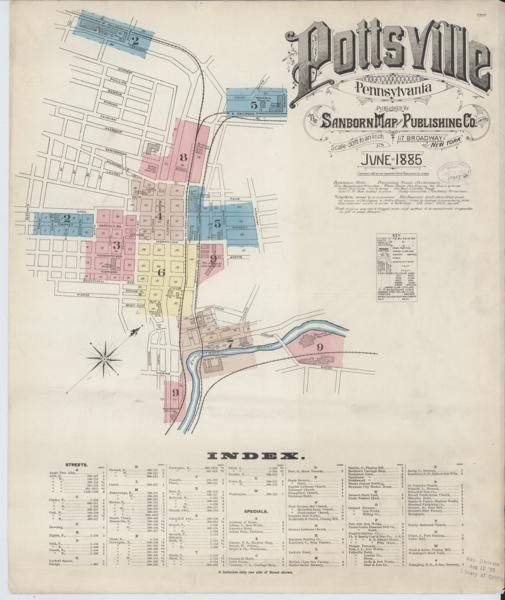
Historic maps and photographs from the Schuylkill Hub archive, each available as an archival print.
Sources
- "To Seek New Bids for Construction of City Hall Here" (Steidel and Grootenboer before the PWA; "the Grootenboer-Knoblock architectural firm in charge of the plans") — Pottsville Republican, Mar. 31, 1936, p. 10 (via Newspapers.com) · 1936-03-31
License: publisher - "Cornerstone of City Hall Laid" — Pottsville Republican, Oct. 17, 1936, p. 9 (via Newspapers.com) · 1936-10-17
License: publisher - "Final Meeting of Council Held in Old Building" / "Historical Society Makes Plea for Lease on Old City Hall Building" — Pottsville Republican, Apr. 14, 1937, p. 9 (via Newspapers.com) · 1937-04-14
License: publisher - "New City Hall Now Occupied" (the three-story building described; the old hall's fire-company lineage) — Pottsville Republican, Apr. 16, 1937, p. 8 (via Newspapers.com) · 1937-04-16
License: publisher - Council's first session in the new chamber; "Old City Hall Leased" (the Historical Society and the Third Brigade Band) — Pottsville Republican, May 12, 1937, p. 15 (via Newspapers.com) · 1937-05-12
License: publisher - "Pottsville's $200,000 City Hall Dedicated" — Pottsville Republican, May 27, 1937, p. 1 (via Newspapers.com) · 1937-05-27
License: publisher - Living New Deal — City Hall, Pottsville, PA (PWA, April 1936 – March 1937; grant $82,636 of a $205,060 total; docket PA W1280; sourced to National Archives Record Group 135)
License: reference - Pottsville Downtown Historic District — National Register nomination (1982): Survey No. 340, 12 N. Third Street ("Old City Hall … originally fire hall … Built 1871") and the verbal boundary description along Laurel Boulevard (National Archives, NAID 71997874) · 1982
License: public-domain - Sanborn Map & Publishing Co., Insurance Maps of Pottsville, Pennsylvania, June 1885, sheet 4 — the Division Street row: engine houses, lock-up, and police station (Library of Congress, Sanborn Maps Collection) · 1885
License: public-domain - Sanborn-Perris Map Co., Insurance Maps of Pottsville, Pennsylvania, April 1896, sheet 4 — the hall lettered "CITY HALL," with tower, lock-up, and engine house, on "Coforth" Street (Library of Congress, Sanborn Maps Collection) · 1896
License: public-domain - Boyd's Pottsville Directory (1889–1890) — the first directory listing of the police station on Goforth Avenue, and Goforth Avenue's first appearance in the street gazetteer · 1889
License: public-domain - Boyd's Directory of Pottsville (1895–1897) — "Pottsville Borough Hall, 3d c Goforth al" · 1895
License: public-domain - Boyd's Directory of Pottsville (1867) — the Town Hall at 310 Centre Street, the borough's earlier public hall · 1867
License: public-domain - W. W. Munsell & Co., History of Schuylkill County (1881) — the 1841 town hall and its destruction by fire on March 19, 1876; the Humane Hose and Steam Fire Engine Company's history · 1881
License: public-domain - Police Historical Book of Pottsville, Schuylkill County, Penna. (reissued edition, late 1930s) — Mayor Claude A. Lord's essay on the new City Hall's police quarters (PA Digital Archives)
License: public-domain - City of Pottsville Code, Chapter 9, Article I — Bureau of Police (adopted May 21, 1966, by Ordinance No. 72-66 as Article 131 of the 1966 Code), eCode360
License: reference - Pennsylvania Historical & Museum Commission — incorporation dates for Schuylkill County municipalities (borough of Pottsville, February 19, 1828; city charter March 22, 1911; city government December 1, 1913)
License: reference - City of Pottsville — official website ("Pottsville City Hall located in 401 North Centre Street," a current City Clerk notice; checked July 2026)
License: reference - Skook News — "Pottsville Swears in New Chief of Police, Captain, Sergeant, and Corporal" (October 25, 2022): the bureau's chief and officers sworn in the Council Chambers · 2022-10-25
License: publisher - Tichnor Bros. postcard, "Pottsville City Hall, Pottsville, Pa." (Boston Public Library, Digital Commonwealth — no known copyright restrictions)
License: reference
Frequently asked
- When was Pottsville City Hall built?
- Between April 1936 and March 1937, as a Public Works Administration project — an $82,636 federal grant toward a $205,060 total cost. The cornerstone was laid October 16, 1936, the city government moved in on April 15, 1937, and the building was formally dedicated on May 27, 1937.
- Who designed Pottsville City Hall?
- The contemporary record names Architect D. H. Grootenboer, whose Grootenboer-Knoblock firm the Pottsville Republican described in 1936 as "in charge of the plans of the municipal building." City Engineer George H. Steidel appeared alongside him before the PWA when the project's bids ran past the estimates.
- What is at 401 North Centre Street in Pottsville?
- Pottsville City Hall — a three-story Indiana-sandstone municipal building of 1936–37. It has been the seat of the city government since April 15, 1937, and the city's police department — the Bureau of Police since a 1966 ordinance — has been headquartered on its first floor from the day it opened.
- Where was Pottsville's City Hall before 1937?
- In the old hall at Third Street and Goforth Avenue, the little lane between Second and Third below Market. The surviving brick building there — originally a fire hall — served as the borough hall by the 1890s and then as City Hall under the city government, until April 15, 1937. After the move, council leased it to the Schuylkill County Historical Society, with the Third Brigade Band upstairs.
- Is Pottsville City Hall part of the Pottsville Downtown Historic District?
- No. The district's 1982 National Register boundary runs along the southern curb line of Laurel Boulevard, directly south of the building — its authors described the area north of that line, where City Hall and the county's civic buildings stand, as outside the downtown core they were listing.
- Is the police department in Pottsville City Hall?
- Yes — the police have been in the building since the day the city moved in. Mayor Claude A. Lord, writing in the reissued police historical book, described the quarters he had built into it: the chief's offices, a teletype room, and the police court on the ground floor, with a gymnasium, an ordnance room, and "a revolver and rifle range the entire length of the building" in the basement.