Libraries · Built 1921–1922
The Pottsville Free Public Library
A red-brick Georgian Revival library at 215 West Market Street, opened May 1, 1922 — designed by Harris & Richards on the Rosengarten homestead lot, and built with a Carnegie grant the city council had first refused.
Listen to this article · 7 min
0:007:10
Read by a synthetic voice, generated from the text of this article. Hear the whole archive on the Listen page.
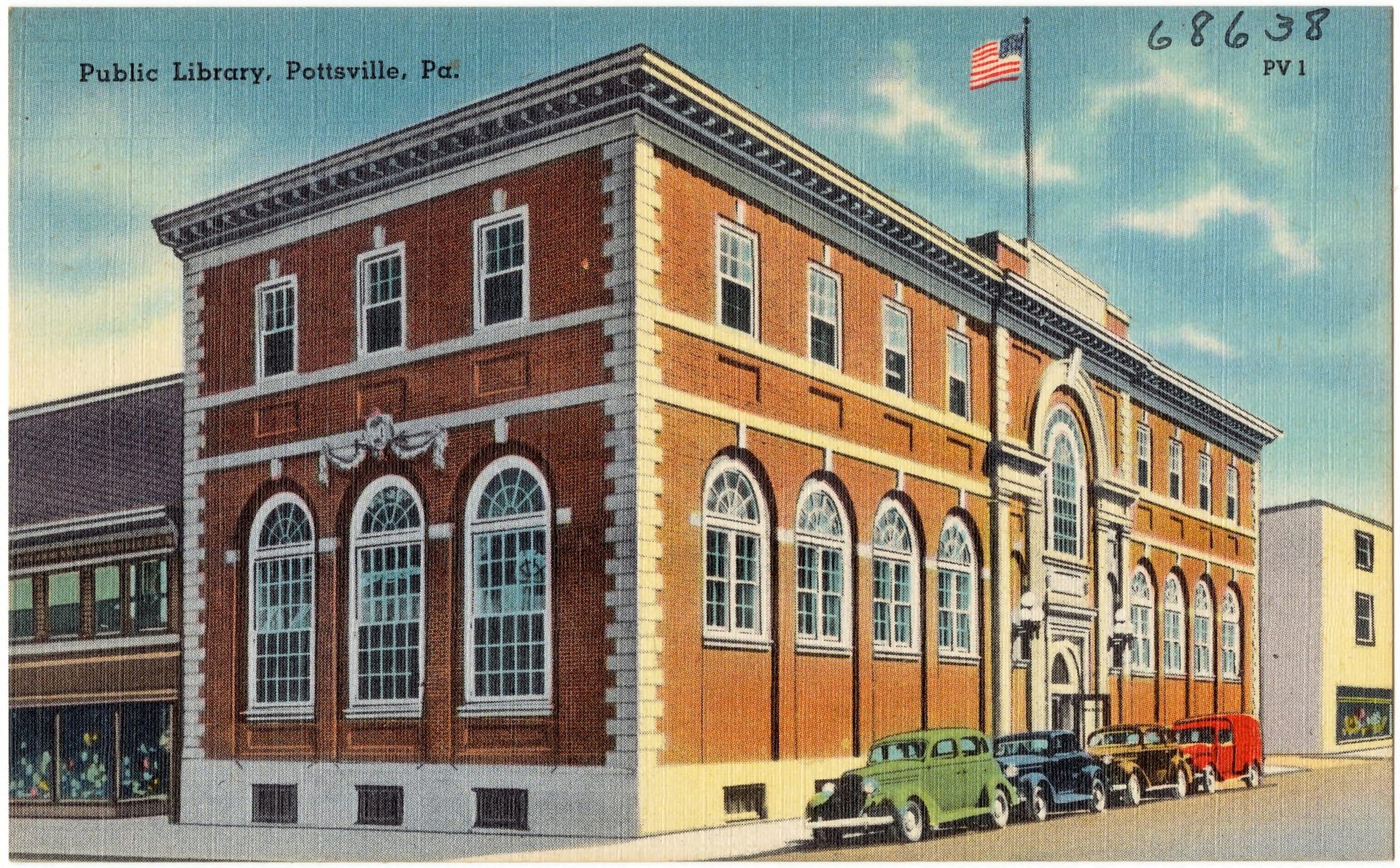
The Pottsville Free Public Library stands at the northeast corner of Third and West Market Streets — a two-story red-brick Georgian Revival building that Pottsville, on the day it opened in 1922, likened to Independence Hall. But the building is the easy part of the story. The library as an institution was already eleven years old when it moved in, and the road from a Y.M.C.A. meeting to an open door ran through a subscription canvass, a coal family’s memorial gift, and a public quarrel over a Carnegie grant that Pottsville’s city council refused.
The lot before the library
The corner of Third and Market was the Rosengarten homestead. Henry Rosengarten, a native of Germany who “followed the Schuylkill canal” as a young man, married Elizabeth Bohler around 1839 and kept a green-grocery at Centre and Mahantongo for some forty years. Henry died in 1893; his widow Elizabeth died in the corner house itself, at 4:20 on the morning of January 26, 1903, “in her 82nd year.” What stood on the ground was a two-and-a-half-story frame building with a forty-two-foot front on Market Street, running a hundred and fifteen feet back along Third to Goforth Alley. After the Rosengartens the property passed to Dr. J. J. McKinstry and then to W. H. McQuail, in whose estate it sat when the library came looking for a site.
An institution before a building (1911)
The movement launched at a meeting in the Y.M.C.A. assembly room on the night of January 16, 1911 — front-page news the next evening under the banner “FREE PUBLIC LIBRARY MOVEMENT IS STARTED.” A two-week canvass that winter, led by the education committee of the Women’s Civic Club with the cooperation of the school board, secured pledges the association reported as $10,775.75 (the library’s own history gives it as $10,775.25). The school board approved a charter for the “Pottsville Free Public Library” on April 12, agreeing to levy a half-mill maintenance tax; the Court of Common Pleas granted it that May, and it was placed on record with Recorder Bailey on May 9, 1911. The library opened for circulation at one o’clock on November 9, 1911, in rented rooms at 208 West Market Street — a first-floor space that had been a saloon — with children making up most of the first day’s borrowers.
The site and the Carnegie fight (1914–1916)
On January 9, 1914, the trustees bought the Rosengarten corner from the McQuail estate for $23,500 — intending, the Republican reported, “to eventually put up a modern library building on the site, possibly through the aid of Andrew Carnegie, although there is considerable sentiment against receiving Carnegie aid.” The money was not the trustees’ own: “earnest friends of the library” — identified by the library’s own history as the Sheafers — made the down payment and quietly carried the mortgage, interest-free, promising to cancel it once a building rose.
The Carnegie chapter proved as contentious as that 1914 note hinted. At the mayor’s application of December 1915, the Carnegie Corporation of New York promised the city $45,000 by letter of January 28, 1916 — its standard formula of twice the city’s population, on a guarantee of one-tenth the grant for annual upkeep. Then Pottsville’s city council refused the gift. The Corporation’s secretary, James Bertram, put it flatly in a letter to school-board president T. W. Swalm printed at the end of 1916: “we have documents from the city formally renouncing the donation.” The School District of Pottsville took the city’s place as beneficiary, and because its guaranteed appropriation was smaller, Carnegie cut the pledge from $45,000 to $36,000.
Construction at last (1919–1922)
The war years stalled everything, and the reduced pledge sat unspent. Two things unlocked the building. First, once the Board of Education guaranteed a permanent maintenance income, the Corporation restored the full $45,000 — the question now, the paper reported in March 1920, was “only whether it will take $45,000 or lose it” (the board’s hope that the new census might lift the gift to $60,000 came to nothing). Second, a death completed the arithmetic. E. Louise Sheafer — a philanthropist whose causes reached from Pottsville to Philadelphia and New York, president of the Pottsville Free Kindergarten, and daughter of the coal geologist Peter W. Sheafer — had died on April 5, 1919; in the spring of 1921 her brothers Henry and Arthur W. Sheafer gave $55,000 for the building in her memory, the larger share of its $100,000 cost.
The design came from the Philadelphia firm Harris & Richards — successors to the Wilson Brothers, one partner with Pottsville roots — retained by the building committee in May 1920; the superintendent of construction was a Pottsville man as well. The general contractor was Brindle Bothwick & Son of Chestnut Hill. Razing of the old frame buildings began on May 3, 1921, and the cornerstone went down at seven on the evening of August 6, 1921, before a crowd lining the streets and the trolley tracks. Librarian Edith Patterson — begging off a long speech by invoking Lincoln at Gettysburg — laid the stone herself; association president W. K. Woodbury dedicated it “to the pleasure, instruction and inspiration of the people of Pottsville and vicinity.”
Opening day — May 1, 1922
The building opened at noon on Monday, May 1, 1922, to hundreds of visitors, a High School orchestra playing through the afternoon and clusters of white electroliers set to light the Third Street entrance after dark. “The beautiful colonial structure,” the Republican told its readers, “appears almost as a replica of Independence Hall, Phila.” — a comparison that has stuck locally for a century, if one the scholarly Buildings of Pennsylvania survey would temper to a “mild-mannered Georgian Revival.” Inside, above a colonial fireplace in the south wall, hung a painting of two Indigenous figures, one writing on parchment, “making figures for the purpose of conveying thought,” as the paper described it.
Since 1922
The library has worked from the corner of Third and Market ever since. It became a district library center in 1962 and a Federal Depository Library in 1967, and in April 1999 it grew by more than 22,000 square feet, volunteers shifting some 120,000 books and materials into the new wing over a single weekend while the original reading room was restored. The building stands within the Pottsville Downtown Historic District, listed on the National Register of Historic Places in 1982; whether the library is counted a contributing building is unconfirmed — the district’s 1982 nomination has not been digitized. Down the block toward Centre Street stands the Lee Building; the county’s Historical Society — represented on the platform at the library’s 1921 cornerstone — keeps its own home a few blocks north in a former grammar school. Current hours and visitor details are on the library’s directory listing.
Timeline
Each entry is graded by how firmly it is sourced — confirmed against a primary page image or an official record, corroborated by an authoritative secondary source, or probable. Weaker leads are left off.
The Rosengarten homestead
- January 26, 1903
Elizabeth Rosengarten dies in the corner house
The widow of the German-born green-grocer Henry Rosengarten (d. 1893) dies at the family home at Third and Market "in her 82nd year" — the two-and-a-half-story frame homestead the library would buy and, in 1921, raze.
Founding the institution · 1911
- January 16, 1911
The library movement launches at the Y.M.C.A.
A meeting in the Y.M.C.A. assembly room starts the drive for a free public library — front-page news the next evening: "FREE PUBLIC LIBRARY MOVEMENT IS STARTED."
- February–March 1911
A two-week canvass raises the first fund
The Women's Civic Club education committee and the school board run a whirlwind subscription canvass, reported at $10,775.75 in pledges (the library's own history gives it as $10,775.25).
Pottsville Republican association report, Dec. 9, 1916 (Newspapers.com)
- May 9, 1911
The charter is granted and recorded
The school board approved the "Pottsville Free Public Library" charter on April 12 with a half-mill tax; the Court of Common Pleas granted it in early May, and it was placed on record with Recorder Bailey on May 9.
- November 9, 1911
First quarters open at 208 West Market Street
The library opens for circulation at 1 p.m. in a rented first-floor room — formerly a saloon — at 208 West Market Street, children the majority of the first day's borrowers.
Pottsville Republican, Nov. 9, 1911; library advertisements, Sept.–Oct. 1911 (Newspapers.com)
The site & the Carnegie fight · 1914–1920
- January 9, 1914
The library buys the Rosengarten corner
The trustees buy the 42-by-115-foot property at Third and Market from the McQuail estate for $23,500; the deed vests title in the library. "Earnest friends of the library" — the library's history names the Sheafers — make the down payment and carry the mortgage interest-free.
Pottsville Republican, Jan. 9, 1914; association report, Dec. 9, 1916 (Newspapers.com)
- January 28, 1916
Carnegie promises the city a library grant
After the mayor's December 1915 application, the Carnegie Corporation of New York agrees to give the city $45,000 for a building — twice the city's population, on a one-tenth annual maintenance guarantee.
- December 1916
City council refuses the gift; the school district steps in
Pottsville's city council formally renounces the donation; at president T. W. Swalm's request the School District becomes beneficiary, and Carnegie cuts the pledge to $36,000. Secretary James Bertram: "we have documents from the city formally renouncing the donation."
- April 5, 1919
E. Louise Sheafer dies
Louise Sheafer — philanthropist, president of the Pottsville Free Kindergarten, and daughter of the coal geologist Peter W. Sheafer — dies at the family home on South Centre Street; her brothers' memorial gift would complete the library's funding.
- March 1920
Carnegie restores the full pledge
Once the Board of Education guarantees a permanent maintenance income, the Corporation restores the full $45,000 — "only whether it will take $45,000 or lose it," the paper reports; a hoped-for census-based increase to $60,000 never comes.
- May 7, 1920
Harris & Richards named architects
The building committee retains the Philadelphia firm Harris & Richards, with a Pottsville superintendent of construction.
Building it · 1921–1922
- Spring 1921
The Sheafer brothers' memorial gift
Henry and Arthur W. Sheafer give $55,000 toward the building in memory of Louise — the larger share of its $100,000 cost, alongside the $45,000 Carnegie grant.
- May 3, 1921
Razing begins; Brindle Bothwick & Son contract
Workmen start tearing down the frame buildings at Third and Market; the general contractor is Brindle Bothwick & Son of Chestnut Hill, and the building is to cost $100,000.
- August 6, 1921
The cornerstone is laid
At 7 p.m., before a crowd lining the streets and trolley tracks, librarian Edith Patterson lays the cornerstone herself; association president W. K. Woodbury dedicates it "to the pleasure, instruction and inspiration of the people of Pottsville and vicinity."
- May 1, 1922
The library opens
The new building opens at noon to hundreds of visitors, a High School orchestra playing through the afternoon; "The beautiful colonial structure," the Republican writes, "appears almost as a replica of Independence Hall, Phila."
Since · 1922–present
- March 1, 1982
Listed within the downtown historic district Corroborated
The library stands within the Pottsville Downtown Historic District (National Register #82003819); its individual standing in the district's un-digitized 1982 nomination is unconfirmed.
National Register of Historic Places #82003819; Living Places summary of the 1982 nomination
- April 1999
A 22,000-square-foot expansion Corroborated
The library adds more than 22,000 square feet at the rear; volunteers move some 120,000 books and materials in a single weekend, and the original main reading room is restored.
From the archive
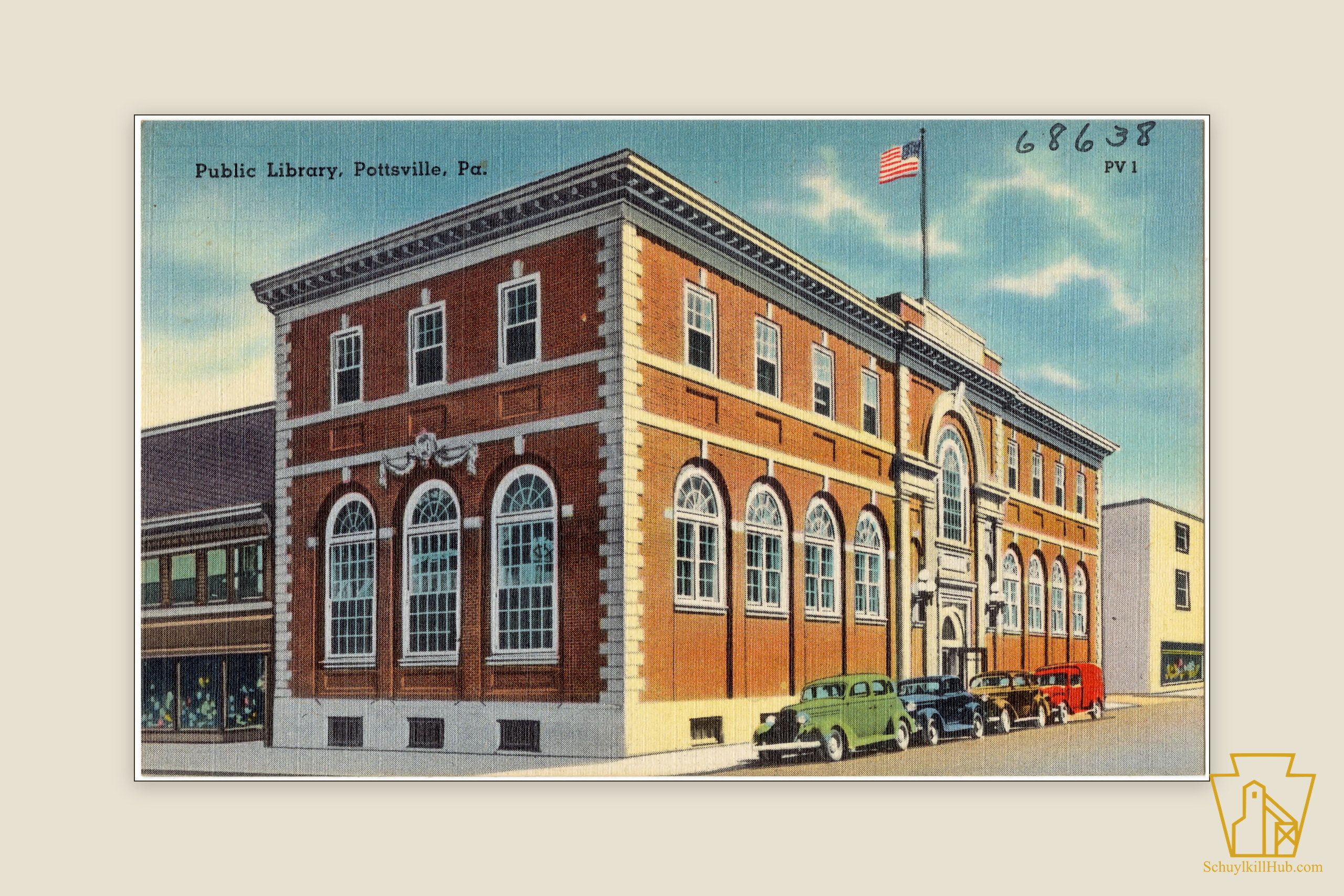
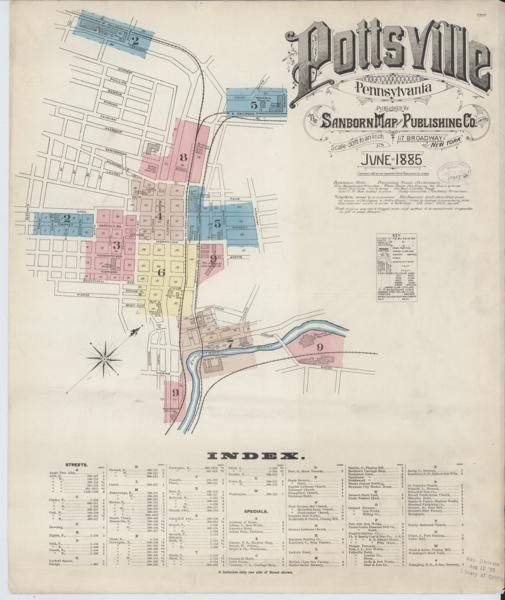
Historic maps and photographs from the Schuylkill Hub archive, each available as an archival print.
Sources
- "Public Library Is Open Today" — Pottsville Republican, May 1, 1922 (via Newspapers.com) · 1922-05-01
License: publisher - "Library Corner Stone Is Laid With Ceremony" — Pottsville Republican, Aug. 8, 1921 (via Newspapers.com) · 1921-08-08
License: publisher - Razing of the site; contractor and $100,000 cost — Pottsville Republican, May 3, 1921 (via Newspapers.com) · 1921-05-03
License: publisher - "Architect for Library" (Harris & Richards retained) — Pottsville Republican, May 7, 1920 (via Newspapers.com) · 1920-05-07
License: publisher - "$45,000 … take it or lose it" (Carnegie pledge restored) — Pottsville Republican, Mar. 4, 1920 (via Newspapers.com) · 1920-03-04
License: publisher - "Death of Miss Louise Sheafer" — Pottsville Republican, Apr. 7, 1919 (via Newspapers.com) · 1919-04-07
License: publisher - "Money For Library … Where Plans Approved" (Bertram letter; the city's refusal; $36,000) — Pottsville Republican, Dec. 28, 1916 (via Newspapers.com) · 1916-12-28
License: publisher - Library association annual report (founding, charter, lot, Carnegie application) — Pottsville Republican, Dec. 9, 1916 (via Newspapers.com) · 1916-12-09
License: publisher - "Library Buys Big Property" (the Rosengarten purchase) — Pottsville Republican, Jan. 9, 1914 (via Newspapers.com) · 1914-01-09
License: publisher - "Death of Mrs. Rosengarten" — Pottsville Republican, Jan. 26, 1903 (via Newspapers.com) · 1903-01-26
License: publisher - "Pottsville Free Public Library" — SAH Archipedia, PA-02-SC13 (architect + Georgian Revival characterization)
License: publisher - Pottsville Free Public Library — "About / History" (institutional history)
License: publisher - Schuylkill County assessment records (Vision/VGSI) — parcel 68-27-0341 (217 W. Market) and the 1914 deed, DB 390-179
License: reference - Pottsville Downtown Historic District, National Register #82003819 (listed 1982) — Living Places summary of the Thomas E. Jones nomination · 1982
License: publisher - W. W. Munsell & Co., History of Schuylkill County, Pa. (1881) — the Pottsville Scientific Association (1854) and Athenaeum (1877) · 1881
License: public-domain
Frequently asked
- Is the Pottsville library a Carnegie library?
- Yes — with a twist. The Carnegie Corporation of New York promised Pottsville $45,000 for a building in January 1916, but the city council formally refused the gift; the school district then accepted it at a reduced $36,000, and once a permanent maintenance income was guaranteed the full $45,000 was restored by 1920. That grant built the library alongside the larger $55,000 memorial gift from the Sheafer family.
- Why does it look like Independence Hall?
- The resemblance was noticed the day it opened — the Pottsville Republican called the "beautiful colonial structure" "almost as a replica of Independence Hall, Phila." Harris & Richards worked in the Georgian Revival, the style that looks back to buildings of Independence Hall's era; the standard architectural survey, Buildings of Pennsylvania, files the library under that heading as a "mild-mannered Georgian Revival."
- What stood on the site before the library?
- The frame homestead of the Rosengarten family. Henry Rosengarten, a German-born green-grocer, and his wife Elizabeth kept the corner of Third and Market for decades; Elizabeth died in the house in 1903. The library bought the 42-by-115-foot lot from the estate of a later owner, W. H. McQuail, in 1914 for $23,500, and razed the frame buildings in 1921.
- When was the library founded?
- The institution came first: chartered as the Pottsville Free Public Library in 1911 and opened that November in rented rooms at 208 West Market Street. The present building — up the same block, at the Third Street corner (215 West Market) — did not open until May 1, 1922.