Schools · Built 1863–1865
The Centre Street Grammar School
Pottsville's Centre Street (Female) Grammar School at 305 North Centre Street — John Fraser's three-story schoolhouse of 1863–65 on John Pott's old school lot, home of the Schuylkill County Historical Society since 2002.
Listen to this article · 6 min
0:006:14
Read by a synthetic voice, generated from the text of this article. Hear the whole archive on the Listen page.
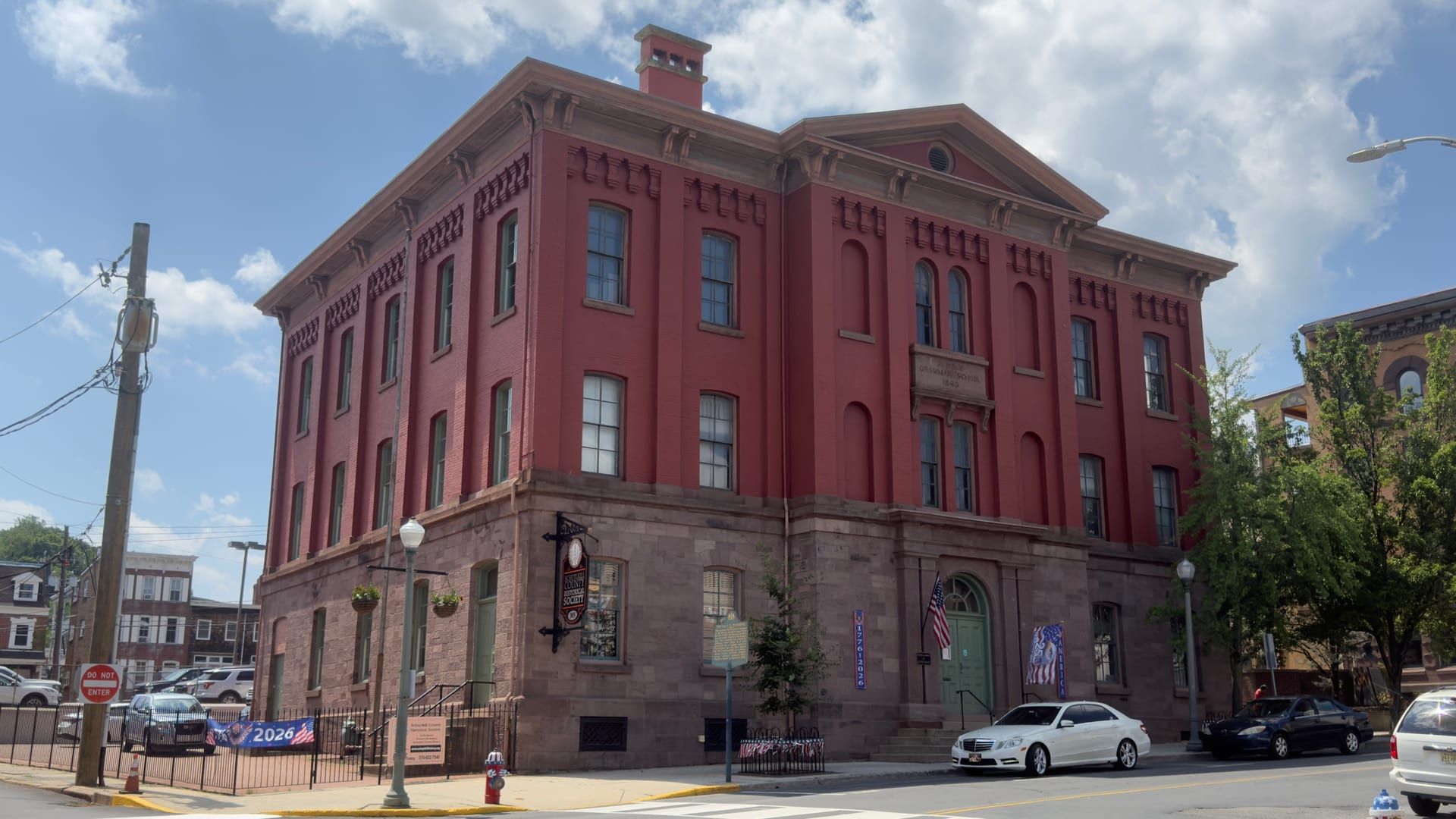
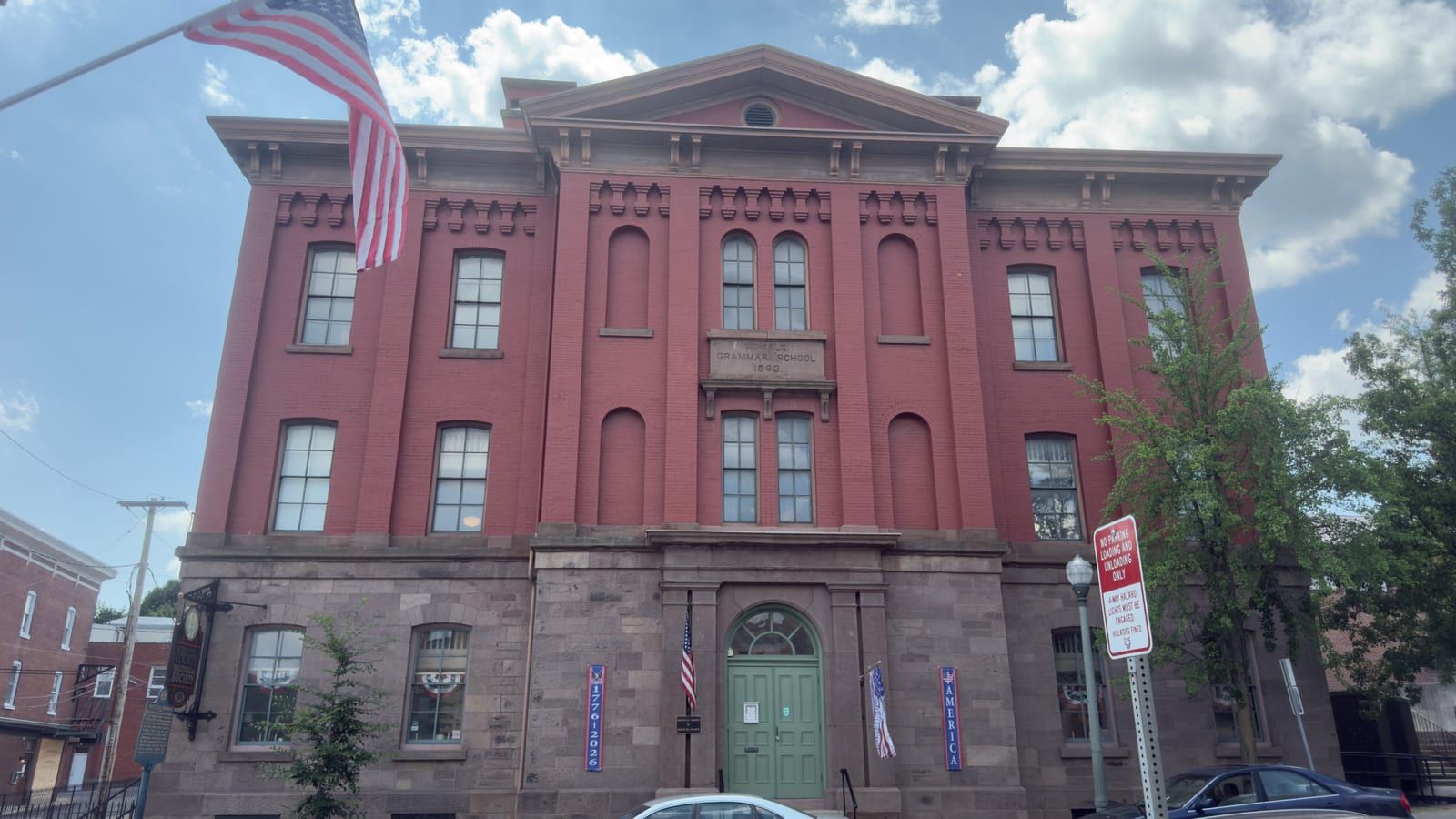
The three-story brick-and-sandstone building at 305 North Centre Street — a corner parcel that also fronts Race Street — is the third school to stand on a lot that has held a schoolhouse since 1819, and the one whose origins the surviving record documents in unusual detail. It was designed by the Philadelphia architect John Fraser, contracted in 1863, and dedicated three days before Christmas in 1865 as the borough’s Female Grammar School. It taught Pottsville’s children for more than a century, closed in 1982, and since 2002 has been the home of the Schuylkill County Historical Society — the county’s history museum and research library.
The lot before the school
The ground had been set aside for schooling almost from the town’s beginning. About 1817, John Pott — the ironmaster who founded Pottsville — dedicated the Centre Street plot as a burial place for the inhabitants and a lot for a school, a grant he never put in writing. A log schoolhouse, the borough’s first, went up on the lot around 1819 at the direction of John Pott Jr.; a stone school replaced it about 1841; and Fraser’s building replaced the stone school. A schoolhouse stood on this corner, in one form or another, from 1819 until 1982 — more than a century and a half.
Clearing the title (1862)
Building on Pott’s old lot first required untangling his unwritten gift. In 1862 the Pennsylvania Supreme Court, in Pott v. School Directors (42 Pa. 132), reversed a lower-court decree that had blocked the district from building there, and dismissed the challenge — clearing the way for construction. The opinion, by Chief Justice Lowrie, is also the authority that fixes the lot’s original dedication at “about 1817.”
John Fraser’s schoolhouse
The school directors did not hire locally. John Fraser (1825–1906), Scottish-born and Philadelphia-based, was best known for the Union League of Philadelphia (1864–65), designed while the Pottsville school was rising; in 1867 he took Frank Furness into partnership as Fraser, Furness & Hewitt — the lineage from which Furness’s celebrated Philadelphia practice descended. The architectural historian George E. Thomas, writing for the Society of Architectural Historians, describes the school today as the “corbeled former Female Grammar School” anchoring “the commercial heart of Pottsville.”
The directors advertised for proposals in the fall of 1862 and signed a contract on April 13, 1863 with three Pottsville builders — Henry Zimmerman, Jonathan Schum, and Samuel Auman — for $21,868.52. The Miners’ Journal of December 3, 1864, describing the near-finished building, fixes its form: a ground plan 76 feet 6 inches along Centre Street by 60 feet deep, three stories of brick over a Trenton-sandstone first story, corbeled brickwork at the cornice, and a cupola. Inside were eight schoolrooms for fifty pupils each, a first-floor lecture-and-examination room, a public-library room, and a directors’ room, warmed by furnaces in the cellar and modeled on one of Fraser’s own Philadelphia schools.
”One of the best school houses in the State”
The building was finished and in use by late 1865 and formally dedicated on the evening of Friday, December 22, 1865. The audience was small — a cold night, dangerous walking, and the approach of the holidays — but the Miners’ Journal called the school “one of the best school houses in the State,” and the speakers, State Superintendent Charles R. Coburn and Prof. J. P. Wickersham, “pronounced the building and furniture the most complete they have seen.” The Civil War had driven up costs: a $9,500 wartime allowance for the rising price of labor and materials brought the total to about $31,368, and even then the contractors reported a loss.
The Female Grammar School
In the common-school era a “grammar school” was the upper-elementary grade between the primary grades and the high school, and Pottsville, in the fashion of the day, separated the sexes at that level. The 1863 building was the borough’s girls’ grammar-grade school, and it doubled from the first as civic space: the county Teachers’ Association met in the new Female Grammar School building in 1866. The same war that inflated its cost also thinned the district’s upper grades — Munsell’s 1881 county history recalled that “when work was plenty and wages high, many of the larger pupils left the school” for the mines — so that a grammar school was often the practical ceiling of a Pottsville child’s formal education.
In 1895 the district cleared the last of John Pott’s old burial ground behind the school and leveled it for a playground.
Closing, and a second life
The Centre Street School closed on January 4, 1982, when Pottsville consolidated its scattered elementaries into the new John S. Clarke Elementary Center; the Pottsville Republican, marking the moment, called it “the oldest of the group of Pottsville Schools which closed.” The building stood vacant for years. Its rescue came from the Historical Society of Schuylkill County, incorporated in 1903 and then housed on North Third Street: with the Albany preservation architects John G. Waite Associates and the Cressona builder Miller Bros. Construction, it restored the derelict school — even recasting, from a surviving mold, cornice pieces removed in the 1950s — and won a 2002 Pennsylvania Historic Preservation Award. The Society moved in that same year.
The Historical Society today
The building now holds the Society’s local-history museum, its genealogical research library, and a collection of more than 20,000 historical photographs, with a Civil War Room as a centerpiece. It stands within the Pottsville Downtown Historic District, listed on the National Register of Historic Places in 1982. A grant-aided project is replacing the building’s fifty-five windows in phases — the 1860s originals giving way to energy-efficient new ones — with the first twenty-five, on the south and west fronts, in place by early 2025. Current visiting hours and contact details are on the Society’s directory listing.
Timeline
Each entry is graded by how firmly it is sourced — confirmed against a primary page image or an official record, corroborated by an authoritative secondary source, or probable. Weaker leads are left off.
Origins on the Pott lot
- c. 1817
The lot is set aside
John Pott — the ironmaster who founded Pottsville — dedicates the Centre Street plot as a burial place for the inhabitants and a lot for a school. The grant is never put in writing, which a later court has to untangle.
Pott v. School Directors, 42 Pa. 132 (opinion of Lowrie, C.J.)
- 1819
The first schoolhouse Corroborated
A log school house — the borough's first — is built on the lot at the direction of John Pott Jr.
- c. 1841
A stone school Corroborated
A stone schoolhouse replaces the log house on the same ground — the second school on the site.
Building the school · 1862–1865
- March 3, 1862
The courts clear the way
In Pott v. School Directors (42 Pa. 132), the Pennsylvania Supreme Court reverses a lower-court decree and lets the district build over part of the old Pott lot. The opinion, by Chief Justice Lowrie, also fixes the lot's dedication at "about 1817."
- Fall 1862
Fraser engaged
The school directors engage the Philadelphia architect John Fraser and advertise for construction proposals.
- April 13, 1863
The building contract
A $21,868.52 contract is signed with the Pottsville builders Henry Zimmerman, Jonathan Schum, and Samuel Auman. (Earlier accounts garbled the names into one "Henry Jonathan Schein" — an OCR misreading corrected against the page image.)
- December 3, 1864
The building described
The Miners' Journal describes the near-finished school: 76 feet 6 inches along Centre Street by 60 feet deep, three stories of brick over a Trenton-sandstone first story, a cupola, and eight schoolrooms for fifty pupils each.
- December 22, 1865
Formal dedication
The school is dedicated on a cold Friday evening. State Superintendent Charles R. Coburn and Prof. J. P. Wickersham "pronounced the building and furniture the most complete they have seen," and the Miners' Journal called it "one of the best school houses in the State." A $9,500 wartime allowance brought the final cost to about $31,368 — and the builders still reported a loss.
The grammar school · 1866–1982
- November 1866
The county teachers meet here
The county Teachers' Association meets "in Female Grammar School building" — one of the new school's earliest civic uses.
- 1895
The old burial ground cleared
The district clears the last of John Pott's burial ground behind the school and levels the ground for a playground.
Miners' Journal & Pottsville Republican, 1895
- January 4, 1982
The school closes
The Centre Street School shuts as Pottsville consolidates its elementaries into the new John S. Clarke Elementary Center. The Pottsville Republican calls it "the oldest of the group of Pottsville Schools which closed."
Pottsville Republican, Jan. 4 & 9, 1982
The Historical Society · 1996–present
- 1996–2002
An award-winning restoration
The Historical Society of Schuylkill County restores the long-derelict school — architects John G. Waite Associates of Albany, builder Miller Bros. Construction of Cressona — even replicating cornice pieces removed in the 1950s. The work wins a 2002 Pennsylvania Historic Preservation Award.
- 2002
The Society moves in
Founded in 1903 and long housed on North Third Street, the Society moves into the former grammar school — its museum, research library, and headquarters ever since. (The move is often dated to 2001, but contemporary coverage shows it still under way in early 2002.)
- January 2025
Restoring the windows Corroborated
A $150,000 Keystone Communities grant helps replace 25 of the building's 55 windows — 161-year-old originals — with energy-efficient new ones; Phase I, covering the south and west fronts, complete by January 2025, with more phases to follow.
From the archive
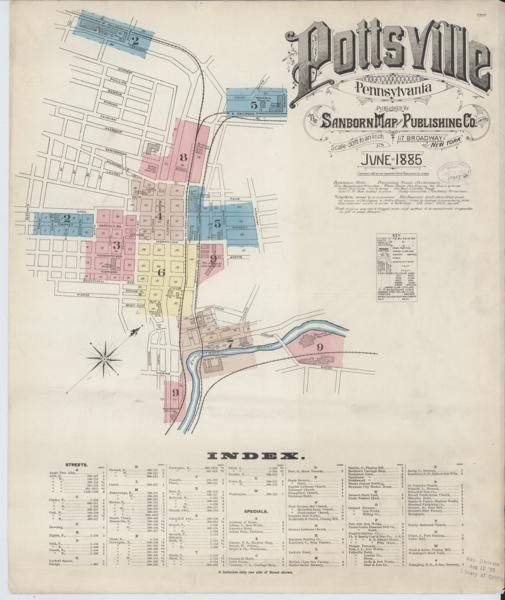
Historic maps and photographs from the Schuylkill Hub archive, each available as an archival print.
Sources
- Miners' Journal (Pottsville), Dec. 3, 1864, p. 2 — the construction account · 1864-12-03
License: public-domain - Miners' Journal (Pottsville), Dec. 30, 1865, p. 2 — "Dedication of the New School Building on Centre Street" · 1865-12-30
License: public-domain - Pott v. School Directors, 42 Pa. 132 (1862) — the title-clearing opinion (Lowrie, C.J.)
License: reference - George E. Thomas, "North Centre Street," SAH Archipedia (PA-02-SC15)
License: reference - "Fraser, John (1825–1906)," Philadelphia Architects and Buildings (Athenaeum of Philadelphia) (archived; the live site is offline)
License: reference - W. W. Munsell & Co., History of Schuylkill County, Pa. (1881) — Educational Interest of Pottsville
License: public-domain - "Historical society renovation wins state recognition," Republican & Herald, Mar. 26, 2002 (via Newspapers.com) · 2002-03-26
License: publisher - Schuylkill County Historical Society — What We Do
License: publisher - Rep. Tim Twardzik, "State Funding, Private Donations Jump-Start Restoration," Jan. 6, 2025 · 2025-01-06
License: reference - Wikipedia — Pottsville Downtown Historic District (NRHP, listed 1982, ref. 82003819)
License: CC-BY-SA-4.0
Frequently asked
- Can you visit the old Centre Street Grammar School?
- Yes. Since 2002 the building has been the home of the Schuylkill County Historical Society, whose local-history museum and genealogical research library are open to the public at 305 North Centre Street in Pottsville. Current visiting hours and contact details are on its directory listing.
- How old is the building, and who designed it?
- It was contracted in April 1863 and dedicated on December 22, 1865, to the design of the Philadelphia architect John Fraser (1825–1906) — who a few years later took Frank Furness into partnership as Fraser, Furness & Hewitt.
- Why was it called the \"Female\" Grammar School?
- In Pennsylvania's nineteenth-century common schools, a "grammar school" was the upper-elementary grade below the high school, and Pottsville separated the sexes at that level. The 1863 building was the borough's grammar-grade school for girls; "Centre Street Grammar School" is the later, locational name for the same building.
- When did the Schuylkill County Historical Society move in?
- The Society — founded in 1903 and long housed on North Third Street — moved into the restored school in 2002, after a preservation project that won a Pennsylvania Historic Preservation Award that year. The move is often dated to 2001, but contemporary coverage shows it still under way in early 2002.
- Is the building on the National Register of Historic Places?
- It stands within the Pottsville Downtown Historic District, which was listed on the National Register of Historic Places in 1982 — a district listing rather than an individual one.