Teaberry — the wintergreen flavor and its Schuylkill County roots
Listen to this article · 13 min
0:0013:01
Read by a synthetic voice, generated from the text of this article. Hear the whole archive on the Listen page.
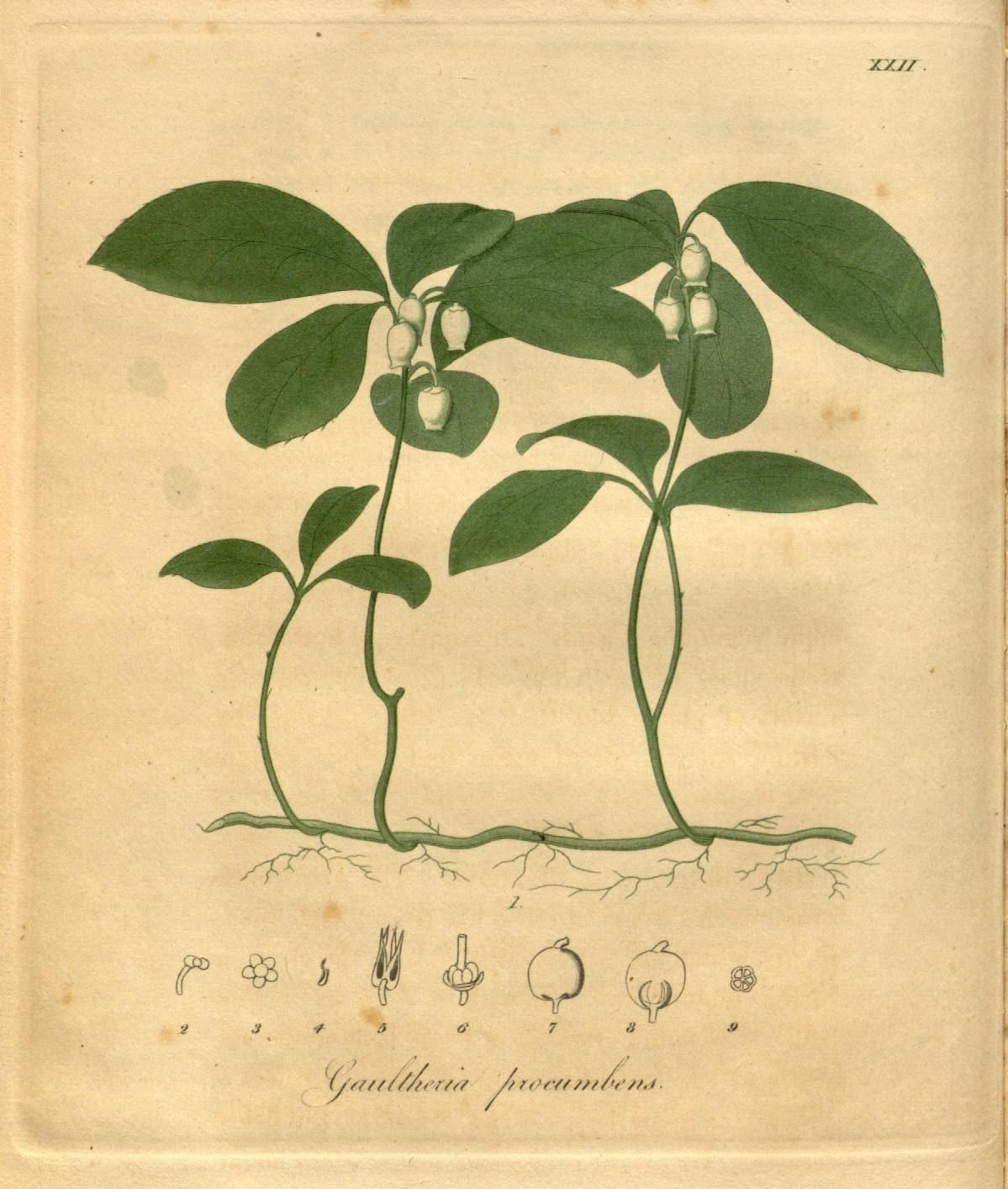
Teaberry is the pink, wintergreen-sharp flavor that Pennsylvania claims as its own, and it begins as a knee-high evergreen carpeting the acidic mountain soils of the anthracite region. Its story has three strands that meet only in the flavor itself. The plant — Gaultheria procumbens — is native to eastern North America and thrives on exactly the ridges that define Schuylkill County. The famous brand most people mean by “teaberry,” Clark’s Teaberry Gum, is a Pittsburgh invention with no tie to the coal region. And the flavor as living culture — teaberry candy, teaberry ice cream, “teaberry” written onto local hills — is genuinely and demonstrably a Schuylkill County thing, traceable in the Pottsville newspapers into the 1890s. The three are worth keeping distinct, because the gum is the one people reach for first and it is not a local product. What is local is older and quieter: the berry itself, and what coal-region people did with it.
The plant, and where its name comes from
Teaberry is Gaultheria procumbens, a low creeping evergreen subshrub of the heath family, four to eight inches tall, bearing white bell flowers and a persistent bright-red berry that lasts through winter. It is a specialist of acidic woodland soils — a preferred pH of roughly 4.5 to 6.0, under oak, pine, and mountain laurel — and it grows well on many substrates including peat, sand, and coal spoils, which is to say it is at home on precisely the sandy, acidic, ridge-and-valley ground of the Pennsylvania anthracite field, and even on the culm banks — the piles of waste coal — left by its mining. Its range runs from Newfoundland and New England south along the mountains to Georgia and west toward Minnesota, with all of Pennsylvania comfortably inside it.
The plant answers to an unusual number of names — teaberry, eastern teaberry, checkerberry, boxberry, spiceberry, American wintergreen, mountain tea, and, loosely and wrongly, partridgeberry, a name that properly belongs to a different plant. The genus commemorates Jean-François Gaultier, an eighteenth-century Quebec physician-botanist. The “checker-” and “grouse-” and “deer-” names come from the winter wildlife that eats the berries; the “tea” names come from people.
The word “teaberry” is first attested in English in 1818, formed simply from tea and berry, because the dried berries were used as a substitute for tea or to flavor it. The older name “wintergreen” had already been applied to this aromatic plant in North America by 1778. That window is not incidental: brewing native leaves as tea gained ground in the Revolutionary era, when the boycott of British tea pushed colonists toward home-grown substitutes, and teaberry was among the native leaves they steeped. Indigenous peoples had used it long before, both as a beverage and — because the plant is a natural salicylate — as a pain remedy.
Why teaberry tastes like wintergreen — because it is wintergreen
The flavor is not a metaphor for wintergreen; it is chemically the same thing. The leaves and berries of Gaultheria procumbens yield methyl salicylate, the compound sold historically as oil of wintergreen, which makes up about 99 percent of the natural oil. Sweet or black birch, an entirely different tree, yields an almost identical oil — about 99.8 percent methyl salicylate — which is why birch was routinely substituted for the scarcer teaberry in the flavor trade. The upshot for a food historian is that “teaberry” is best understood not as a chemically distinct flavor but as a regional name — chiefly Pennsylvanian, and later cemented by Clark’s gum — for the wintergreen note. Sellers did sometimes shelve “teaberry” and “wintergreen” side by side as separate lines, but the distinction was one of branding and trace aromatics, not of active compound.
Most modern teaberry flavoring is not distilled from the plant at all; it is synthetic methyl salicylate, cheaper than the natural oil since the 1880s. (Oil of wintergreen is concentrated salicylate and genuinely toxic in quantity — a caution worth keeping in mind.)
The vanished trade: distilling oil of wintergreen
Before it was a gum flavor, “wintergreen” was an extracted commodity. Pickers — very often women and children — worked the forest floor gathering leaves by the sackful; a still charged with chopped leaves and water was fired for hours, and the steam carried the volatile oil through a copper coil cooled in a stream, condensing into a jar where oil and water separated.
The documented industrial epicenter of this trade sat just east of Schuylkill County, in the Carbon and Luzerne county uplands, where the acidic mountain forest and the pickers to work it came together. Contemporary accounts credit the region with an extraordinary share of national output: a 1952 survey in Economic Botany found that about 90 percent of the country’s wintergreen oil came from the mountains of Carbon and Luzerne counties. Commercial birch-oil distilling — the near-identical substitute — is documented as beginning in 1865 in Luzerne County, the northern anthracite field. The trade was then killed by chemistry: after Schimmel & Co. of Leipzig began making synthetic methyl salicylate on a commercial scale in 1886, the cheap “artificial oil of wintergreen” undercut the natural product, and the mountain stills dwindled toward extinction over the following century.
Did Schuylkill County itself distill the oil? The wider literature centers the trade in Carbon and Luzerne counties and is nearly silent on Schuylkill — which would leave a gap in a county foodways history. The county’s own newspaper closes it. In a November 1940 books column, the Pottsville Republican printed readers correcting the local record: Schuylkill County, they insisted, had distilled not only birch but wintergreen oil as well.
John Bowman recalled Schuylkill Haven playmates who gathered “teaberry plants” for “the Birch Factory” in the 1870s, and Manuel Marburger located the birch distillery “back in the hill, somewhere between the Farmer’s Hotel and Cape Horn,” remembering its boilers in action and the two-foot billets of birch wood stacked ready to use. Neither could name who operated the still, and the account is a reminiscence set down decades after the fact rather than a contemporaneous business notice. But it is specific, named, and located, and it places a small birch- and wintergreen-oil still in Schuylkill County, fed in the 1870s by local children gathering teaberry plants.
The Schuylkill County thread, in the county’s own press
Away from the extracted oil, teaberry lived in Schuylkill County as a plant people walked out to gather, a word they hung on their hills, and a flavor they sold in shops. The Pottsville papers carry it steadily from the 1890s.
Gathering. Teaberrying was a real autumn activity, woven into the same coal-region foraging economy as the better-documented huckleberry trade. In April 1892 the Miners’ Journal ran a small drama under the head “Lost in the Woods”: Franklin Spehrley, a Pottsville painter and paperhanger, took his two sons up Peach Mountain to pick tea-berries, and the elder boy wandered off and was found only after a long search by a crowd of Fishbach people. Spehrley gave his address as 213 North Centre Street — the downtown address later folded into the Coney Island building. That same autumn the Pottsville Republican joked that, “encouraged by the Schuylkill county huckleberry industry,” a neighboring paper was now touting a teaberry “industry” — a passing line that nonetheless treats teaberry-gathering as a recognized county trade. In 1894 a crowd of young ladies went out for teaberries, and by 1895 the plant had a cash value on the street, when a brief Pottsville news column announced simply that teaberries were for sale.
Drinking. The plant’s name records what people did with it first: the dried berries were brewed as a substitute for tea, or used to flavor it. The habit outlasted the fashion. In August 1920 the Republican pressed it on readers as a household remedy — “Ho, ye sufferers from rheumatism and other bodily nerve and muscular aches and pains,” the notice opened, urging “the revival of the old time teaberry tea of grandmother’s days,” drunk “morning and evening for a week or two,” and adding that it “won’t hurt or cost you anything to try it.” The confidence was the paper’s own — the salicylate in the leaves belongs to the aspirin family, not to any cure — but the item records a county still brewing teaberry tea well into the twentieth century.
Place-names. A plant that carpets the mountains gets written onto the map. By 1895 “Teaberry Hill” was an established local landmark: when Buffalo Bill’s Wild West Show came to Pottsville that May, the Republican reported that non-paying spectators — “deadheads” — watched the performance free from Teaberry Hill, “numbered way up into the thousands,” while Colonel Cody worked the crowd below. The teaberry name still sits on the local map: Teaberry Hill Road survives near Minersville today. Four years later a society party climbed Sharp Mountain — the ridge immediately south of Pottsville — to take tea on a spot called “Teaberry Flat,” overlooking the Schuylkill Valley, and set off fireworks as darkness came.
Candy. Teaberry reached the Pottsville counter as confectionery. In August 1902 the candy list of Dives, Pomeroy & Stewart — the city’s landmark department store — offered teaberry drops among “the many different kinds” of candy “to be had at 10c. per pound,” listed separately from its “Wintergreen and Peppermint Wafers.” The list is doubly useful: it documents teaberry candy sold locally a generation before Clark’s gum made the flavor a national brand, and it shows “Teaberry” and “Wintergreen” listed as separate lines — the regional-naming distinction, in a Pottsville shop window, in 1902.
A century on, the candy was still doing holiday work. On Christmas Eve 2003 the Republican & Herald’s County Kitchen page ran the family recipes of an Ashland household, among them a cornflake Christmas wreath — corn flakes bound in green-tinted marshmallow, worked into a ring by hand, and finished with a scatter of teaberry candies where a wreath would carry its red berries. In a county that had been buying teaberry drops since at least 1902, teaberry was the candy a wreath’s berries were made of.
Ice cream — the living flavor
The thread that runs unbroken to the present is teaberry ice cream, and Schuylkill County sits near its center. The earliest county advertisement found runs in June 1930, when the Home-Maid Ice Cream Stores made “Teaberry Ice Cream” its featured weekend flavor at fifty cents a quart, with “ten other flavors to choose from.” A companion advertisement the next spring names the whole local chain — Home-Maid Ice Cream Stores of Minersville, Hamburg, and St. Clair, with two Pottsville shops at 1588 West Market and 534 North Centre — again headlining teaberry. The flavor stayed an ordinary local offering for decades — a Pottsville grocery still advertised teaberry ice cream in 1978 — and the tie holds to the present day.
Today the flavor is a fixture at the county’s own ice cream houses. Leiby’s, near Tamaqua in West Penn Township, has churned its ice cream since 1928, and teaberry is among the flavors it is known for — when the Times News asked area ice cream counters about their flavors in 2024, an employee said teaberry is the one ordered most often at Leiby’s.
This is not merely local color. Teaberry ice cream is largely a Pennsylvania regional specialty, and by Google-Trends reporting it is the state’s single most-searched ice-cream flavor. The Pennsylvania Milk Marketing Board treats it as a state culinary emblem: a board newsletter titles it “a Keystone Classic,” observes that the commonwealth is “the only state looking for teaberry ice cream,” and — tellingly for this county — reprints a teaberry recipe its author found online from “a Schuylkill County native.” Those proportions — milk, cream, yolks, sugar, and a teaspoon of teaberry extract — are the starting point for the teaberry ice cream in our own recipe collection.
A flavor the nation forgot when Clark’s gum faded is, in the coal region, still a summer expectation. It is exactly the kind of living foodway the county’s food guide documents alongside its diners and its heritage recipes.
The famous gum — a Pittsburgh story
Most people who know the word “teaberry” know it from Clark’s Teaberry Gum, and the gum has no Schuylkill County origin. It was a western-Pennsylvania product. The flavor was developed by Charles Burke, who experimented with chewing gum in Pittsburgh, and the D. L. Clark Company — a Pittsburgh confectioner best known for the Clark Bar — bought his patent and introduced the gum around 1900. Its cultural peak came in the 1960s, when the “Teaberry Shuffle” television campaign set everyday people dancing to Herb Alpert and the Tijuana Brass’s “The Mexican Shuffle,” re-cut for the sponsor as “The Teaberry Shuffle.” The brand later passed among nostalgia-candy firms and is today a registered trademark of a family-run confectioner in New Jersey — no longer any Clark entity.
Two related points are easy to get wrong. Boyer Candy Company of Altoona bought the Clark Bar in 2018 but never owned the Teaberry gum — the two products parted ownership long ago. And there is no verified branded “teaberry soda,” in Pennsylvania or elsewhere; teaberry and wintergreen were historically soda-fountain syrup flavors, and Pennsylvania’s enduring bottled cousin in this family is birch beer, not teaberry.
The gum made the name famous. But the flavor was in these mountains first — in the berry underfoot, in the little still between the Farmer’s Hotel and Cape Horn, on the hills people named for it, and in the pink teaberry ice cream the county’s own ice cream houses still churn today.
Related
Towns: Pottsville, Minersville, Schuylkill Haven, Tamaqua, Saint Clair
Sources
- USDA Forest Service, Fire Effects Information System — Gaultheria procumbens (eastern teaberry)
License: public-domain - Online Etymology Dictionary — "teaberry"
License: reference - William P. C. Barton, M.D., Vegetable Materia Medica of the United States, or Medical Botany — "Gaultheria Procumbens. Mountain-Tea. Tea-Berry.": the Revolutionary-era practice of brewing "a tea of the recent or dried leaves," drunk "at breakfast and supper, in lieu of common tea or coffee" (Henriette's Herbal Homepage) · 1818
License: public-domain - King's American Dispensatory — Oleum Betulae (oil of birch) and oil of wintergreen (Henriette's Herbal Homepage) · 1898
License: public-domain - New York Almanack — "The Wintergreen Oil Bootleggers" (Carbon & Luzerne County distilling trade) · 2023
License: reference - Pennsylvania Milk Marketing Board — "Teaberry Ice Cream: A Keystone Classic" (Carol A. Hardbarger) · 2019
License: reference - Billy Penn — "Why this bright pink ice cream is the most-searched flavor in PA" · 2019
License: reference - Wikipedia — Clark's Teaberry
License: CC-BY-SA-4.0 - Wikipedia — Clark Bar (Boyer Candy Company acquired the Clark Bar in 2018)
License: CC-BY-SA-4.0 - Wikipedia — Teaberry ice cream (availability largely a Pennsylvania regional specialty)
License: CC-BY-SA-4.0 - Leiby's Dairy — Tamaqua-area ice cream, made since 1928
License: reference - Leiby's Ice Cream House & Restaurant — 848 W. Penn Pike, West Penn Township (Tamaqua), Schuylkill County; teaberry among its ice-cream flavors
License: reference - Times News (Lehighton), "Ice cream comes in enough varieties to please every palate" (Jill Whalen) — teaberry the most-ordered flavor at Leiby's, South Tamaqua · 2024-07-20
License: reference - The Miners' Journal (Pottsville), April 11, 1892, p. 4 — "Lost in the Woods" (teaberrying on Peach Mountain), via Newspapers.com · 1892-04-11
License: publisher - Pottsville Republican, October 14, 1892, p. 2 — the teaberry "industry" alongside the county's huckleberrying, via Newspapers.com · 1892-10-14
License: publisher - Pottsville Republican, September 29, 1894, p. 4 — a crowd of young ladies gathering teaberries, via Newspapers.com · 1894-09-29
License: publisher - Pottsville Republican, April 2, 1895, p. 4 (Local Brevities) — "teaberries are for sale" in Pottsville, via Newspapers.com · 1895-04-02
License: publisher - Pottsville Republican, May 7, 1895, p. 1 — Teaberry Hill and Buffalo Bill's Wild West Show, via Newspapers.com · 1895-05-07
License: publisher - The Miners' Journal (Pottsville), July 5, 1899, p. 4 — a society party on "Teaberry Flat," Sharp Mountain, via Newspapers.com · 1899-07-05
License: publisher - Pottsville Republican, August 23, 1902, p. 1 — Dives, Pomeroy & Stewart candy list (teaberry drops, listed apart from wintergreen), via Newspapers.com · 1902-08-23
License: publisher - Pottsville Republican, August 21, 1920, p. 4 — "the revival of the old time teaberry tea of grandmother's days" (the remedy claims are the paper's own), via Newspapers.com · 1920-08-21
License: publisher - Pottsville Republican, June 20, 1930, p. 6 — Home-Maid Ice Cream Stores, "Teaberry Ice Cream," via Newspapers.com · 1930-06-20
License: publisher - Pottsville Republican, April 23, 1931, p. 8 — Home-Maid Ice Cream Stores (five locations), via Newspapers.com · 1931-04-23
License: publisher - Pottsville Republican, November 23, 1940, p. 4 — "About Books … and Thereabouts" (Schuylkill County birch- and wintergreen-oil distilling), via Newspapers.com · 1940-11-23
License: publisher - Pottsville Republican, August 2, 1978, p. 3 — grocery advertisement listing teaberry ice cream, via Newspapers.com · 1978-08-02
License: publisher - Republican & Herald (Pottsville), December 24, 2003, p. 19 — "County Kitchen" / "Family Favorites": the Cornflake Christmas Wreath finished with teaberry candies, with the Stepanchick family of Ashland, via Newspapers.com · 2003-12-24
License: publisher
Frequently asked
- What is teaberry, exactly?
- Teaberry is the flavor of Gaultheria procumbens, a native evergreen ground shrub of eastern North America also called eastern teaberry, checkerberry, boxberry, and American wintergreen. Its flavor comes from methyl salicylate — the same compound sold historically as oil of wintergreen — so teaberry is, chemically, wintergreen. "Teaberry" is mainly a regional, largely Pennsylvanian, name for it.
- Where does the word "teaberry" come from?
- From the practice of brewing the dried berries as a substitute for tea, or to flavor it. The word is first recorded in English in 1818, formed from tea plus berry; the older name "wintergreen" had been applied to the plant in North America by 1778. Both uses drew on a habit older still among Indigenous peoples, who steeped the leaves and used the plant as a salicylate medicine.
- Was Clark's Teaberry Gum made in Schuylkill County?
- No. Clark's Teaberry Gum is a Pittsburgh product of the D. L. Clark Company, introduced around 1900, from a flavor developed by Charles Burke of Pittsburgh. It has no origin in Schuylkill County or the anthracite region. Boyer of Altoona later bought the Clark Bar, but never the Teaberry gum.
- Then what is teaberry's tie to Schuylkill County?
- The plant grows abundantly on the county's acidic mountain soils, and the flavor is woven into local foodways. The Pottsville papers record families gathering teaberries on Peach Mountain in 1892 and a party taking tea at "Teaberry Flat" on Sharp Mountain in 1899; the place-names Teaberry Hill and Teaberry Flat; teaberry candy sold downtown in 1902; a local birch- and wintergreen-oil still that children fed with gathered teaberry plants in the 1870s; and, still today, teaberry ice cream, sold at Schuylkill County ice cream houses such as Leiby's near Tamaqua.
- Is teaberry ice cream really a Pennsylvania thing?
- Strikingly so. It is largely a Pennsylvania regional specialty, and by Google-Trends reporting it is the state's most-searched ice-cream flavor. The Pennsylvania Milk Marketing Board calls it a "Keystone Classic" and notes the commonwealth is "the only state looking for teaberry ice cream"; a board newsletter even reprinted a teaberry recipe found online from a Schuylkill County native.
- Is there such a thing as teaberry soda?
- Teaberry and wintergreen were historically soda-fountain syrup flavors, but no verified bottled "teaberry soda" brand has been documented. Pennsylvania's enduring bottled cousin in this flavor family is birch beer, not teaberry.