Brewing in Schuylkill County — Yuengling, Kaier's, Mount Carbon, and the coal-town breweries
Listen to this article · 16 min
0:0015:54
Read by a synthetic voice, generated from the text of this article. Hear the whole archive on the Listen page.
For a century and a half, Schuylkill County drank its own. Brewing arrived with the anthracite boom — a German craft serving a mining workforce — and grew into an industry of its own: D. G. Yuengling’s Eagle Brewery of 1829 in Pottsville, now the oldest brewery in America; the Charles D. Kaier Company of Mahanoy City, whose founder’s name still marks a park and a body of local legend; and town breweries from Tamaqua to Minersville to Shenandoah. The brewing historian Rich Wagner counts “no fewer than nine breweries” in Pottsville and neighboring Mount Carbon alone. Prohibition drove the trade into near beer, soda water — and, by local account and federal court record, somewhat wetter arrangements. Then, in one postwar decade, the old names went dark: Shenandoah’s Columbia late in 1967, Kaier’s early in 1968, Mount Carbon’s Bavarian in 1976. Only Yuengling brewed on — and, since the 2010s, a craft generation has picked the trade back up. This is the county’s beer story, told from the records.
Beer follows coal
Pottsville was a young canal-boom town when D. G. Yuengling opened the Eagle Brewery in 1829 — “when American brewing was a business in its infancy,” as the county’s 1881 history put it. That book found the brewery producing porter, ales, brown stout, and lager at a capacity of about 175 barrels a day, and judged its output “fully half of the whole amount manufactured in this Congressional district.” It also noticed something subtler: the Eagle had become “the training school for several of the most successful men who are now in the business,” naming the Philadelphia brewer Betz, D. G. Yuengling Jr., and Henry C. Clausen of New York among its graduates. The full Yuengling story — the 1831 fire, the hillside caves, the Prohibition dairy, the modern expansion — has its own page; what matters here is what the Eagle anchored: a county brewing culture, overwhelmingly German, that the coal-era German immigration carried into nearly every trading town in the coal fields.
Pottsville itself supported three long-lived breweries. The Orchard Brewery was first operated by A. S. Moore about 1830; George Lauer became its owner about five years later, and it passed down through Frederick Lauer and Henry B. Lauer & Co. to Lorenz Schmidt, its lessee by 1881 and Lauer’s successor. Schmidt, the 1907 county history records, “abandoned the old brewery and rebuilt his brewery in Mount Carbon in 1886”; the plant at the borough line was still running in his estate’s name two decades later, and Mount Carbon’s chapter of the story runs all the way to 1976. The Market Street Brewery began as a small plant started by Gottlieb Shaidle, was carried on from 1865 by Charles Rettig and John Leibner, and moved to 818–822 Market Street in 1868; Rettig was sole proprietor from 1878 until his death in 1893, after which Chas. Rettig & Son and then a stock company kept the lager, ale, and porter coming — about two thousand barrels a year with eight men in 1881. A fourth name, the old Christian Kuenzler brewery on North Centre Street, was already “a thing of the past” by 1907.
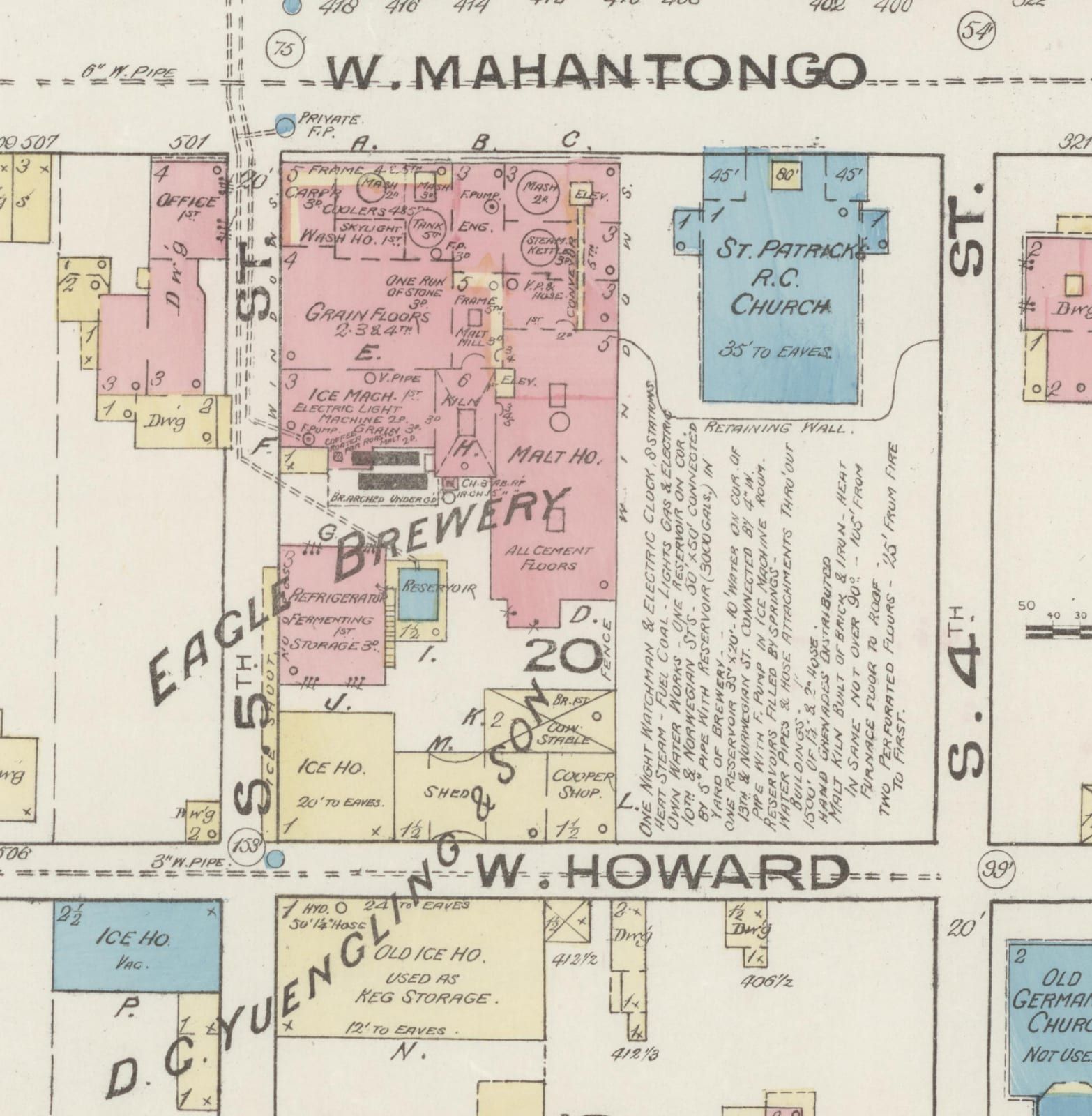
The 1885 Sanborn fire-insurance map draws the Eagle Brewery complex at Fifth and West Mahantongo in loving actuarial detail: mash tubs and steam kettle, malt house and kiln, an ice machine and an electric-light machine, a private reservoir — and, in a note that will please anyone who has toured the brewery, “BR. ARCHED UNDER G’D”: brick arches underground, the lagering caves themselves, mapped between the fire hydrants.
A brewery in every coal town
The pattern repeated at smaller scale across the county. In Minersville, a brewery went up on the south side of Sunbury Street between First and Second as early as 1830 or 1831 — “one of the first institutions of its kind in the county,” the 1907 history says — and by 1881 the borough counted two breweries among its businesses. Tamaqua’s first brewery was established in 1850 by George Goeldner on Broad Street behind the National House; he sold out five years later to Joseph Adam, “the second brewer, and an early settler,” and by 1881 three breweries — Joseph Haefner’s, Adam’s, and Lawrence Koenig’s — enjoyed what the county history calls “a local trade.” Even the mine patches had their moments — of East Norwegian Township’s villages, Munsell’s history records: “Some years since Martin Dormer was running a brewery here. He now calls it the Atlantic Hotel.”
Shenandoah, the county’s most crowded borough, got its breweries later and louder. In April 1895 the Evening Herald reported a meeting of brewers from Pottsville, Shenandoah, Ashland, and Mahanoy City — “a general talk on beer,” as those who were there put it — occasioned by allegations that the young Columbia Brewing Company of Shenandoah was cutting prices and “spoiling the trade for the twelve or thirteen sales agents of other beers doing business there.” The report added a distinctly coal-region wrinkle: one of Columbia’s stockholders was said to be a Reading Coal and Iron official, and miners were “being urged to use the Shenandoah beer, and patronize only those saloons where it is sold” — which, the Herald observed, “is equivalent to making a man’s position in the mines depend on the kind of beer he drinks.” By 1906 the county history counted “two fine breweries” in Shenandoah supplying, in its dry phrase, “a ‘long felt want.’”
Beer moved through agents and bottlers as much as breweries. Mahanoy City’s chief burgess for 1880, the Bavarian-born John Weber, had “for years… represented the brewery firm of D. G. Yuengling & Co. in this vicinity”; the Philadelphia giant Bergner & Engel kept a beer depot in Mahanoy City into the 1890s. It was exactly this layer of the trade — the agency, the bottling works, the saloon supply route — that produced the county’s biggest brewing story after Yuengling.
Kaier’s of Mahanoy City
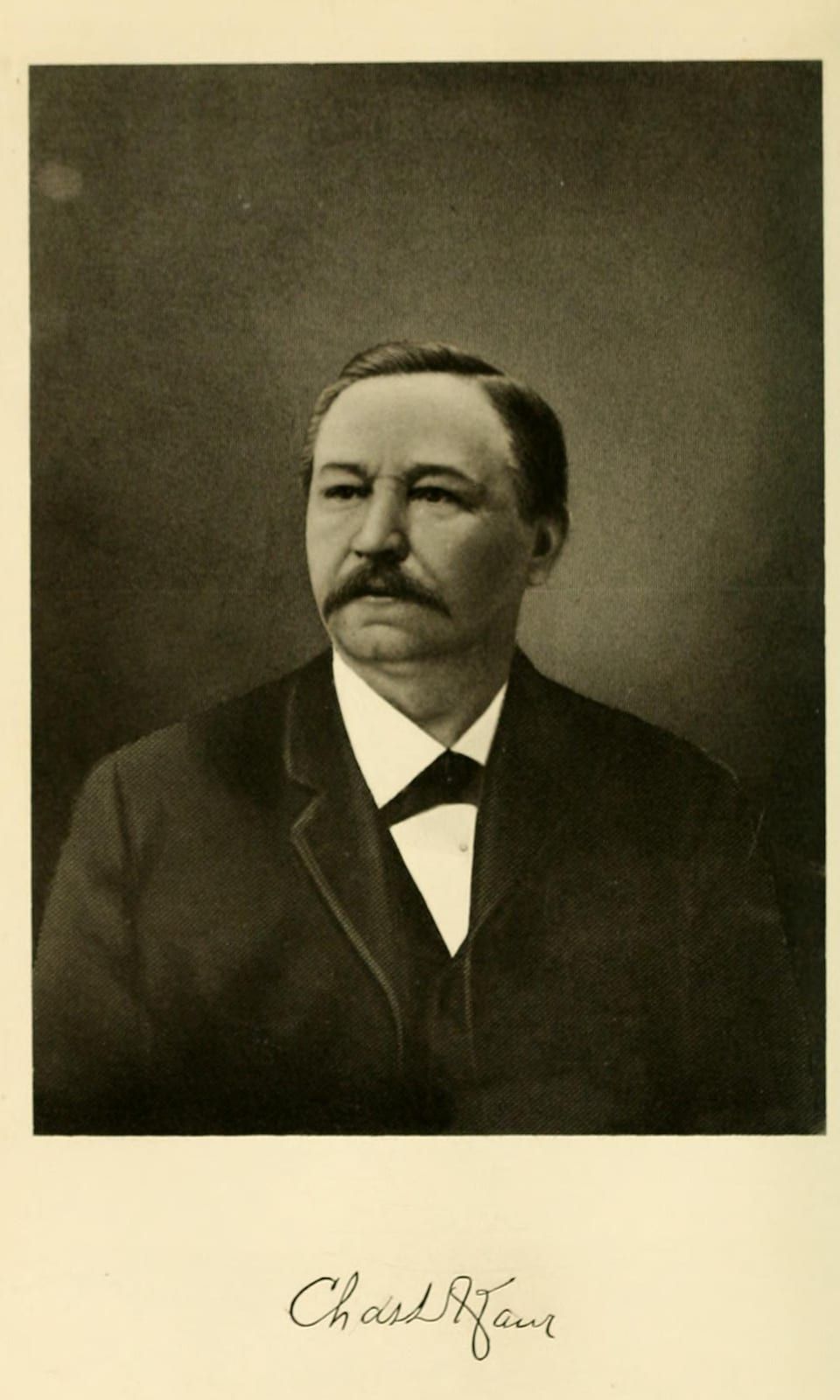
Charles D. Kaier came to Mahanoy City in 1862, a Baden-born baker’s apprentice by way of Norristown and St. Clair, newly married to Margaret Curry of Pottsville. He started in business with Frederick Gantert, then built his own establishment at 113 East Centre Street and “engaged in bottling ale and porter,” as the 1907 county history tells it. The bottler became an agent: Kaier took the local agency for Bergner & Engel, “the great brewing firm of Philadelphia,” covering Schuylkill, Columbia, Carbon, and Northumberland counties, and made it — in the 1916 county history’s words — “one of the best paying in the State.” All of it was apprenticeship for the ambition the same book records plainly: “to start a brewery of his own.”
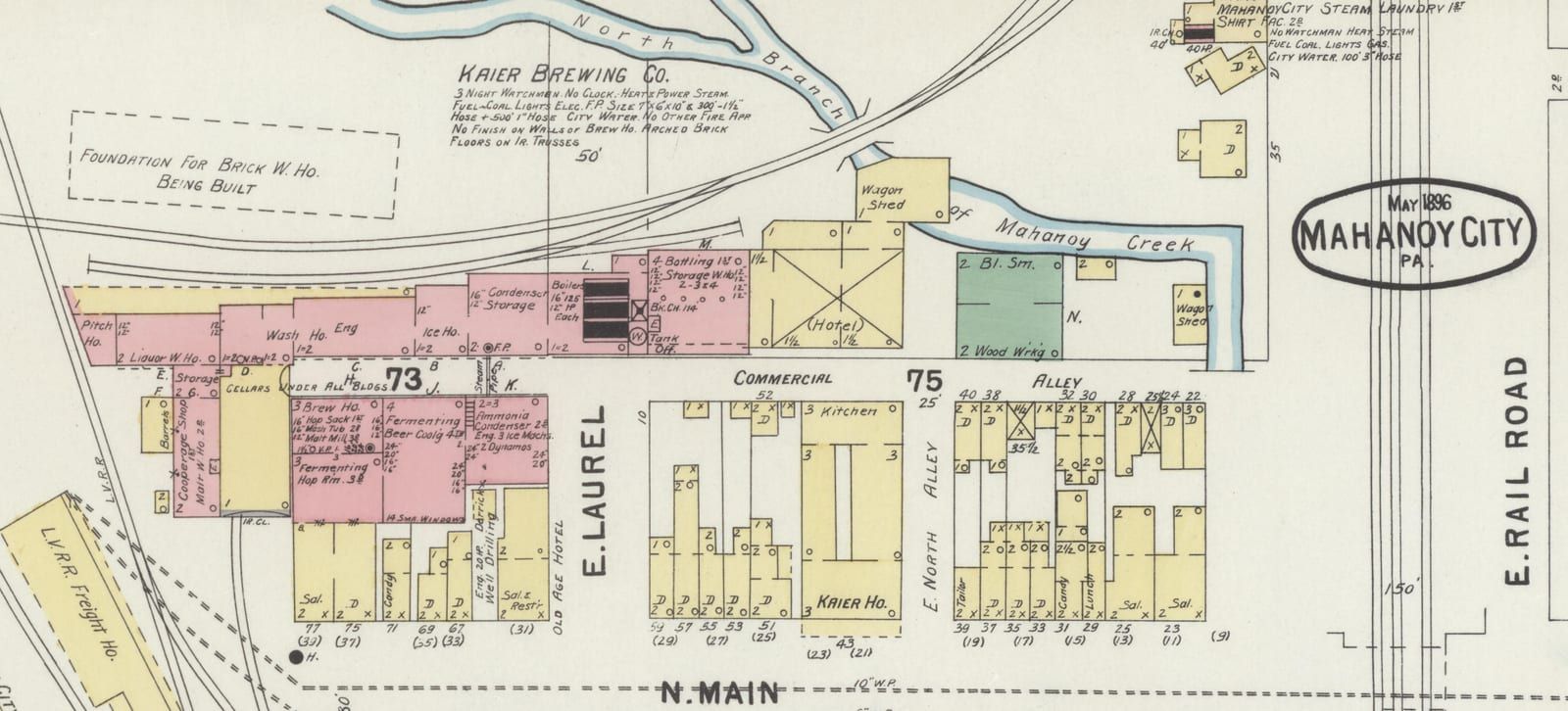
In 1883 he erected one, at Main Street and Commercial Alley. The 1893 county cyclopedia — writing while Kaier was alive — gives the chronology exactly: “The first plant was erected in 1883 by Charles D. Kaier… and was rebuilt and enlarged on the same site in 1890 by Mr. Kaier, who operated the business up to September 1, 1892, when it was merged into a co-partnership under the firm-style of the Charles D. Kaier Brewing Company, Limited.” In 1893 the brewery employed thirty hands and produced twenty-five to thirty thousand barrels a year. The rebuilt plant of 1890 is what the region remembered: when Kaier died, the Shenandoah Evening Herald’s obituary called it simply “the big brewery which has made his name known throughout the region.” The May 1896 Sanborn map draws the complex along the North Branch of Mahanoy Creek — brew house, malt house, ammonia ice machines, dynamos, “cellars under all bldgs.,” three night watchmen, and a new brick warehouse foundation already “being built.”
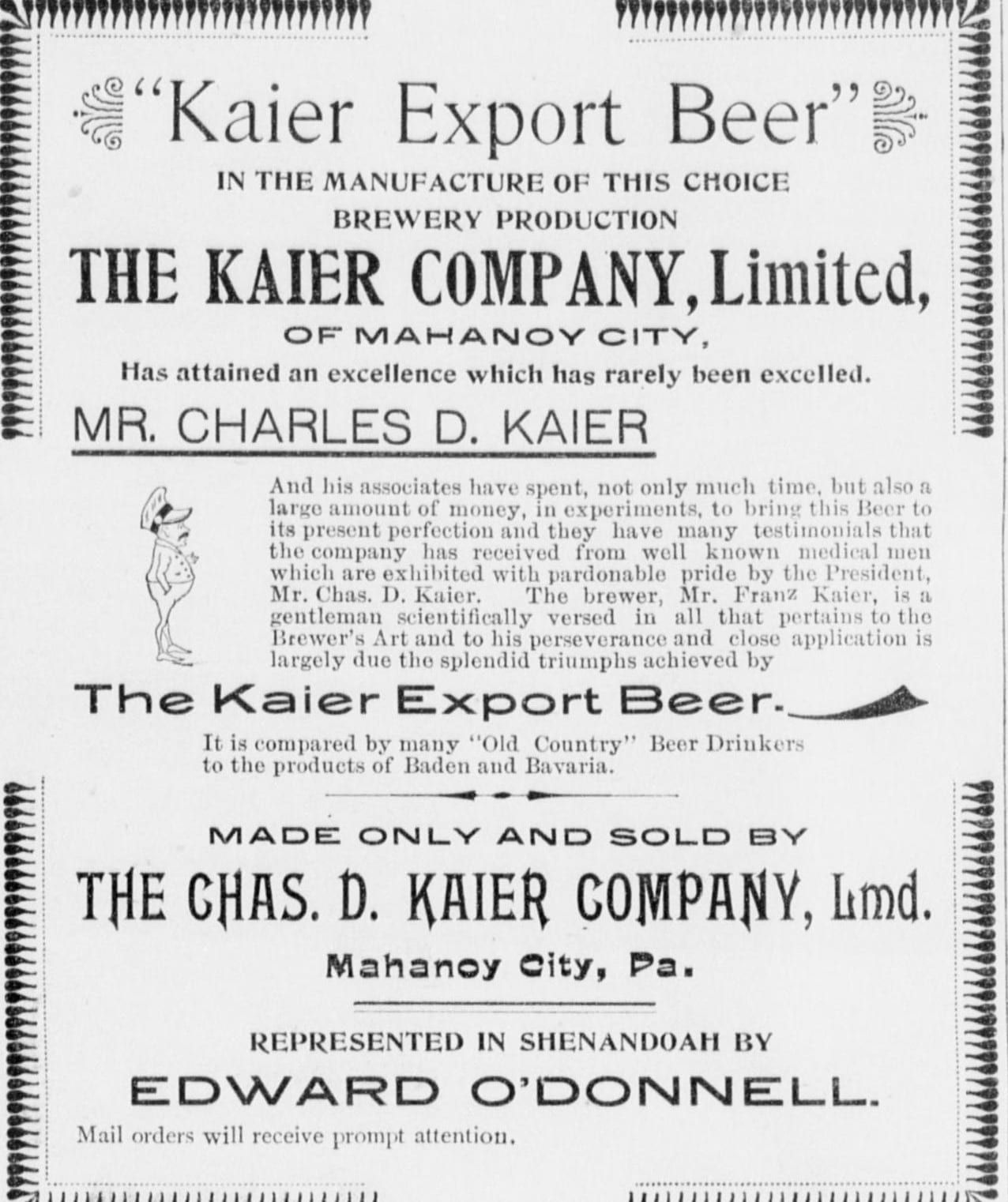
The company sold the beer with gusto. A display advertisement that ran for weeks in the 1898 Evening Herald promised that “Kaier Export Beer… is compared by many ‘Old Country’ Beer Drinkers to the products of Baden and Bavaria,” and introduced the man who made it: “The brewer, Mr. Franz Kaier, is a gentleman scientifically versed in all that pertains to the Brewer’s Art.” Franz X. Kaier, Baden-born like the founder and trained in Germany, had arrived in America in 1882, worked six months in Pottsville, and joined the Mahanoy City establishment, rising to superintendent when the concern moved into its larger quarters; the family’s own roll of company brewmasters begins with his name.
Around the brewery Charles Kaier assembled what can only be called a local empire, and the contemporary record is blunt about its shape. “He held a controlling interest in the brewery and practically owned about 40 saloons,” the 1899 obituary reported, alongside the Kaier Opera House — “the finest place of amusement in the county” — the Kaier Cottage Hotel, and control of the town’s ice business. The county histories add the Broad Mountain Ice Company, founded “originally as an accommodation for the brewery business”; control of the Anthracite Light, Heat & Power Company; and a vice-presidency of Mahanoy City’s Union National Bank, organized in 1889 — while the town’s other national bank, its gas company, and the rival Mahanoy City power company were all headed by E. S. Silliman. The saloon network left its own paper trail. A bond dispute that reached the state Supreme Court in 1902 preserves the mechanics: an agent appointed in 1897 “for the sale of the product of the brewery and wines and liquors… in the towns of Ashland, Girardville and vicinity,” bonded for $2,000. And in 1912 rival applicants formally challenged the company’s brewing license because stockholders owned “a number of houses which were leased to other parties who held licenses to sell liquors at retail”; the Superior Court let the license stand, ruling that mere ownership of a tenant’s saloon building did not prove a forbidden “pecuniary interest in the profits.”
Kaier died in Philadelphia on May 31, 1899, after years of failing health. By then, the 1916 county history judged, his brewery “ranked with the largest breweries in the State, with an annual production of over 100,000 barrels, and affording employment to 150 men.” What happened next deserves to be better known: Margaret Curry Kaier headed the Charles D. Kaier Company from her husband’s death until her own in December 1913 — a Pottsville-born woman running one of Pennsylvania’s larger breweries for fourteen years. (Beers’ county history preserves her proudest memory: presenting the first American flag to the first company of soldiers organized in Pottsville for the Civil War.) Her only surviving son, Charles F. Kaier, managed the estate after her.
Prohibition: near beer, soda water — and a pipeline
When national Prohibition arrived in 1920, the county’s breweries took the legal road — officially. Kaier’s obtained a federal permit to operate a cereal-beverage plant — near beer, capped at half a percent alcohol — “and secured a permit every year thereafter,” as the Third Circuit later summarized, while its bottling lines ran Kaier’s ginger ale, root beer, and orange soda. Yuengling famously survived on near beer and an ice-cream dairy.
Unofficially? The Mahanoy Area Historical Society’s account — retold by the writer Mitch Troutman — describes a pipe run from the brewery down the North Branch of Mahanoy Creek to a barn on Vine Street, where kegs of real beer were filled in secret while paid “spotters” on the roads into town telephoned warnings whenever federal agents’ cars appeared. The story is local memory, not court record — but the court record is vivid enough on its own. In 1929, federal agents visited the plant and, in the Third Circuit’s words, “found the applicant’s employees rolling kegs on skids from the racking room of the brewery to a blacksmith shop across the way. The employees ran on seeing the agents.” A pit connected the shop to a cellar; voices and the odor of beer came up from it; and when agents returned with a search warrant, “the pit leading to the cellar had been closed with fresh concrete.” The district judge who first heard the case allowed himself a wry aside: “It is the common belief that breweries put out, whenever they can, so-called ‘high-powered beer.’”
The prohibition administrator refused to renew Kaier’s permit for 1930, and the company went to court. It lost its first round, won a decree ordering the permit issued, was reversed on appeal — and then, on rehearing in 1932, the Third Circuit dismissed the government’s appeal on a procedural defect, leaving the company’s permit standing. Kaier’s outlasted the dry years — the Brussels medal and the last call both still lay ahead — and the same local account remembers the brewery whistle sounding to warn the bootleg-coal miners of the Depression years when the coal company moved on their diggings. In the coal region, the line between lawbreaking and community service could run thin.
Last call
The postwar years opened well enough. In November 1950 the Shenandoah Evening Herald reported that “first prize in Class I — American beer — has been won by the Chas. D. Kaier Co., Mahanoy City, in an international competition at Brussels, Belgium,” with a Star of Excellency medal and an eighteen-by-twenty-four-inch diploma in French, duly displayed in a Shenandoah storefront window; the historical society puts the company’s postwar peak near 200,000 barrels a year. But the arithmetic of American brewing was turning against every regional producer at once — national brands, television advertising, price wars, aging plants.
The end came quickly, and in pairs. In June 1966 the Philadelphia papers reported that Lloyd Fahler, the Mahanoy City banker who held the controlling interest, had sold the Charles D. Kaier Brewing Co. to Philadelphia’s Ortlieb Brewing Co. “The selling price was not disclosed,” the Inquirer noted; the new owners promised to retain the Kaier name. Late in 1967 the Columbia Brewing Co. of Shenandoah folded; early in 1968, Kaier’s shut its doors. The Pottsville Republican’s post-mortem that July — headlined “County Breweries Down to Two” — drew the moral dryly: “In both instances, the closing of the industries was preceded by the sale of the county operation to persons representing larger brewing concerns. And, in both instances, the purchasing company issued a statement at the time of the sale indicating that there would be no change in the operation” of the plants.
The two survivors were Yuengling and Mount Carbon, and for eight more years the little borough brewery held on, its Bavarian brand — “more popular than Yuengling around Pottsville from the mid 50s til the mid 70s,” as local memory has it — commanding real loyalty. On March 31, 1976, the Mount Carbon Brewing Company ceased operations, laying off about forty employees. Yuengling bought the Bavarian label and recipe (with the bottles, cases, and kegs, but not the plant), kept Mount Carbon’s brewmaster Gene Frantz on “for awhile” to match the flavor, and its president told the Republican, “The taste will be so close to the original very few people will be able to tell the difference.” Mount Carbon had brewed 59,000 barrels of Bavarian in its final year. With that, a county that once supported a brewery in nearly every trading town was down to one.
The Kaier plant outlasted its beer by half a century, looming empty over North Main Street until a grant-funded demolition brought it down in March 2017 — the collapse was dramatic enough to make the regional news — and in 2018 the borough broke ground on Kaier’s Park, a playground on the brewery site. The name, at least, still pours.
What’s brewing now
The survivor made the story hard to mourn too much: D. G. Yuengling & Son remains at Fifth and Mahantongo — the oldest operating brewery in the United States — with a second county plant in Port Carbon since 2000 and its lagering caves now a tour stop. And in the 2010s and 2020s, small brewing returned to the county’s main streets. Stoker’s Brewing Company has brewed in Tamaqua since 2018 — its taproom advertises “25 Different Handcrafted Beers BREWED ON-SITE!” Pilger Ruh Brewing opened in 2021 in downtown Pottsville, in the former Coney Island restaurant building at 213–215 North Centre Street. Black Rock Brewpub, reopened in January 2025 after a long licensing fight, pours its own-branded beers honestly made elsewhere — contract-brewed to its specifications by other Pennsylvania craft breweries. And each July, the Schuylkill County Brew Fest closes a block of Centre Street in Pottsville — thirty-some breweries pouring in the seat of a county that, from the Eagle Brewery of 1829 to the pipeline down Mahanoy Creek to the last barrel of Bavarian, has never really been dry.
Related
People: Charles D. Kaier (1837/1839–1899), David Yuengling (1808–1877)
Towns: Pottsville, Mahanoy City, Mount Carbon, Tamaqua, Minersville, Shenandoah
Sources
- Munsell, History of Schuylkill County (1881) — the Pottsville "Breweries" section (Eagle, Orchard, Market Street), the Tamaqua and Minersville chapters, and the Mahanoy City sketches · 1881
License: public-domain - Samuel T. Wiley, ed. Henry W. Ruoff, Biographical and Portrait Cyclopedia of Schuylkill County (1893) — the Kaier Brewing Company entry (plant erected 1883, rebuilt 1890, partnership of September 1, 1892) and the Mahanoy City bank and utility officer lists · 1893
License: public-domain - Schalck & Henning, History of Schuylkill County, Pennsylvania (1907), Vol. I — the Pottsville breweries recap, the Mahanoy City industries page, Mount Carbon, and Shenandoah's "two fine breweries" · 1907
License: public-domain - Schalck & Henning, History of Schuylkill County, Pennsylvania (1907), Vol. II — the Charles D. Kaier and Franz X. Kaier biographies, with the Charles D. Kaier portrait plate · 1907
License: public-domain - J. H. Beers & Co., Historical and Biographical Annals of Schuylkill County (1916), Vol. I, pp. 165–168 — the Charles D. Kaier biography · 1916
License: public-domain - The Evening Herald (Shenandoah), April 20, 1895, p. 1 — the county brewers' meeting and the Columbia Brewing Company price war (Library of Congress, Chronicling America) · 1895-04-20
License: public-domain - The Evening Herald (Shenandoah), May 26, 1898, p. 3 — the "Kaier Export Beer" display advertisement (Library of Congress, Chronicling America) · 1898-05-26
License: public-domain - The Evening Herald (Shenandoah), June 1, 1899, p. 1 — "D. Kaier Dead," the contemporary obituary (Library of Congress, Chronicling America) · 1899-06-01
License: public-domain - Charles D. Kaier Company, Limited v. O'Brien, 202 Pa. 153 (1902) — the sales-agency bond for "the towns of Ashland, Girardville and vicinity" · 1902
License: public-domain - In re Charles D. Kaier Company, Limited, 49 Pa. Super. 413 (1912) — the brewer's-license challenge over saloon properties leased to licensed tenants · 1912
License: public-domain - Charles D. Kaier Co. v. Doran, 42 F.2d 923 (E.D. Pa. 1930) — the cereal-beverage permit suit · 1930
License: public-domain - Doran v. Charles D. Kaier Co., 60 F.2d 259 (3d Cir. 1932) — the raid evidence and, on rehearing, the dismissal of the government's appeal · 1932
License: public-domain - "Kaier's Beer Awarded High Honor in Belgium Contest," Evening Herald (Shenandoah), November 16, 1950, p. 12, via Newspapers.com · 1950-11-16
License: publisher - "Ortlieb Buys Kaier Brewery," The Philadelphia Inquirer, June 24, 1966, p. 22, via Newspapers.com · 1966-06-24
License: publisher - Jim Kane, "County Breweries Down to Two," Pottsville Republican, July 2, 1968, p. 6, via Newspapers.com · 1968-07-02
License: publisher - Garnett Joseph, "Mount Carbon Brewery Closes," Pottsville Republican, March 31, 1976, p. 24, via Newspapers.com · 1976-03-31
License: publisher - Sanborn Map Company, Insurance Maps of Mahanoy City, Pennsylvania, May 1896, sheet 8 — the Kaier Brewing Co. complex (Library of Congress, Sanborn Maps Collection) · 1896
License: public-domain - Sanborn Map Company, Insurance Maps of Pottsville, Pennsylvania, June 1885, sheet 3 — the Eagle Brewery of D. G. Yuengling & Son (Library of Congress, Sanborn Maps Collection) · 1885
License: public-domain - Mahanoy Area Historical Society — "Welcome to the Kaier Page" (the family and company record, drawing on the 1912 fiftieth-anniversary souvenir booklet)
License: reference - Mitch Troutman, "Mahanoy City's Prohibition Pipeline" (PM Press blog, October 28, 2022), retelling the historical society's account · 2022-10-28
License: reference - Rich Wagner, "Breweries of the Schuylkill: A Virtual Trip Upstream," Mid-Atlantic Brewing News, October/November 2010 (archived) · 2010
License: reference - Skook News, "Did the Mt. Carbon Brewery Produce Some of the Best Beer in Schuylkill County?" (2014) — the local memory of the Bavarian brand · 2014
License: publisher - WNEP-16, "Watch the Old Kaier Brewery Come Crashing Down in Mahanoy City" (March 10, 2017) · 2017-03-10
License: publisher - The Shenandoah Sentinel, "Mahanoy City breaks ground on Kaier's Park" (August 15, 2018) · 2018-08-15
License: publisher - Stoker's Brewing Company — the brewery's own site ("25 Different Handcrafted Beers BREWED ON-SITE!"; founded 2018; checked July 2026)
License: reference - "Black Rock Brewing reopens Saturday, ending 20-month conflict with Pottsville," Republican Herald, January 16, 2025 (via Yahoo News) · 2025-01-16
License: publisher - 2026 Schuylkill County Brew Fest — Downtown Pottsville, Saturday, July 25, 2026 (event listing) · 2026-07-25
License: reference
Frequently asked
- When did brewing begin in Schuylkill County?
- With the coal boom itself. D. G. Yuengling established the Eagle Brewery at Pottsville in 1829 — today the oldest operating brewery in the United States — and the Orchard Brewery followed under A. S. Moore about 1830. A brewery opened on Minersville's Sunbury Street in 1830 or 1831, which the 1907 county history calls one of the first institutions of its kind in the county, and Tamaqua's first brewery was built by George Goeldner in 1850.
- What was Kaier's brewery?
- The Charles D. Kaier Company of Mahanoy City — after Yuengling, the county's best-known brewing name. Charles D. Kaier settled in Mahanoy City in 1862 and built up a bottling and wholesale liquor business; he erected his brewery in 1883 at Main Street and Commercial Alley, rebuilt it on a larger scale in 1890, and merged the business into the Charles D. Kaier Brewing Company, Limited on September 1, 1892. By his death in 1899, the county histories say, it ranked with the largest breweries in the state, with an annual production of over 100,000 barrels. The brewery won first prize among American beers at an international competition in Brussels in 1950, was sold to Philadelphia's Ortlieb Brewing Company in June 1966, and shut its doors in early 1968.
- How did Schuylkill County breweries survive Prohibition?
- Legally, on near beer and soft drinks: Kaier's ran a federally permitted cereal-beverage plant and bottled sodas, and Yuengling brewed near beer and opened a dairy. Less legally: the Mahanoy Area Historical Society's account describes a pipeline that carried real beer from the Kaier plant down the North Branch of Mahanoy Creek to a barn where kegs were filled, with paid spotters watching the roads for federal agents. The federal court record is real enough — in 1929 agents found Kaier employees rolling kegs to a blacksmith shop whose cellar pit was later sealed with fresh concrete, and the administrator refused the company's 1930 renewal — yet Kaier's ultimately kept its permit when the government's appeal was dismissed in 1932.
- When did the county's old breweries close?
- Within one decade. The Columbia Brewing Company of Shenandoah folded late in 1967; Kaier's of Mahanoy City shut its doors early in 1968, less than two years after its sale to Ortlieb; and the Mount Carbon Brewery — the last heir of Pottsville's 1830 Orchard Brewery — ceased operations on March 31, 1976, with Yuengling purchasing its Bavarian label and recipe. Yuengling itself never closed, and remains the county's — and the country's — oldest brewery.
- Who brews in Schuylkill County today?
- D. G. Yuengling & Son, at its 1831 hillside site in Pottsville and a second plant in Port Carbon; Pilger Ruh Brewing, pouring small-batch beer since 2021 in the former Coney Island building on North Centre Street; and Stoker's Brewing Company in Tamaqua, brewing on-site since 2018. Black Rock Brewpub in Pottsville serves its own-branded beer, contract-brewed to its specifications by other Pennsylvania craft breweries. Each July, the Schuylkill County Brew Fest closes a block of Centre Street in Pottsville.