Before Pottsville: the pioneer settlers around Pott's furnace
Listen to this article · 19 min
0:0018:55
Read by a synthetic voice, generated from the text of this article. Hear the whole archive on the Listen page.
The people who were here before the towns — as the record holds them. Markers: verified against a contemporaneous or official record — a census return, a land patent, a state card file, a newspaper of the day · confirmed by a retrospective or secondary account — Rupp wrote forty years after the settlement he describes · corrects a common error · open/caution.
In 1845 the compiler I. Daniel Rupp printed the earliest roster of the people living around John Pott’s iron furnace on the upper Schuylkill — the valley that became Pottsville — in a book whose title page promises “a brief history of the first settlers.” It is one page long, and it is the earliest account of the place we have: a furnace with tenant houses, a few farms and saw-mills, the Black Cabin at the Big Spring on the Broad Mountain, and a scatter of families whose surnames are still on the county’s mailboxes. Rupp’s verdict on them is the plainest sentence on the page: these families, with Mr. Pott, were “the pioneer settlers of this portion of the anthracite region.” This page sets out who they were, where he puts them, and what the records add — family by family, in his order.
The country before the furnace
The ground was nearly empty, and the histories say so. “Before 1790,” Rupp writes, “there were, comparatively speaking, few settlers north of the Blue, or Kittatinny mountain, within the limits of Schuylkill county, except in the valley south of the Second mountain.” The 1907 county history explains why: north of Second mountain the country offered “no attractions to settlers, except to an occasional adventurous hunter” — the coal was unknown, the mountains were too steep to farm, and though the timber was abundant, “neither the timber nor its product could be marketed.”
At least one family, the Neymans, occupied the site of Pottsville by 1780. The 1907 county history says four of them were killed there by Native Americans that year, and that D. C. Henning, working through the Pennsylvania Archives, had established the killings “beyond a doubt.” The same correspondence shows soldiers and marines at work in the timber nearby, “cutting mast timbers for the French navy” — “the head of the Schuylkill” was reckoned a good place to get them. A camp of colonial marines under Capt. Dennis Leary stood at the gap in Second mountain, near the later Mount Carbon — said to be “the only authorized military station” in the county’s bounds during the Revolution.
When settlers did come, they came for the trees. Maj.-Gen. Balsar Gehr “operated a saw-mill at Pottsville prior to 1800,” George Orwig ran another near the later Saint Clair, and a Pottstown company — Samuel and Thomas Potts and their partners — cut on Norwegian creek until they gave the enterprise up about 1798. A local tradition recites that their lumbermen found the strange black stone, could not burn it, and decided it was “a species of black rock” and worth nothing. Lumber, the county history says, “was the principal article of export,” and without the timber “the settlement of Schuylkill county would have been long delayed.”
The furnace families
The settlement itself began with iron. About 1795 or ‘96, Lewis Reese and Isaac Thomas settled on the north side of Sharp mountain — Rupp gives the hill its German name, “Schneid Berg” — in the Schuylkill Gap, put up a small furnace, and ran it until 1806, when they sold to John Pott of District township, Berks County. Pott tore the furnace down, raised the Greenwood forge in its stead, and built the Greenwood furnace in 1807.
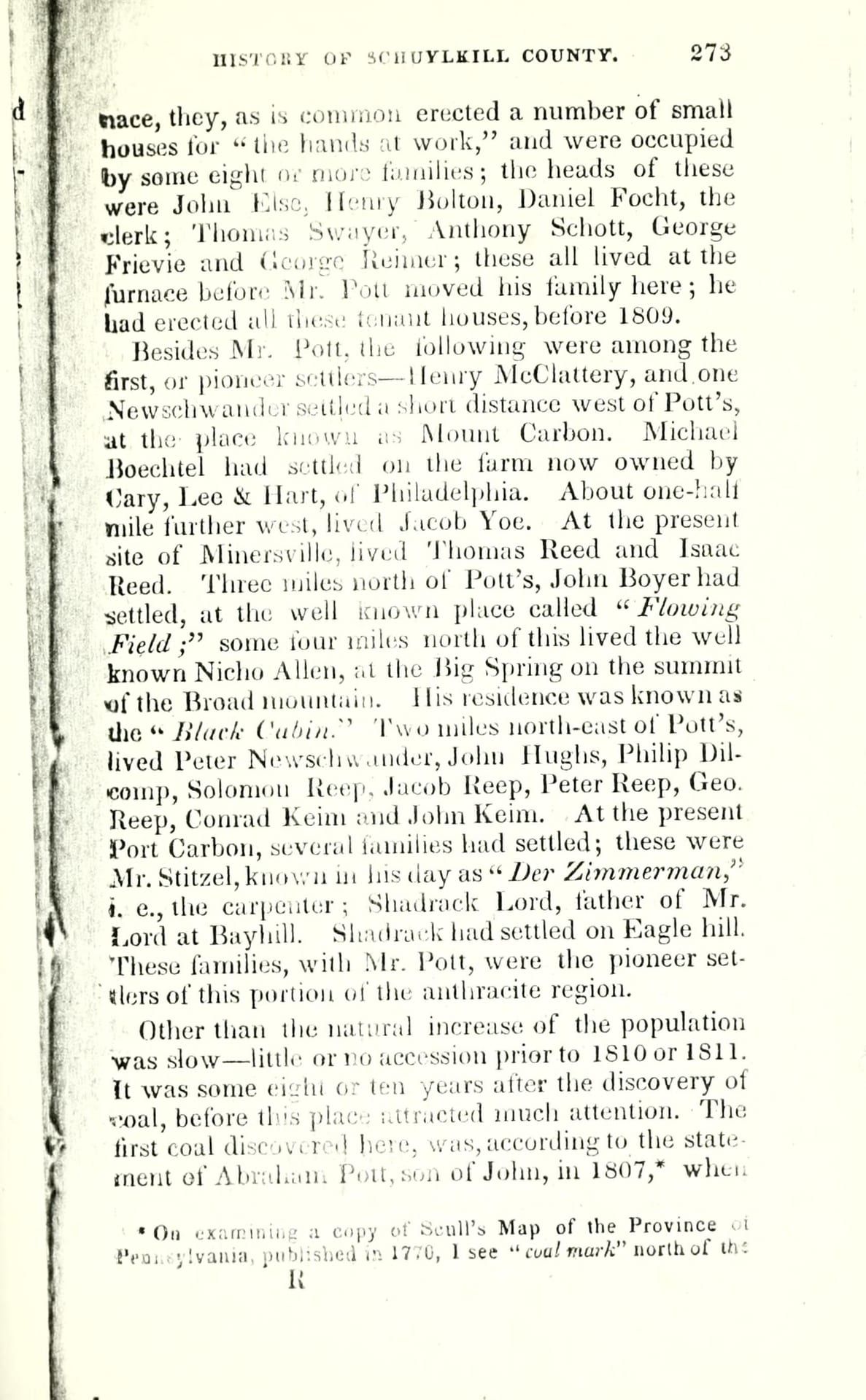
Around the works stood a hamlet of company housing — “a number of small houses for ‘the hands at work,’” in Rupp’s words, “occupied by some eight or more families” — and he names the heads of them:
John Else, Henry Bolton, Daniel Focht, the clerk; Thomas Swayer, Anthony Schott, George Frievie and George Reimer; these all lived at the furnace before Mr. Pott moved his family here; he had erected all these tenant houses, before 1809.
The proprietor himself was the last to arrive: “John Pott himself became a resident of the settlement (which subsequently became Pottsville) in 1810, removing from Berks county,” the 1907 history records, and in the years between 1806 and 1810 his interests here were managed by his son John Pott, Jr., with Daniel Focht — Rupp’s furnace clerk — as his assistant. The same account counts six houses then standing on the village site: the Reed house; the Alspach house, later “fitted up for a residence for the Pott family”; Anthony Schutt’s on Lawton’s hill; Thomas Swoyer’s; Nathan Taylor’s; and “the old Neyman house” — the Neymans’ cabin still standing in the ground called the Orchard, thirty years on. Distance meant little in that country: in those days, the county history observes, “neighbors were considered ‘near’ when separated by several miles.”
Rupp’s roster, 1845
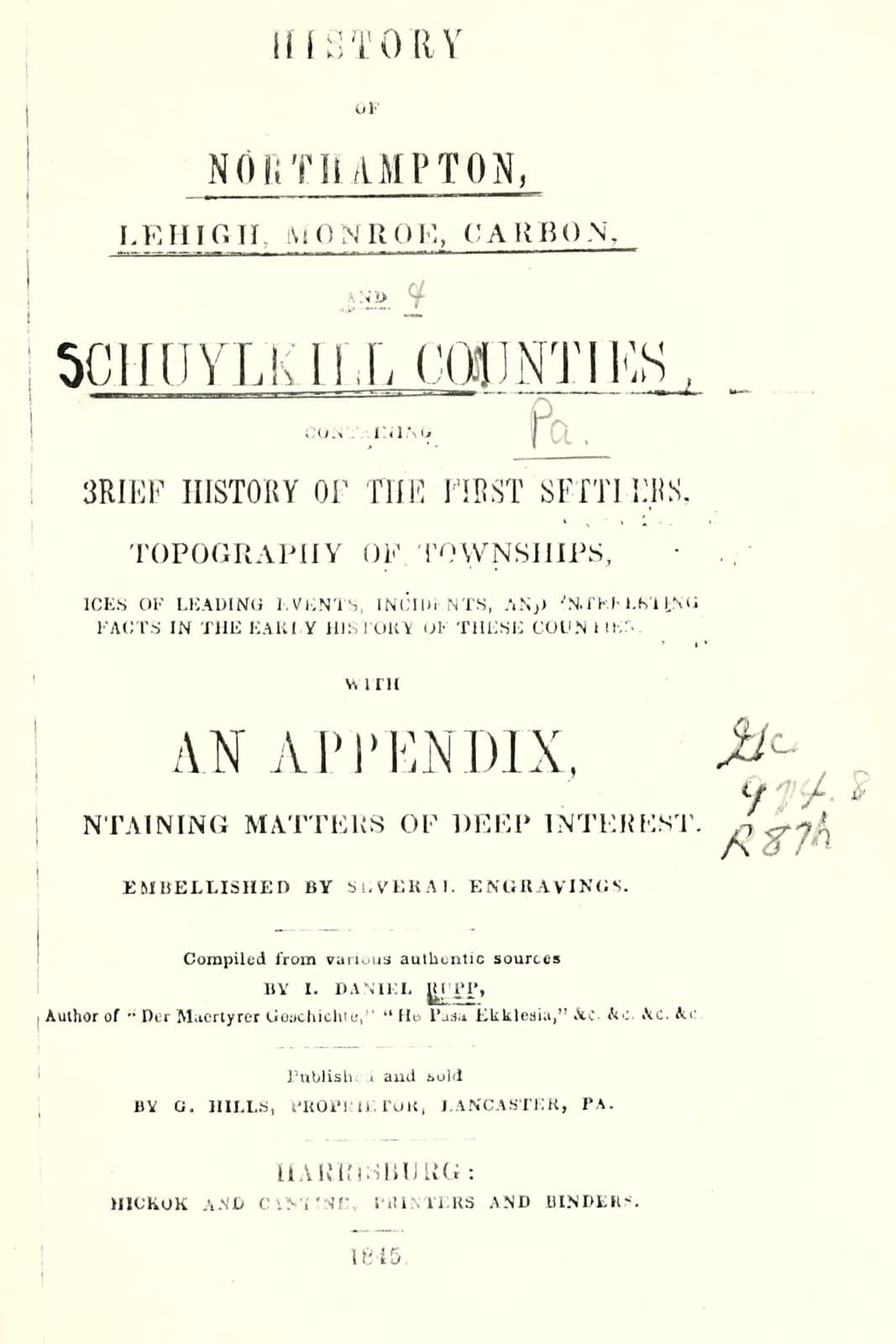
Rupp compiled his history of five counties “from various authentic sources” and published it at Harrisburg in 1845, about forty years after the settlement he describes. Here is his roster of the neighborhood, entire:
Besides Mr. Pott, the following were among the first, or pioneer settlers—Henry McClattery, and one Newschwander settled a short distance west of Pott’s, at the place known as Mount Carbon. Michael Boechtel had settled on the farm now owned by Cary, Lee & Hart, of Philadelphia. About one-half mile further west, lived Jacob Yoe. At the present site of Minersville, lived Thomas Reed and Isaac Reed. Three miles north of Pott’s, John Boyer had settled, at the well known place called “Flowing Field;” some four miles north of this lived the well known Nicho Allen, at the Big Spring on the summit of the Broad mountain. His residence was known as the “Black Cabin.” Two miles north-east of Pott’s, lived Peter Newschwander, John Hughs, Philip Dilcomp, Solomon Reep, Jacob Reep, Peter Reep, Geo. Reep, Conrad Keim and John Keim. At the present Port Carbon, several families had settled; these were Mr. Stitzel, known in his day as “Der Zimmerman,” i. e., the carpenter; Shadrack Lord, father of Mr. Lord at Bayhill. Shadrack had settled on Eagle hill. These families, with Mr. Pott, were the pioneer settlers of this portion of the anthracite region.
The rest of this page walks that list, direction by direction, and adds what the other records carry about each family.
Every name in the record
Four separate lists of names survive from the furnace years, and they are not one list. The two men who built the furnace before John Pott bought it; the tenant families housed at the works; the neighborhood roster Rupp printed in 1845; and the six houses found standing on the village site when Pott’s people arrived. Each name below appears first as its own source spells it, with the later spelling beside it wherever a source writes the same man two ways.
The furnace, before the town
| Name, as its source spells it | Also recorded as | Where the source places them |
|---|---|---|
| Lewis Reese | — | built a small furnace on the north side of Sharp mountain about 1795–96, with Isaac Thomas; sold it to John Pott in 1806 |
| Isaac Thomas | — | built and ran that furnace with Lewis Reese |
| John Pott | — | bought the furnace in 1806, raised the Greenwood forge in its place, and moved his family up in 1810 |
The furnace tenant families, before 1809
Rupp names seven heads of household in the company houses at the works, and the 1907 county history repeats the same seven.
| Name, as its source spells it | Also recorded as | Where the source places them |
|---|---|---|
| John Else | — | a tenant house at the furnace |
| Henry Bolton | — | a tenant house at the furnace |
| Daniel Focht | — | the furnace clerk; assistant to John Pott, Jr., between 1806 and 1810 |
| Thomas Swayer | Swoyer — the same seven-name tenant list, respelled | a tenant house at the furnace; the 1907 history’s “Thomas Swoyer’s house” stood on the site of a livery stable later established on Union street |
| Anthony Schott | Schutt — read here as one man | a tenant house at the furnace; the 1907 history’s “Anthony Schutt” lived on Lawton’s hill |
| George Frievie | — | a tenant house at the furnace |
| George Reimer | — | a tenant house at the furnace |
Two of these men are written two ways, and the two cases are not equally certain. Rupp’s Thomas Swayer is the 1907 history’s Thomas Swoyer: both books print the same list of seven tenant families, in the same order, with that one name respelled — the lists match, so the men do. Rupp’s Anthony Schott is more likely than not the same history’s Anthony Schutt, but the evidence is thinner: Schott is the spelling in both books’ tenant lists, and Schutt appears only once, four pages later, in the list of houses on the village site. No source says the two are one man; the forename, the surname and the village all agree, and that is the whole of it. Each is listed once here, in this table, and the houses table below points back rather than counting either a second time.
Rupp’s roster of the neighborhood, 1845
| Name, as its source spells it | Also recorded as | Where the source places them |
|---|---|---|
| Henry McClattery | — | at the place known as Mount Carbon, a short distance west of Pott’s |
| Newschwander | — | at Mount Carbon with McClattery; Rupp names only “one Newschwander,” giving no forename |
| Michael Boechtel | Bechtel, in the 1907 history | on the farm owned in 1845 by Cary, Lee & Hart of Philadelphia; the 1907 history makes Michael Bechtel the first settler at St. Clair |
| Jacob Yoe | Yohe and Yoh, in the 1907 history | half a mile west of Boechtel’s farm; his son William is written Yoh, Yohe and Yok, but Yok is never applied to Jacob |
| Thomas Reed | — | at the present site of Minersville |
| Isaac Reed | — | at the present site of Minersville |
| John Boyer | — | three miles north of Pott’s, at the “well known place” called Flowing Field |
| Nicho Allen | — | four miles north of Boyer, at the Big Spring on the summit of the Broad mountain, in the house known as the “Black Cabin”; this site spells his given name Necho |
| Peter Newschwander | Neuschwender and Neuschwander, in the 1907 history | two miles north-east of Pott’s; the 1907 history places the cluster near Mill creek |
| John Hughs | Hughes, in the 1907 history | two miles north-east of Pott’s, near Mill creek |
| Philip Dilcomp | Delcamp, in the 1907 history | two miles north-east of Pott’s, near Mill creek |
| Solomon Reep | Reed in one 1907 chapter, Reel in another | two miles north-east of Pott’s, near Mill creek |
| Jacob Reep | Reed in one 1907 chapter, Reel in another | two miles north-east of Pott’s, near Mill creek |
| Peter Reep | Reed in one 1907 chapter, Reel in another | two miles north-east of Pott’s, near Mill creek |
| Geo. Reep | Reed in one 1907 chapter, Reel in another | two miles north-east of Pott’s, near Mill creek |
| Conrad Keim | Heim, in the 1907 history | two miles north-east of Pott’s, near Mill creek |
| John Keim | Heim, in the 1907 history | two miles north-east of Pott’s, near Mill creek |
| Mr. Stitzel | — | at the present Port Carbon; “Der Zimmerman,” the carpenter, whose mill stood on Mill creek by about 1800 |
| Shadrack Lord | Shadrach, in the 1907 history | at the present Port Carbon, settled on Eagle hill; “father of Mr. Lord at Bayhill” |
The six houses on the village site, 1806–1810
What John Pott, Jr., and Daniel Focht found already standing, as the 1907 county history counts them.
| Name, as its source spells it | Also recorded as | Where the source places them |
|---|---|---|
| the Reed house | — | on the village site |
| the Alspach family | — | on the present site of the Charles Baber residence; the house was later fitted up for the Pott family |
| Anthony Schutt | Schott in the tenant list above — read here as one man | on Lawton’s hill |
| Thomas Swoyer | Swayer in the tenant list above — the same man | on the site of a livery stable later established on Union street |
| Nathan Taylor | — | on the site of the Philadelphia & Reading freight depot |
| the old Neyman house | — | in the ground called the Orchard; the 1907 history says four of the family were killed there by Native Americans in 1780 |
West of Pott’s: Mount Carbon, a farm, and the Reeds of Minersville
Henry McClattery and a Newschwander held the ground “at the place known as Mount Carbon.” Rupp’s sentence is all the record carries of them. The place itself became “the northern terminus of the Schuylkill navigation” — until the canal was pushed on to the mouth of Mill creek — the outlet of the Center turnpike commerce “from the Susquehanna region,” and “one of the first boroughs in the county.”
Michael Boechtel sat on a farm “now owned” — in 1845 — “by Cary, Lee & Hart, of Philadelphia.” The 1907 history knows the family on different ground: “Michael Bechtel was the first settler” at Saint Clair, where he was followed by John Malone and the Nichols family “at the beginning of the last century,” where “lumbering was the first general industry” — and where, in 1831, the same Philadelphia firm of Carey, Lee and Hart bought the Nichols land and laid out the village’s first street.
Jacob Yoe lived half a mile beyond Boechtel’s farm. The county history gives him the earliest date on the roster — “Jacob Yohe settled about a mile east of Minersville between 1780 and 1790” — though its New Castle chapter, counting him among that township’s first settlers with John Boyer and Nicho Allen, says the three families came “about the year 1800”; the book carries both dates without noticing.
Thomas Reed and Isaac Reed were “at the present site of Minersville,” and Thomas is the best-documented settler on the page. He came to the site “in March, 1793,” built a saw-mill on the West Branch “just below the mouth of Wolf creek,” the first log house in the village limits, a distillery for his surplus grain, and a tavern that every traveler on the old King’s highway between Reading and Sunbury knew as the “Half-Way House” — locally, the “Red House.” He kept it until he died in 1814, “and his was the first interment in the cemetery at the rear of his hotel.” His family made the first entries in Minersville’s book of records: the first birth, Susanna Reed, December 18, 1793; the first marriage, Jacob Reed to Rebecca Bittle, January 13, 1813. And in 1818, Rupp records, a Jacob Reed “opened a vein of coals at Minersville.”
North: Flowing Field and the Big Spring
John Boyer farmed three miles north of the furnace, at the “well known place” Rupp names Flowing Field. He was “the first settler on the turnpike,” and about 1810, when “the turnpike was made passable,” he and his son-in-law William Yohe built a tavern near it; a house they had put up earlier, half a mile south, “became a well-known landmark, familiar to all travelers between Pottsville and New Castle.” The 1907 history tells the tavern story three ways — Boyer’s “hotel” stood “near the top of Mine hill” in its tavern chapter, near Norwegian township’s northern border in its Norwegian chapter, and in its New Castle chapter William Yoh, “son of Jacob, and son-in-law of John Boyer,” himself “built the first tavern in the township, about the year 1810.” However the chapters divide the houses, the pioneers ended in the same ground: when New Castle township buried its first generation, “among the early burials there were the pioneers William Yoh and John Boyer and their wives.”
Nicho Allen — Rupp’s spelling — lived four miles beyond Boyer, “at the Big Spring on the summit of the Broad mountain,” in the house “known as the ‘Black Cabin.’” He is the one name on the roster the county never forgot: the hunter credited by tradition with discovering anthracite by campfire, and, in the records, a tavern-keeper and landholder whose documented life is told separately on this site. Rupp, writing in 1845, attaches no discovery story to him at all — merely a man at a spring on a mountain summit.
Two miles north-east: the Mill Creek families
The thickest cluster on the roster lived two miles north-east of the furnace: a second Newschwander household, Peter’s; John Hughs; Philip Dilcomp; four Reeps — Solomon, Jacob, Peter and George — and two Keims, Conrad and John. The 1907 history places them exactly, as the first settlers of what became East Norwegian township: “These families all located near Mill Creek, and were contemporary with the Bechtel family at St. Clair.”
The record holds these Pennsylvania-German names loosely. The four men Rupp printed as Reep in 1845 — with a P — appear in the 1907 history’s Pottsville chapter with a D, as “Solomon, Jacob, Peter and George Reed,” and in its East Norwegian chapter — the same book — with an L, as “Solomon, Jacob, Peter and George Reel”; Rupp’s Philip Dilcomp is that chapter’s “Philip Delcamp”; and his Conrad Keim and John Keim are its “John and Conrad Heim.” A Philip Delcamp appears once more in the same history, as the pioneer schoolmaster of Branch township’s German church schools — “Philip Delcamp was the pioneer teacher. The rates of tuition were fifty cents per month for each child” — whether the Mill creek settler or another man of the name, the book does not say.
At the present Port Carbon: the carpenter and the Lords
Rupp puts two households at “the present Port Carbon”: Mr. Stitzel, “known in his day as ‘Der Zimmerman,’ i. e., the carpenter,” and Shadrack Lord.
Stitzel’s trade left the first mark on the ground. A mill had been put up on Mill creek “previous to 1810, and probably about the year 1800, by a Mr. Stitzel, who also erected a log house for the accommodation of his employes” — and the sawyer in that mill, Philip Faust, “is believed to have been the first resident of what is now Port Carbon.” John Pott built a second saw-mill there in 1821 with a log house for his own sawyer; his son Abraham laid out the first lots of the village then called Middleport, put up its third dwelling and five tenant houses in 1826, and by that year the place was already “prominent in the business world.”
Shadrack Lord is a quieter figure, and Rupp’s two clauses are nearly all of him — “father of Mr. Lord at Bayhill,” and “settled on Eagle hill.” Rupp’s page is the only history that says anything about him; the 1907 history repeats the bare name from his roster and adds nothing. The name itself, though, is rare enough to follow through the records. The first federal census, in 1790, found a Shadrach Lord keeping a household of six in Montgomery County. The census of 1800 has him in New Hanover township there — one man of 26 through 44, an older woman, a small boy and girl. And the State Archives’ Revolutionary War card file holds a card for a Shadrac Lord of Philadelphia — the county New Hanover belonged to until Montgomery was created from it on September 10, 1784. Whether the Montgomery man and the settler on Eagle hill were one, the record does not say.
The surname, at any rate, was in the new county’s censuses early and stayed. The census of 1820 counts two Lord households in Schuylkill township — Henry Lord’s, seven strong, and a second entered as “Jep Lord” — with two more, Thomas’s and Frederick’s, in Brunswick township. By 1830 there were four Lord households in the county, two of them in Pottsville itself: Frederick Lord, a man in his fifties with nine in the house, and Henry Lord, a man of forty-odd with ten — eight of them children; his own page identifies him as the man Beers’s genealogy calls Elijah.
Elijah Lord enters the record later, and secondhand — Beers’s contribution, set down in 1916 inside a sketch of another family entirely: “Elijah Lord, Mrs. Shellhammer’s grandfather, was a pioneer settler in Pottsville, and died in the borough. He is buried in the Presbyterian cemetery. His children were: Seth, Charles, Peggin, Henry, Jeremiah, Isaac, William and Frank, all of whom lived and died at Pottsville.” Four of those eight children — Jeremiah, Charles, Isaac and Henry — are exactly the four Lords that Ella Zerbey Elliott lists among the town’s “early builders, contractors and dealers in mountain stone, and carpenters,” so the two sources describe one family. The lumber trade kept the surname long after them: “It was established originally by Charles Lord, the firm afterwards becoming Weed & Sailor, and a number of years ago it was incorporated as The Sailor Planing Mill & Lumber Company.”
The son Henry — who carried his father’s name — was born at Pottsville on December 23, 1819, and “was a carpenter, and followed contracting to the end of his days,” in Beers’s words. When he died, on Thursday, February 7, 1889 — of injuries from an accident by Beers’s account, after months of illness by the newspaper’s — the Daily Republican filled the record out: “a carpenter and builder,” and “proprietor of a lumber yard” at Fourth and Callowhill streets for many years; at one time “Captain of the Washington Artillerists,” and later a lieutenant in the National Light Infantry. He died “in the 70th year of his age” at 509 West Mahantongo Street, and the notice named his burial ground: “Interment at Presbyterian Cemetery.” Beers puts his father the pioneer settler in the same cemetery. A son of his first marriage, William, had been killed at the battle of Gettysburg.
Of the eight children Beers lists, Isaac is the one he leaves blank — no dates, no wife, no children. The county’s orphans’-court file fills that in: in April 1841 an Isaac Lord, “a minor above the age of fourteen years,” petitioned to choose his own guardian as “Son of Henry Lord late of the Borough of Pottsville”, deceased. A minor above fourteen that April was born between 1820 and 1827, and Pottsville’s 1850 census holds exactly one Isaac Lord in that window — a carpenter of the South Ward, and the grandfather of Claude A. Lord, the city’s mayor for sixteen years. No document yet found names Isaac’s father and his trade in the same breath, so that last step from the settler to the mayor rests on the age and on how rare the name was. The settler’s own page sets out the file.
Nothing on record joins Elijah’s Pottsville family to the family on Eagle hill — Rupp names Shadrack’s son only as “Mr. Lord at Bayhill.” The given name, though, persisted. Blythe township was erected in 1846 out of the Schuylkill township where the 1820 Lords were counted. In 1870 the census finds James Lord’s household there, at the Silver Creek post office by New Philadelphia, with a sixteen-year-old Shedrick in the house, and a second boy of the name, Shadrig Lord, born about 1862, in another household of the same township.
The coal ends the quiet
The settlement had been standing on coal, and did not know what it was worth. A vein was struck digging the Greenwood furnace foundation in 1807 — so Abraham Pott, John’s son, later stated — and a nine-foot vein digging the foundation of Pott’s grist mill in 1810, “but its use and value was not then known and fully appreciated.” The population barely moved: “little or no accession prior to 1810 or 1811,” Rupp says of the settlement.
Then, within a decade, everything on the roster’s map changed at once. Doctor McFarland opened his vein on the “York Farm” in 1814; John Pott laid out Pottsville in 1816, Henry Donnell surveying the plot and building one of its first houses, with William Casley, Joseph Leckey and George Dengler putting up dwellings just after; Jacob Reed opened his vein at Minersville in 1818. The Schuylkill Navigation company had been incorporated in March 1815 — James McFarland and John Pott were among the commissioners named to open its books — and its first dam went in at Mount Carbon in the spring of 1817, Lewis Wernwag the contractor. On the roster’s ground, towns followed within a generation: Port Carbon “prominent in the business world as early as 1826,” Minersville founded in 1830, St. Clair’s first street laid out in 1831, Palo Alto — the boatmen’s borough along the base of Sharp mountain — laid out in 1844–45, New Philadelphia grown from the “two houses in the village” of 1841. The anthracite trade did the rest.
Rupp, writing in 1845, described what the place had become: Pottsville “formed the nucleus of a dense settlement” — ‘an oppidan settlement,’ in his words — “for it is surrounded by towns, hamlets and villages.” Forty years earlier it had been a furnace and its tenant houses, and the neighbors: a carpenter at Mill creek, a tavern-keeper on the mountain, the Reeds at their saw-mill, the Reeps and Keims along the creek, Boyer at Flowing Field, Shadrack Lord on Eagle hill. “These families, with Mr. Pott, were the pioneer settlers of this portion of the anthracite region.”
Related
People: John Pott (1759–1827), Necho Allen and the Discovery of Anthracite, Claude A. Lord (1889–1954), Henry (Elijah) Lord (1788–1835)
Towns: Pottsville, Port Carbon, Minersville, Mount Carbon, Saint Clair, New Philadelphia, Palo Alto
Sources
- I. Daniel Rupp, History of Northampton, Lehigh, Monroe, Carbon and Schuylkill Counties (Harrisburg: Hickok and Cantine, 1845), pp. 272–274 (Internet Archive) · 1845
License: public-domainThe earliest county history — its title page promises "a brief history of the first settlers" and says the book was "compiled from various authentic sources" — read from the page images. P. 272: "Before 1790, there were, comparatively speaking, few settlers north of the Blue, or Kittatinny mountain, within the limits of Schuylkill county, except in the valley south of the Second mountain. About the year 1795, or '96, two individuals, Lewis Reese and Isaac Thomas, settled on the north of the well known 'Schneid Berg,' i. e. Sharp mountain, in the Schuylkill Gap. Having purchased a tract of land, and erected a small furnace, carrying it on for some time, they sold it in 1806, to John Pott, of District township, Berks county." P. 272 continues: "Mr. Pott tore down the furnace, and erected in its stead, Greenwood forge, the remains of which are still visible. In 1807, he built Greenwood furnace, which was successfully in operation till 1827, the time of John Pott's death." P. 273, on the furnace tenants — the sentence carries over the page break from p. 272: "they, as is common erected a number of small houses for 'the hands at work,' and were occupied by some eight or more families; the heads of these were John Else, Henry Bolton, Daniel Focht, the clerk; Thomas Swayer, Anthony Schott, George Frievie and George Reimer; these all lived at the furnace before Mr. Pott moved his family here; he had erected all these tenant houses, before 1809." Then the roster, in full: "Besides Mr. Pott, the following were among the first, or pioneer settlers—Henry McClattery, and one Newschwander settled a short distance west of Pott's, at the place known as Mount Carbon. Michael Boechtel had settled on the farm now owned by Cary, Lee & Hart, of Philadelphia. About one-half mile further west, lived Jacob Yoe. At the present site of Minersville, lived Thomas Reed and Isaac Reed. Three miles north of Pott's, John Boyer had settled, at the well known place called 'Flowing Field;' some four miles north of this lived the well known Nicho Allen, at the Big Spring on the summit of the Broad mountain. His residence was known as the 'Black Cabin.' Two miles north-east of Pott's, lived Peter Newschwander, John Hughs, Philip Dilcomp, Solomon Reep, Jacob Reep, Peter Reep, Geo. Reep, Conrad Keim and John Keim. At the present Port Carbon, several families had settled; these were Mr. Stitzel, known in his day as 'Der Zimmerman,' i. e., the carpenter; Shadrack Lord, father of Mr. Lord at Bayhill. Shadrack had settled on Eagle hill. These families, with Mr. Pott, were the pioneer settlers of this portion of the anthracite region. Other than the natural increase of the population was slow—little or no accession prior to 1810 or 1811. It was some eight or ten years after the discovery of coal, before this place attracted much attention. The first coal discovered here, was, according to the statement of Abraham Pott, son of John, in 1807, when" — continuing on p. 274 — "the foundation for Greenwood furnace was dug, in digging which, a vein of coal was found; and in digging the foundation of Pott's grist mill, in 1810, a vein of nine feet thick was struck, and now successfully worked by Mr. Joseph Beddle; but its use and value was not then known and fully appreciated." P. 274 continues: Doctor McFarland opened a vein on the "York Farm" in 1814; "the laying out of Pottsville, by John Pott, in 1816"; "The ground or town plot was surveyed and laid off for the proprietor, by Henry Donnell, who was also among the first to erect a house. William Casley, Joseph Leckey and Geo. Dengler also, each of them, put up dwellings here, shortly after Pottsville was laid out. About this time, or shortly afterwards, in 1818, Mr. Jacob Reed opened a vein of coals at Minersville. From this time onward speculators, and a consequent tide of immigration, tended to this region of country. Pottsville formed the nucleus of a dense settlement—'an oppidan settlement,' for it is surrounded by towns, hamlets and villages."
- Adolf W. Schalck and D. C. Henning, History of Schuylkill County, Pennsylvania (1907), Vol. I, pp. 256–258 — Pottsville Borough (Internet Archive) · 1907
License: public-domainRead from the page images. P. 256: "the town was not laid out until 1816, though at least one family occupied the site of Pottsville as early as 1780, this being the ill-fated Neyman family, four of whom were massacred by Indians, as appears in another chapter. Lewis Reese and Isaac Thomas, with their employes, some eight or more families, located north of Sharp mountain, in the Schuylkill gap, in 1795, or perhaps a year later"; the furnace was "sold to Mr. Pott in 1806"; and "Previous to 1809, Mr. Pott erected tenant houses for several families of employes... These families constituted the first settlers of the immedite [sic] vicinity of Pottsville, and were represented by John Else, Henry Bolton, Daniel Focht, Thomas Swoyer, Anthony Schott, George Frievie and George Reimer. In the days to which this record relates, neighbors were considered 'near' when separated by several miles." P. 257 repeats Rupp's roster with the spellings changed: "family, Michael Boechtel, Jacob Yohe, Thomas and Isaac Reed, John Boyer, Nicho Allen, Peter Neuschwender, John Hughes, Philip Dilcomp, Solomon, Jacob, Peter and George Reed, Conrad and John Keim, Mr. Stitzel, Shadrach Lord. John Pott himself became a resident of the settlement (which subsequently became Pottsville) in 1810, removing from Berks county, where he was born." P. 258: Samuel and Thomas Potts of Pottstown, with Gen. Arthur St. Clair and others, established "a saw-mill on Norwegian creek" and commenced lumbering, "an enterprise which they abandoned about 1798"; a local tradition recites that these lumbermen found anthracite but, "being unable to burn it, they decided it was a species of black rock with which they were not familiar." Between 1806 and 1810 the elder Pott's interests were managed by "his son John Pott, Jr., and his assistant Daniel Focht. They found six houses on the village site; viz., the Reed house; a house occupied by the Alspach family, on the present site of the Charles Baber residence; a house occupied by Anthony Schutt, on Lawton's hill; Thomas Swoyer's house on the site of a livery stable later established on Union street; Nathan Taylor's house on the site of the Philadelphia & Reading freight depot; and the old Neyman house in the 'Orchard.' The Alspach house was fitted up for a residence for the Pott family."
- Schalck & Henning, History of Schuylkill County (1907), Vol. I, p. 87 and p. 249 — the Neyman massacre of 1780, the mast-timber camp, and Mount Carbon (Internet Archive) · 1907
License: public-domainP. 87: "By deep research and careful and persistent investigation of the Pennsylvania Archives, Mr. Henning has established, beyond a doubt, the murder of the Neyman family by Indians, on the present site of Pottsville, in 1780," and the correspondence "reveals the fact that a considerable number of soldiers and marines were at work in the timber not far distant from the scene of the tragedy, cutting mast timbers for the French navy, 'the head of the Schuylkill' being considered a very advantageous point from which to secure this timber"; the reader is referred to "volume 8, pages 529 to 571, of Pennsylvania Archives." P. 249: "Manheim township was the temporary camp of a company of colonial marines under command of Capt. Dennis Leary at the time of the Neyman massacre... These men were sent out to guard workmen engaged in cutting mast timbers for the colonial and French navies"; the Indians had "learned that to 'nick' a log meant its rejection"; the marines "were the first on the ground when news of the Neyman murder was spread. This is said to have been the only authorized military station within the bounds of Schuylkill county during the Revolutionary war. This camp was established at the northern entrance to the gap in Second mountain," a little south of the present site of Mount Carbon. P. 249 also carries Mount Carbon itself: "Mount Carbon, now an unimportant suburban village adjoining Pottsville on the south, was one of the first boroughs in the county. This borough was at the northern terminus of the Schuylkill navigation, hence the outlet for all the commerce conveyed over the Center turnpike from the Susquehanna region, as well as the shipping point for the Schuylkill valley coal region... But much of its prestige departed with the extension of the navigation to the mouth of Mill creek, and the building of the Mine Hill railroad."
- Schalck & Henning, History of Schuylkill County (1907), Vol. I, pp. 57 and 59 — the lumber country before the coal (Internet Archive) · 1907
License: public-domainP. 57: "The territory north of Second mountain presented no attractions to settlers, except to an occasional adventurous hunter, during the period of early settlement. The existence of coal in the region was unknown, and though there was abundance of choice timber, neither the timber nor its product could be marketed, while the surface was too mountainous for successful farming." And: "Maj.-Gen. Balsar Gehr operated a saw-mill at Pottsville prior to 1800, and George Orwig established a similiar [sic] industry near Saint Clair, but did not make his residence there. Probably other mills of this character were established in the early days, in anticipation of the lumber trade, which soon became the principal industry of the county." P. 59: "lumber was the principal article of export," and "But for the existence of these valuable timber lands, the settlement of Schuylkill county would have been long delayed, since the narrow valleys and the rocky, rugged mountains did not present an inviting prospect for agricultural pursuits." The same page records the Schuylkill Navigation company incorporated March 8, 1815, with James McFarland and John Pott among the commissioners appointed to open its subscription books, and "The first dam built on this system of navigation was at Mount Carbon, in the spring of 1817, Lewis Wernwag, who constructed many of the first dams along the route, being the contractor."
- Schalck & Henning, History of Schuylkill County (1907), Vol. I, p. 254 — Norwegian township: the Yohe and Boyer settlements (Internet Archive) · 1907
License: public-domain"The first settlements of Norwegian township, as at present constituted, were made on the road between Pottsville and Minersville. A man named Bright made the first improvements on the York farm... The date of Bright's settlement is not certainly known; but Jacob Yohe settled about a mile east of Minersville between 1780 and 1790. John Boyer was the first settler on the turnpike, and his son-in-law, William Yohe, came about the same time. The turnpike was made passable about 1810, and Boyer and Yohe built a tavern near this thoroughfare, and near the northern border of Norwegian township. They had previously erected a house half a mile south of this which became a well-known landmark, familiar to all travelers between Pottsville and New Castle. This tavern was kept for some years by another son-in-law of Boyer, but subsequently changed hands frequently."
- Schalck & Henning, History of Schuylkill County (1907), Vol. I, p. 86 — the wayside taverns (Internet Archive) · 1907
License: public-domainOn the taverns that came with the roads: "The first tavern of this character in the county was located on the top of Broad mountain, and was kept by Nicho Allen and his wife. They were succeeded in the proprietorship by Mr. Eckbrod, and he by a Mr. Lumison. Another 'hotel' was located near the top of Mine hill, built by John Boyer, and first kept by his son-in-law, William Yok."
- Schalck & Henning, History of Schuylkill County (1907), Vol. I, p. 245 — New Castle township (Internet Archive) · 1907
License: public-domain"The first settlers of this territory were Jacob Yoh, John Boyer and Nicho Allen... These three families took up a residence in what is now New Castle township about the year 1800. Allen settled at the Big Spring, on the summit of Broad mountain, the site of a later roadside tavern. William Yoh, son of Jacob, and son-in-law of John Boyer, built the first tavern in the township, about the year 1810." On the township's first cemetery, established before the first school house of 1828: "among the early burials there were the pioneers William Yoh and John Boyer and their wives."
- Schalck & Henning, History of Schuylkill County (1907), Vol. I, p. 188 — Minersville borough: Thomas Reed (Internet Archive) · 1907
License: public-domain"Thomas Reed was the first settler, and he came to the present site of the borough in March, 1793, and soon thereafter built a saw-mill on the west branch of the Schuylkill, just below the mouth of Wolf creek, where he also built the first log house in the village limits. He soon afterward built a tavern on the present site of the church of St. Vincent de Paul. About this time he also built a distillery for the conversion of his surplus grain into a more salable commodity. Mr. Reed's hotel was known as the 'Half-Way House,' on the old King's highway between Reading and Sunbury, and it also had the local name of the 'Red House.' He conducted this hotel until his death in 1814, and his was the first interment in the cemetery at the rear of his hotel. The Reed family is also distinguished as having the first birth and the first marriage in Minersville, the former being Susanna, born Dec. 18, 1793, and Jacob Reed was married to Rebecca Bittle, Jan. 13, 1813." The same page dates the founding of Minersville as a town to 1830, by Titus Bennet.
- Schalck & Henning, History of Schuylkill County (1907), Vol. I, p. 209 — East Norwegian township and Palo Alto (Internet Archive) · 1907
License: public-domain"The first settlers of this territory were Peter Neuschwander, John Hughes, Philip Delcamp, John and Conrad Heim, Solomon, Jacob, Peter and George Reel. These families all located near Mill Creek, and were contemporary with the Bechtel family at St. Clair." The same page: "Palo Alto Borough (named after the Mexican city where our army had won a victory in the war with Mexico). This village was laid out in the fall and winter of 1844-45, John G. Hewes being the promoter of the enterprise... The borough extends along the base of Sharp mountain, on the south side of the Schuylkill river." P. 210 adds: "Palo Alto was the home of many of the boatmen formerly employed on the canal when that point was the northern terminus of both the railroad and the canal."
- Schalck & Henning, History of Schuylkill County (1907), Vol. I, p. 211 — Port Carbon borough: Stitzel's mill (Internet Archive) · 1907
License: public-domain"Port Carbon Borough was incorporated in April, 1852, though as a village it had an existence, and was prominent in the business world as early as 1826. The first lots were laid out by Abraham Pott, and the village was named Middleport... the name was very properly changed to 'Port Carbon.' Philip Faust is believed to have been the first resident of what is now Port Carbon. He was the sawyer in a mill erected on Mill creek previous to 1810, and probably about the year 1800, by a Mr. Stitzel, who also erected a log house for the accommodation of his employes. In 1821 John Pott, the father of Abraham Pott, and the founder of Pottsville, built a saw-mill near the later location of the Schuylkill Valley railroad scales, and near this mill he also built a rude log house which was the home of his sawyer. In 1826 Abraham Pott erected the third dwelling in the village, and during the same year he built five tenant houses, some of which still exist." Of Abraham Pott: "He accompanied his parental family from Reading to Pottsville in 1810, and became a resident of Port Carbon in 1827."
- Schalck & Henning, History of Schuylkill County (1907), Vol. I, p. 215 — St. Clair borough: Michael Bechtel (Internet Archive) · 1907
License: public-domain"St. Clair is situated on Mill creek, near the center of the first or southern anthracite coal field. Michael Bechtel was the first settler, and he was soon followed by John Malone and the Nichols family, who took up residences in the primitive forest at the beginning of the last century. Saint Clair Nichols owned the original site of the village... The territory was covered with heavy timber, and lumbering was the first general industry." And: "In 1831 Carey, Lee and Hart, who had bought the Nichols land, laid out the first street in the new village."
- Schalck & Henning, History of Schuylkill County (1907), Vol. I, pp. 184–185 — Blythe township, New Philadelphia and Cumbola (Internet Archive) · 1907
License: public-domainP. 184, on Blythe township: "The early history of the territory now embraced in this township is incorporated in that of Schuylkill, from which it was erected in 1846," and "Silver creek rises in the northern part, and empties into the Schuylkill at New Philadelphia." P. 185, on New Philadelphia: "In 1841 there were but two houses in the village, and these were built by Andrew Bubb and Nathan Barlow," and — of New Philadelphia, whose borough section this closes — "The postoffice name of the place is Silver creek." The same page notes "Cumbola is a small village in the western part of the township."
- Schalck & Henning, History of Schuylkill County (1907), Vol. I, p. 187 — Branch township: the pioneer teacher (Internet Archive) · 1907
License: public-domainOn the early church schools of Branch township, taught in German under the Lutherans: "Philip Delcamp was the pioneer teacher. The rates of tuition were fifty cents per month for each child."
- Schuylkill County Orphans' Court — petition of Isaac Lord, son of Henry Lord, to choose a guardian, April 1841 (Estate Files, 1841; Pennsylvania, U.S., Wills and Probate Records, 1683–1993, via Ancestry) [subscription]
License: publisherRead from the file images (film 005549994, images 458–459, in the Schuylkill > Estate Files, 1841 section). A printed petition form filled in manuscript: "THE petition of Isaac Lord Son of Henry Lord late of the Borough of Pottsville in said county, deceased, RESPECTFULLY SHEWETH, That your petitioner is a minor above the age of fourteen years, and hath no guardian to take care of his person and estate," praying to be admitted to make choice of a guardian; signed Isaac Lord, witness Edw Owen Parry. The verso is docketed "Petition of Isaac Lord for Guardian 1841" with the court's order of April 17, 1841 at Orwigsburg admitting the petitioner's choice of Samuel Sillyman as guardian. The same file holds the widow Susanna Lord's petition counting Henry's "issue Eight Children" and a matching choice-of-guardian petition by a brother, Jeremiah. Cited here because this page reports what the file holds; the full file is set out on the Elijah Lord page.
- J. H. Beers, Schuylkill County, Pennsylvania: Genealogy — Family History — Biography (1916), vol. II, p. 687 (Internet Archive) · 1916
License: public-domainInside a sketch of the Shellhammer family, read from the page image: "Elijah Lord, Mrs. Shellhammer's grandfather, was a pioneer settler in Pottsville, and died in the borough. He is buried in the Presbyterian cemetery. His children were: Seth, Charles, Peggin, Henry, Jeremiah, Isaac, William and Frank, all of whom lived and died at Pottsville." And: "Henry Lord, father of Mrs. Shellhammer, was born Dec. 23, 1819, at Pottsville, and passed all his life there, dying Feb. 7, 1889, as the result of injuries received in an accident. He was a carpenter, and followed contracting to the end of his days. His first wife, Ann (Williams), born Dec. 7, 1822, died Nov. 7, 1855, leaving four children: William, who was killed at the battle of Gettysburg; Susan, who married Charles Seaman, a veteran of the Civil war; Ellen, wife of Joseph R. Sowers; and Albert, now living at Shamokin, Pa." By his second wife, Lucretia Hagar of Orwigsburg, four more children, among them Minnie H., Mrs. James M. Shellhammer.
- J. H. Beers, Schuylkill County, Pennsylvania (1916), vol. I, pp. 606–607 — the Sailor Planing Mill & Lumber Company (Internet Archive) · 1916
License: public-domainIn a sketch of Conrad K. Hock, on the Pottsville planing-mill and lumber business, read from the page image: "It was established originally by Charles Lord, the firm afterwards becoming Weed & Sailor, and a number of years ago it was incorporated as The Sailor Planing Mill & Lumber Company."
- Ella Zerbey Elliott, Old Schuylkill Tales: A History of Interesting Events, Traditions and Anecdotes (Pottsville, 1906), p. 295 (Internet Archive) · 1906
License: public-domainOn the town's early tradesmen, read from the page image: "The early builders, contractors and dealers in mountain stone, and carpenters were: Charles Gillingham, Adam and Daniel Eiler, Jeremiah, Charles, Isaac and Henry Lord, Capt. Isaac Lykens, Isaac Severn, John McBarron and Hugh Dolan and Daniel Old."
- 1790 United States Federal Census — Shadrach Lord, Montgomery County, Pennsylvania (NARA M637, roll 9, p. 10; via Ancestry) [subscription]
License: publisherThe first federal census. "Shadrach Lord," Montgomery, Pennsylvania: one free white male of sixteen and over, one male under sixteen, four females — a household of six. Enumerated as of Aug. 2, 1790.
- 1800 United States Federal Census — Shadrack Lord, New Hanover township, Montgomery County, Pennsylvania (NARA M32, roll 41, p. 61; via Ancestry) [subscription]
License: publisher"Shadrack Lord," New Hanover, Montgomery, Pennsylvania: one male 26 through 44, one male under 10, one female under 10, one female 45 and over — a household of four. The only entry under the name in the state's schedules that year as indexed.
- Pennsylvania, U.S., Veterans Card Files, 1775–1948 — Shadrac Lord (Revolutionary War Military Abstract Card File, Pennsylvania State Archives series 13.50; via Ancestry) [subscription]
License: publisherAn index card in the State Archives' Revolutionary War Military Abstract Card File: "Shadrac Lord," enlistment period 1775–1783, enlistment place Pennsylvania, company "(8th)," residence Philadelphia. The card file abstracts service records; it gives no unit name and no dates of service beyond the war-era range.
- Pennsylvania Historical and Museum Commission — incorporation dates for Pennsylvania municipalities: Montgomery County (PDF)
License: reference"Created on September 10, 1784 from part of Philadelphia County."
- 1820 United States Federal Census — Henry Lord, Schuylkill township, Schuylkill County, Pennsylvania (NARA M33, roll 111, p. 117; via Ancestry) [subscription]
License: publisherEnumerated Aug. 7, 1820. "Henry Lord," Schuylkill township: one male 26 through 44, one female 26 through 44, three boys and two girls under 10 — seven persons. The same schedule's index carries a second Schuylkill-township household entered as "Jep Lord" (five persons), and two more in Brunswick township, Thomas Lord (four) and Frederick Lord (nine).
- 1830 United States Federal Census — Frederick Lord, Pottsville, Schuylkill County, Pennsylvania (NARA M19, roll 160, p. 127; via Ancestry) [subscription]
License: publisher"Frederick Lord," Pottsville: a man of 50 through 59 and a woman of 40 through 49, with four males and three females younger — nine persons. The 1830 index for Schuylkill County carries four Lord households in all: Frederick and Henry at Pottsville, Jesse in Norwegian township (nine persons), and Thomas in Brunswick township (six). None of the four heads is entered as Elijah.
- 1830 United States Federal Census — Henry Lord, Pottsville, Schuylkill County, Pennsylvania (NARA M19, roll 160, p. 128; via Ancestry) [subscription]
License: publisher"Henry Lord," Pottsville: a man of 40 through 49 and a woman of 30 through 39, with six boys — three of them under five — and two girls: ten persons, eight of them children.
- 1870 United States Federal Census — the James Lord household, Blythe township, Schuylkill County, Pennsylvania (NARA M593, roll 1449, p. 32A; via Ancestry) [subscription]
License: publisherPost office Silver Creek. The household: James Lord, 46; Susan Lord, 50; "Shedrick" Lord, 16, laborer, born in Pennsylvania about 1854; Samuel, 12; Henry, 8; William, 3; Thomas, 2; and Elizabeth. The surname is written "Llord" for several members on the sheet. The same census's index carries a second boy of the name in the township — "Shadrig Lord," born about 1862 — in another Blythe household.
- "Died" and "Henry Lord" (death notice and obituary), Pottsville Republican (Daily Republican), February 8, 1889, p. 4 (Newspapers.com) [subscription] · 1889-02-08
License: publisherThe notice: "LORD—At Pottsville, on Thursday February 7th, Mr. Henry Lord, in the 70th year of his age. Services at his late residence, No. 509 Mahantongo street, on Monday, 11th inst. Interment at Presbyterian Cemetery. Friends and relatives respectfully invited." The obituary, same page: "Henry Lord, a well known and respected citizen, died at his home, No. 509 West Mahantongo street, last night at 8:30 o'clock after an illness of some month's duration. He was in his 70th year and spent the greater portion of his eventful life in this vicinity. He was a carpenter and builder, and was proprietor of a lumber yard, 4th and Callowhill streets, for many years. At one time he was Captain of the Washington Artillerists and at a later period held the position of Lieutenant in the National Light Infantry." Seven children survived him, among them Mrs. James Shellhammer of Pottsville and Albert of Shamokin; the Seneca Tribe of Red Men had charge of the funeral.
Frequently asked
- Who were the first settlers of Pottsville?
- Before the town existed, the settlement was the iron furnace Lewis Reese and Isaac Thomas built in the Schuylkill Gap about 1795–96 and sold to John Pott in 1806. Rupp's 1845 history names the furnace tenant families — John Else, Henry Bolton, Daniel Focht the clerk, Thomas Swayer, Anthony Schott, George Frievie and George Reimer — all living there before Pott moved his own family up in 1810, in tenant houses he had built before 1809. The 1907 county history adds that one family, the Neymans, had occupied the site as early as 1780, and that four of them were killed there that year.
- Who lived around Pott's furnace before Pottsville was laid out?
- Rupp's roster of 1845 places Henry McClattery and a Newschwander at Mount Carbon; Michael Boechtel on a farm beyond them; Jacob Yoe near Minersville, with Thomas and Isaac Reed at Minersville itself; John Boyer at "Flowing Field" and Nicho Allen at the Big Spring on the Broad Mountain; Peter Newschwander, John Hughs, Philip Dilcomp, four Reeps and two Keims two miles north-east of the furnace — the cluster the 1907 county history sites near Mill creek; and Mr. Stitzel the carpenter with Shadrack Lord at the present Port Carbon. "These families, with Mr. Pott, were the pioneer settlers of this portion of the anthracite region."
- Who was the first settler of Minersville?
- Thomas Reed, who came to the site "in March, 1793," built a saw-mill on the West Branch just below the mouth of Wolf creek, the first log house in the village limits, a distillery, and the tavern known as the "Half-Way House" — locally the "Red House" — on the old King's highway between Reading and Sunbury. He kept it until his death in 1814, and his was the first burial in the cemetery behind it. His family also counted the town's first recorded birth, Susanna Reed, born December 18, 1793, and its first marriage, Jacob Reed to Rebecca Bittle in 1813; in 1818 a Jacob Reed opened a coal vein at Minersville.
- Who was the first settler of Port Carbon?
- The 1907 county history says Philip Faust is "believed to have been the first resident of what is now Port Carbon." He was the sawyer in a mill built on Mill creek "probably about the year 1800" by Mr. Stitzel — the man Rupp's roster calls "Der Zimmerman," the carpenter — who also put up a log house for his hands. Rupp counts Stitzel and Shadrack Lord among the families settled at "the present Port Carbon" before the coal trade began.
- Who was Shadrack Lord?
- One of Rupp's pioneer settlers, among the first families at the present Port Carbon — "father of Mr. Lord at Bayhill," who had "settled on Eagle hill." Rupp's page of 1845 is the only history that says anything about him; the 1907 county history repeats the bare name from Rupp's roster and adds nothing. The name is rare in the records: the 1790 census of Pennsylvania carries a Shadrach Lord in Montgomery County, the 1800 census finds him in New Hanover township there, and the State Archives' Revolutionary War card file holds a card for a Shadrac Lord of Philadelphia — the county that ground belonged to until Montgomery was created in 1784. Whether that man and the settler on Eagle hill were one, the record does not say.
- What did people do in the Pottsville area before coal?
- Timber, mostly, and the trades that went with it. The county history reckons that lumber "soon became the principal industry of the county": Balsar Gehr ran a saw-mill at Pottsville before 1800, George Orwig another near Saint Clair, Thomas Reed sawed at Minersville from 1793, Stitzel's mill stood on Mill creek by about 1800, and a Pottstown company had cut on Norwegian creek until about 1798. Around the mills were farms, the iron furnace in the gap, and taverns — Necho Allen's on the Broad Mountain summit, John Boyer's on the turnpike below.
- How reliable is Rupp's 1845 roster?
- It is the earliest printed account, written about forty years after the settlement it describes. Even the county's own later histories could not hold the names still: the four Reeps of Rupp's page — spelled with a P — appear in the 1907 history as Reed in one chapter and Reel in another, his Dilcomp becomes Delcamp, his Keims become Heims, and his Jacob Yoe is elsewhere Jacob Yoh and Jacob Yohe — while that man's son William is written Yoh, Yohe and Yok. That drift is why Rupp's roster is quoted here exactly as he printed it, and why the roster on this page keeps each spelling attached to the man a source actually applies it to.