The Salvation Army in Schuylkill County
Listen to this article · 10 min
0:009:45
Read by a synthetic voice, generated from the text of this article. Hear the whole archive on the Listen page.
The Salvation Army reached Schuylkill County in the winter of 1885–86 — first at Shenandoah in December 1885, then at Pottsville, where a corps — the Army’s term for a local congregation — opened on Sunday, January 31, 1886, under two women officers. The Pottsville Republican recorded the arrival almost day by day, and its pages and the public city directories carry the early chain: a leased hall on Centre Street, decades documented on Minersville Street, a corner house on North Second Street. A hundred and forty years on, the corps is still at work — today at 400 Sanderson Street.
Markers: verified · corroborated · single-source or open. The 1880s–1920s facts here are cited to dated Pottsville Republican page images or to public-domain city directories, linked where they are used.
At a glance
A quick map of the article; each point is sourced in the sections that follow.
- County first: a branch rented Robbins’ Opera House, Shenandoah, for one month from December 1, 1885 — the county’s earliest documented post.
- Pottsville opening: Sunday, January 31, 1886 — open-air at Norwegian and Centre Streets, indoors at Mountain City Hall on Centre Street.
- Women in command: Captain Brown and Lieutenant Osgood, transferred from Pittsfield, Massachusetts; Captain Mirandon in the opening party.
- Opening night: “nearly one thousand” filled the hall, with more outside trying to get in.
- Longest documented home: Minersville Street — the leased Zoar Baptist Church from June 1886; documented on the street again in 1918, listed at 328 West Minersville by 1919.
- Then: 224 North Second Street by the 1922–24 directory — the corner house that had been Myer Strouse’s and Dr. Mary Alice Swayze’s — with the corps’ adjutant living there into the 1926–28 edition.
- Today: the corps at 400 Sanderson Street and a thrift store on North Centre Street; Tamaqua also maintains an active corps.
Before the Army crossed into the county
The movement was young in America when it reached the anthracite fields. William and Catherine Booth’s London mission — founded in 1865 — had been carried to the United States by Eliza Shirley, an English teenager who took the Army’s work to Philadelphia (The Salvation Army USA). The official pioneer party — Commissioner George Scott Railton and seven women officers — landed at New York on March 10, 1880; by its own account the Army was “officially organized in the United States” on March 28, 1885 (Empire State Division history).
Schuylkill County read about it before it saw it. In January 1885 the Pottsville Republican was reprinting a Wilkes-Barre report headlined “The Salvation Army Takes Possession of Plymouth” — Plymouth being one county north, in Luzerne (Jan. 13, 1885). Within the year, the Army itself crossed into the county.
Shenandoah first: December 1885
A branch of the Salvation Army has rented Robbins’ Opera House, Shenandoah, for one month commencing Dec. 1.
That single sentence, in the Republican’s brevity column — its run of one-line local items — of November 7, 1885, is the earliest documentation yet located of the Salvation Army in Schuylkill County. The engagement was framed as one month: an opening campaign rather than a chartered corps. Into the new year, the paper’s Salvation Army items kept clustering on Shenandoah. The Pottsville paper alone does not settle whether the campaign rolled directly into a standing corps or lapsed and was later refounded. What it settles is priority: the county’s first documented Salvation Army post stood at Shenandoah, about two months ahead of the county seat.
Pottsville opens: January 31, 1886
Pottsville waited through December. “The ‘Salvation Army’ was expected to arrive here this week,” the paper noted on December 12, 1885, “but so far nothing has even been seen of an advance guard. But they are coming; and lookout then when they are here for developments.”
The developments came at the end of January. On Saturday, January 30, 1886, the Republican previewed the opening: the Army proposed to open the next day at Mountain City Hall on Centre Street, and the “attacking party” would be “Captains Mirandon and Miss Brown, Lieut. Miss Osgood,” possibly joined during the day by a delegation from Shenandoah. Captain Brown and Lieutenant Osgood — both women, lately stationed at Pittsfield, Massachusetts — were named the resident officers in charge. The hall was leased only “until the first of April,” a trial term. The same issue’s jail column adds a period detail: “The videttes of the Salvation Army visited the prison this morning” — “videttes,” the paper’s cavalry word for scouts riding ahead of the main body; the visit came a day before the first meeting. The women-led command fit the pattern of the Army’s American beginnings.
The corps opened the next day, Sunday, January 31, 1886, with a 10:30 a.m. open-air service at the corner of Norwegian and Centre Streets, an indoor service at 11, an afternoon open-air meeting, and a 3 o’clock service at Mountain City Hall, a cornet carrying the singing. At night came the crowd: “nearly one thousand persons filled the building, and many persons were outside trying to gain admittance.” Asked “how he was pleased” with Pottsville — a pronoun that points away from the two resident women officers, though the paper names no one — the captain in charge answered:
why we are more than pleased; a couple of gentlemen paid for the lumber that we used in erecting the new seats for the hall; we have been treated very kindly by the people.
Members of the Shenandoah post came down to reinforce the opening — the older post seeding the newer one (Pottsville Republican, Feb. 1, 1886).
The new corps settled in. It called the hall its “barracks” — the Army’s term for a corps hall — and stayed past the April lease term. The paper notes a Salvation Army banquet “at the Barracks, Mountain City Hall” on May 20, 1886. On Sunday, June 13, a visiting officer, Captain Penny of Harrisburg, “conducted the services at the barracks … and aroused much enthusiasm among the soldiers of the Salvation Army” (June 14, 1886) — “soldiers,” in the Army’s usage, its enrolled lay members, suggesting the corps, then in its fifth month, had a soldiery of its own.
The Minersville Street decades
Then the corps made the move that anchors the rest of its early record. From the brevity column of June 19, 1886: “The Salvation Army will change on Minersville next week, having leased Zoar Baptist Church for their barracks.” Five months after opening, it left Centre Street for Minersville Street.
The record next finds the corps in the same quarter three decades on. The weekly church directory of January 5, 1918 lists “Salvation Army Hall, Minersville St.,” with a full Sunday of services — Sunday school at 10:30, open-air meetings at 2 and 7, a holiness meeting at 3, a salvation meeting at 8 — under “Capt. and Mrs. Wood, officers in charge.” Boyd’s city directory for 1919–1921 fixes the address: “Salvation Army, 328 W Minersville.” The same volume lists “Wood William A., ensign Salvation Army,” at 627 West Race Street — plausibly the officer of the 1918 notice.
The record’s two anchors sit on one street: the June 1886 move, and the 1918–1921 listings. The years between are unread here, and the record does not settle whether the corps kept the leased church building throughout, moved within the street, or spent time elsewhere between the sightings.
The church directory of March 12, 1921 names the corps’ officers — “Capt. and Mrs. Rivell,” as the paper printed the name — with service times but no address. By the 1922–1924 edition of Boyd’s the corps had moved: “Salvation Army, 224 N 2d.” The house at 224 North Second Street, at the corner of Second and Race, carried its own history: it had been the home of Congressman Myer Strouse and then, from 1886 to 1911, the home and office of the physician Mary Alice Swayze. By the early 1920s the corps was listed there, and the 1926–28 edition places its officer — “Phillips Charles H., (Lottie M.), adjutant Salvation Army, 224 N 2d, h do” — in residence at the house. The sources gathered here do not fix when the corps left North Second Street, or when it settled at its present Sanderson Street address.
Beyond Pottsville: Shenandoah, Tamaqua, and neighboring corps
The Pottsville corps was one node in an anthracite network. Tamaqua maintains an active corps today, at 105 West Broad Street (Tamaqua Corps). Shenandoah — where the county’s story began — is a different case: no source gathered here records a Salvation Army post there today, or dates the closing of its pioneering one. Just past the county’s northwestern line, the Shamokin post now works under The Salvation Army in Sunbury (Sunbury — Shamokin). The record gathered here also leaves open whether corps stood in other coal boroughs — Mahanoy City, Frackville, Ashland — during the movement’s first decades.
The Army in Pottsville today
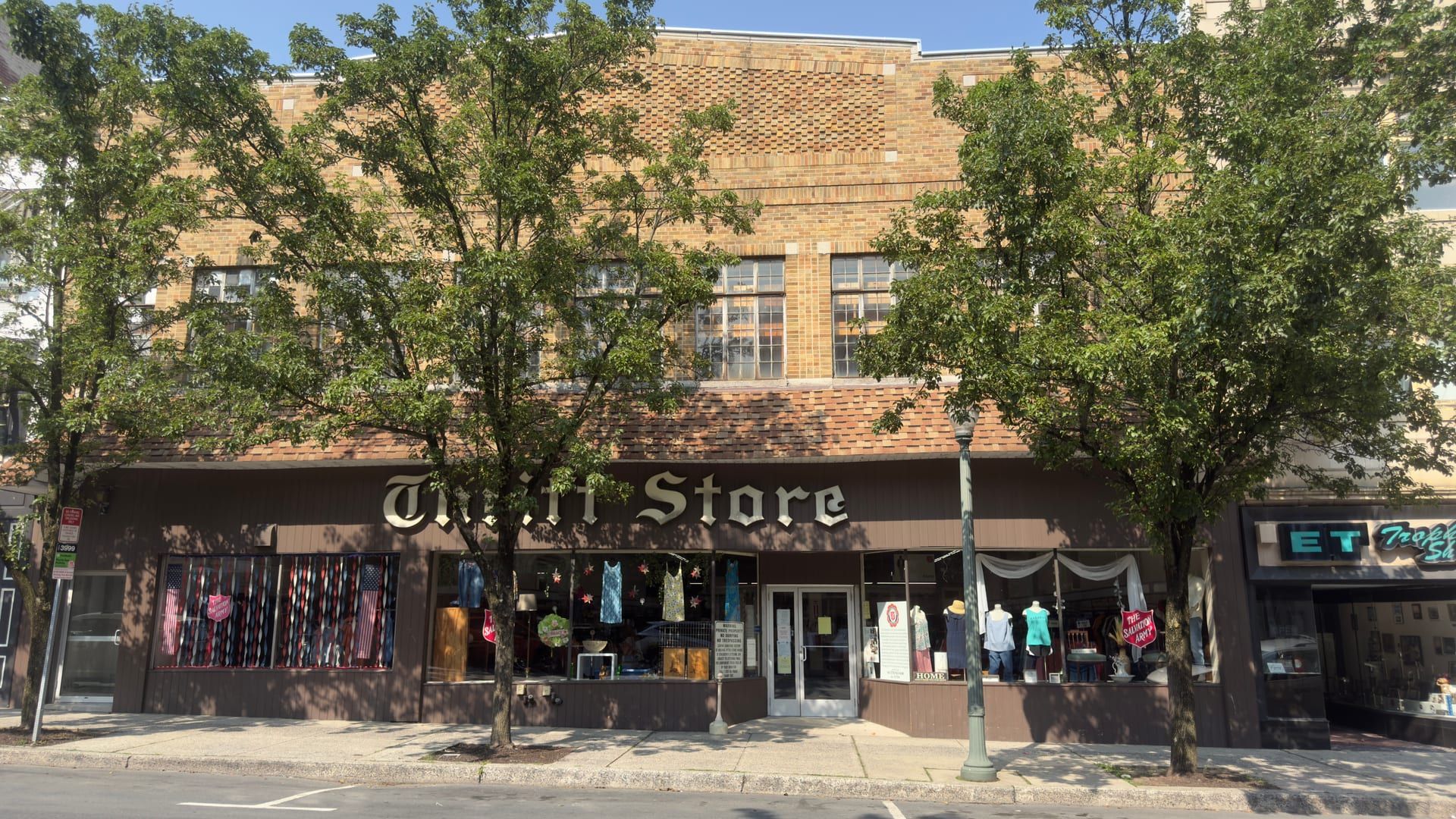
The Salvation Army of Pottsville operates from 400 Sanderson Street (official corps page). As of mid-2026 its corps officers are Captains Derek and Betty Ellen Barrett, who took command in February 2022 — then lieutenants, succeeding Lieutenants Holly and Gavin Yeatts (Times News, Feb. 4, 2022). The corps’ own pages list Sunday worship with Sunday school, a Wednesday Bible study, men’s and women’s ministries, and hunger-relief and holiday-assistance programs. The Army’s thrift store occupies the 200 block of North Centre Street (Pottsville locations). It is the same street where the corps first opened in 1886.
Related
People: Myer Strouse (1825–1878), Dr. Mary Alice Swayze (1845–1925)
Towns: Pottsville, Shenandoah, Tamaqua
Sources
- Paywalled newspaper reporting — 'The Salvation Army Takes Possession of Plymouth' (Wilkes-Barre reprint), Pottsville Republican, Jan. 13, 1885, p. 1 (Newspapers.com) · 1885-01-13
License: publisher - Paywalled newspaper reporting — Shenandoah Opera House rental brevity, Pottsville Republican, Nov. 7, 1885, p. 8 (Newspapers.com) · 1885-11-07
License: publisher - Paywalled newspaper reporting — 'expected to arrive' brevity, Pottsville Republican, Dec. 12, 1885, p. 1 (Newspapers.com) · 1885-12-12
License: publisher - Paywalled newspaper reporting — Salvation Army opening preview and 'Jail Jottings,' Pottsville Republican, Jan. 30, 1886, p. 1 (Newspapers.com) · 1886-01-30
License: publisher - Paywalled newspaper reporting — 'The Salvation Army' (opening report), Pottsville Republican, Feb. 1, 1886, p. 4 (Newspapers.com) · 1886-02-01
License: publisher - Paywalled newspaper reporting — barracks banquet brevity, Pottsville Republican, May 20, 1886, p. 4 (Newspapers.com) · 1886-05-20
License: publisher - Paywalled newspaper reporting — 'Salvation.' (Captain Penny at the barracks), Pottsville Republican, June 14, 1886, p. 4 (Newspapers.com) · 1886-06-14
License: publisher - Paywalled newspaper reporting — Zoar Baptist Church lease brevity, Pottsville Republican, June 19, 1886, p. 4 (Newspapers.com) · 1886-06-19
License: publisher - Paywalled newspaper reporting — weekly church directory (Salvation Army Hall, Minersville St.; Capt. and Mrs. Wood), Pottsville Republican, Jan. 5, 1918, p. 6 (Newspapers.com) · 1918-01-05
License: publisher - Paywalled newspaper reporting — weekly church directory (Capt. and Mrs. Rivell), Pottsville Republican, Mar. 12, 1921, p. 4 (Newspapers.com) · 1921-03-12
License: publisher - Boyd's Directory of Pottsville, 1919–1921 — 'Salvation Army, 328 W Minersville' (Internet Archive) · 1919
License: public-domain - Boyd's Directory of Pottsville, 1922–1924 — 'Salvation Army, 224 N 2d' (Internet Archive) · 1922
License: public-domain - Boyd's Directory of Pottsville, 1926–1928 — 'Phillips Charles H., (Lottie M.), adjutant Salvation Army, 224 N 2d, h do' (Internet Archive) · 1926
License: public-domain - The Salvation Army of Pottsville — official corps pages (address, officers, programs)
License: reference - The Salvation Army — Pottsville, Pennsylvania locations page (corps and thrift store addresses)
License: reference - Times News (Lehighton) — 'Salvation Army Pottsville Corps welcomes new officers,' Feb. 4, 2022 · 2022-02-04
License: publisher - The Salvation Army Empire State Division — 'A Brief History of The Salvation Army'
License: reference - The Salvation Army USA — 'Trailblazer of Faith: Eliza Shirley'
License: reference - The Salvation Army Tamaqua Corps — West Broad Street Corps page
License: reference - The Salvation Army of Sunbury — Shamokin service page
License: reference - Wikidata — The Salvation Army (Q188307); founding date and founders
License: CC0
Frequently asked
- When did the Salvation Army come to Schuylkill County?
- The first documented post was at Shenandoah, which rented Robbins' Opera House for a month-long opening campaign beginning December 1, 1885. The Pottsville corps opened about two months later, on Sunday, January 31, 1886; nearly one thousand people filled its opening-night meeting.
- Who opened the Salvation Army's Pottsville corps?
- The Pottsville corps opened on January 31, 1886, under two women officers — Captain Brown and Lieutenant Osgood, lately stationed at Pittsfield, Massachusetts — with Captain Mirandon in the opening party and a delegation from the older Shenandoah post reinforcing the first services.
- Where has the Pottsville corps been located?
- It opened at Mountain City Hall on Centre Street in January 1886 and moved that June to the leased Zoar Baptist Church on Minersville Street — the street where the corps is documented again in 1918–1921, listed at 328 West Minersville Street. By the 1922–24 city directory it had moved to 224 North Second Street, where the 1926–28 edition still lists its adjutant in residence; today it operates from 400 Sanderson Street.
- Is the Salvation Army still active in Schuylkill County?
- Yes. The Pottsville corps holds Sunday worship and weekday programs and runs hunger-relief and holiday assistance, and the Army operates a thrift store on North Centre Street. Tamaqua also maintains an active corps, at 105 West Broad Street.