Mahantongo Valley folk art — painted furniture and fraktur
Listen to this article · 20 min
0:0019:46
Read by a synthetic voice, generated from the text of this article. Hear the whole archive on the Listen page.
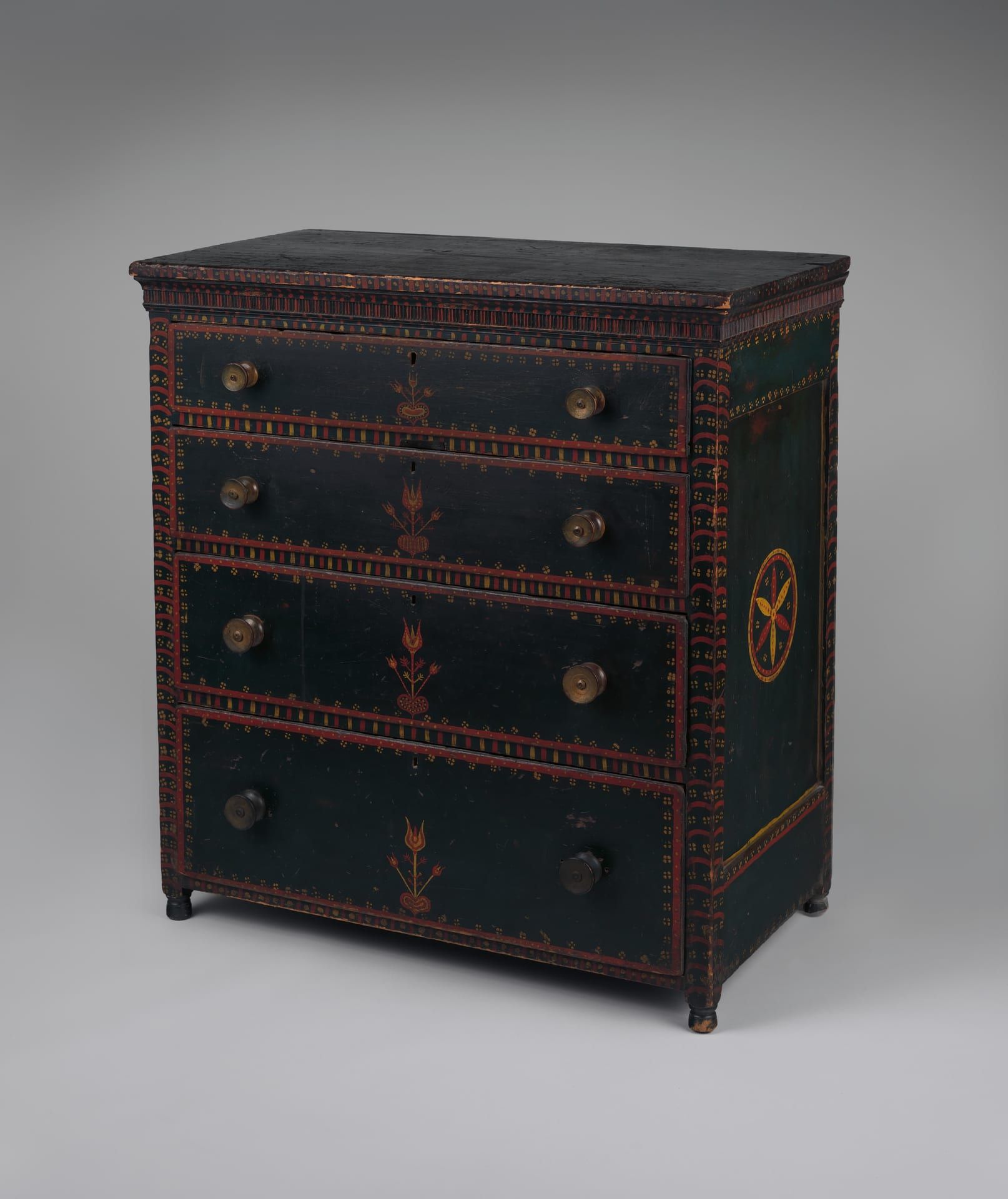
Between 1798 and 1841, the farm families of the Mahantongo Valley — a pocket of Pennsylvania German country about seventeen miles long and four wide, astride the line where Schuylkill County meets Northumberland — painted their furniture the way they lettered their baptismal certificates. Chests, chests of drawers, desks, and cupboards left the valley’s shops covered in the vocabulary of fraktur — angels, paired birds, leaping deer, tulips, hearts, praying children, stamped rosettes — on grounds of deep green, blue, and reddish brown. The valley was one culture across a county line, and the record splits its honors across that line too: the classic painted group’s best-documented workshop families worked on the Northumberland side, while the Schuylkill side — the county’s historic Upper and Lower Mahantongo Townships — produced fraktur artists, a documented chest-maker, and furniture inscribed with the county’s own name. Today the results sit in Winterthur, the Philadelphia Museum of Art, the Metropolitan Museum of Art, the Barnes Foundation, and the Smithsonian, and set records whenever they surface. This is the story of how a valley the coal county barely noticed painted its way into America’s museums.
The valley
The Mahantongo is not coal country. It is a ridge-walled farm valley in Schuylkill County’s northwestern corner and the adjoining corner of Northumberland, drained westward to the Susquehanna by Mahantango Creek — the stream rises in northern Schuylkill County and gives the valley its name — with Schwaben Creek gathering the Northumberland side. The name is Lenape; the standard rendering, which our survey of the county’s Lenape place-names records from George P. Donehoo’s 1928 reference, is “where we had plenty of meat to eat” — good hunting grounds. The creek’s name is often spelled “Mahantango,” the valley and its culture have generally kept “Mahantongo,” and Pottsville’s grandest street carries the same word east into the coal region.
The Pennsylvania Germans who settled it were part of the same migration that filled the county’s southern valleys — Lutheran and German Reformed families arriving from the late 1700s, Alexander Klinger and his four sons settling what became Klingerstown in 1780. Both Upper and Lower Mahantongo Townships are older than Schuylkill County itself: the 1811 act erecting the county out of Berks names them among its founding townships. Lower Mahantongo was later carved away entirely — Porter Township was taken from it in 1840, part of Frailey in 1847, and Hegins Township “originally taken wholly” from it — and by 1881 the county history counted it among the original townships whose names, as Munsell put it, “do not now exist.” Eldred Township was cut from Upper Mahantongo in 1848. The valley’s remoteness from the county’s coal economy was a running joke in Pottsville: when a new county was proposed in 1841, the Miners’ Journal wrote, “The new county will embrace the two Mahantongos. We go in for the new county. The Mahantongos have always been an expense to Schuylkill, and the sooner they are cut off the better.” The 1875 Beers atlas plate of Upper Mahantongo Township shows what the editors dismissed: a dense lattice of German family farms.
Henry M. Reed — who curated the 1987 Bucknell University exhibition that transformed study of the valley — described it as “much like a diminutive ‘Brigadoon’”: no major highway, its character little changed in a century, “a place that time forgot.” But the isolation can be overstated. As Lisa Minardi observes of the objects themselves, “Although it is often assumed that the valley was isolated by its rugged terrain, the furniture and fraktur made and owned by its inhabitants suggest otherwise” — the printed certificates its decorators copied came from shops in Allentown, Harrisburg, Reading, and Lebanon, some more than eighty miles away.
Furniture painted like fraktur
Scholars divide the valley’s furniture into two documented groups. The first is a set of seventeen known dower chests dated from 1798 to 1828, each bearing its owner’s name — chests “customarily given to young women and men in their eighteenth year,” lightly grain-painted in curved lines and dots on reddish-brown grounds, the names set in double-lined cartouches with small flower pots. The second is the group the auction rooms know: about sixty-three vividly decorated pieces, the dated ones running from 1827 to 1841 — chests, chests of drawers, slant-top desks, freestanding and hanging cupboards, painted with “colorful birds, flowers, angels, praying children, and geometric devices” on grounds of bright green and blue with contrasting stamped rosettes. Chrome yellow, the pigment that carries so much of the effect, only became commercially available around 1818.
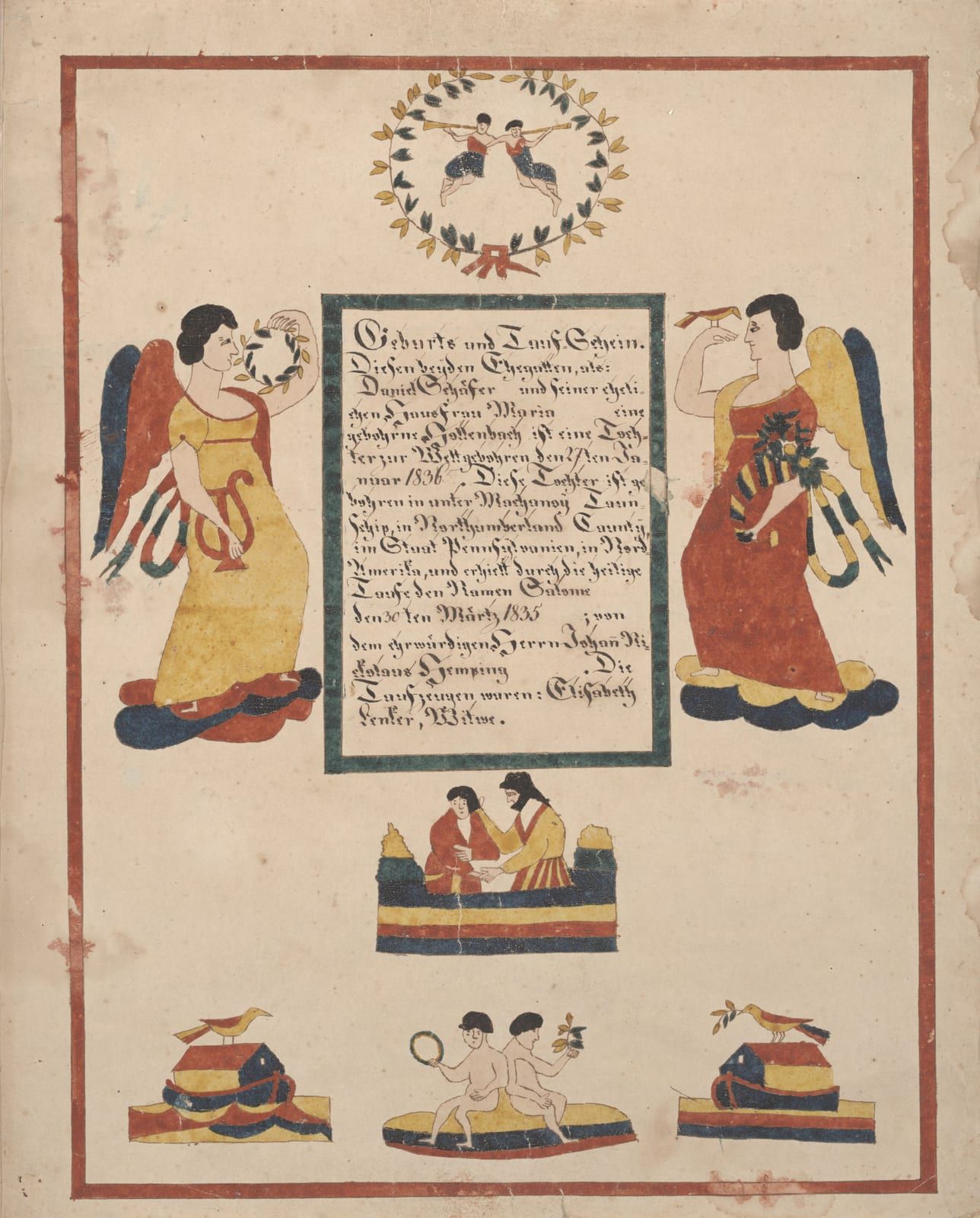
What makes the group extraordinary is where the decoration came from. In Minardi’s account, fraktur served as a design source for painted furniture “particularly in the Mahantongo Valley of Northumberland and Schuylkill Counties, where furniture was routinely decorated with motifs copied directly from printed fraktur.” The angels on drawer fronts and cupboard doors were lifted from birth-and-baptismal certificates printed by Gustav S. Peters and by Henrich Ebner of Allentown; the leaping deer from certificates printed by the Baumanns of Ephrata; and the praying children on several chests from certificates printed by Jacob and Joseph Schnee of Lebanon — an image whose original source, remarkably, was Sir Joshua Reynolds’s painting The Infant Samuel, exhibited at London’s Royal Academy in 1776. A devotional image could travel from a London exhibition wall through a Pennsylvania German print shop onto the drawer front of a farm family’s chest — and in the Mahantongo Valley, it did.
The furniture, in other words, is fraktur’s second life in wood. The certificates came first: they hung in the same houses, recorded the same births, and were lettered by hands the valley knew. In 1944 the collector Earl F. Robacker put the result at the top of the field: “If one could have a single wish granted, and if that wish were for the most desirable Pennsylvania Dutch chest, the Mahantongo Valley painted bureau would be the thing to ask for.”
The Otto family: from the Tulpehocken to the valley
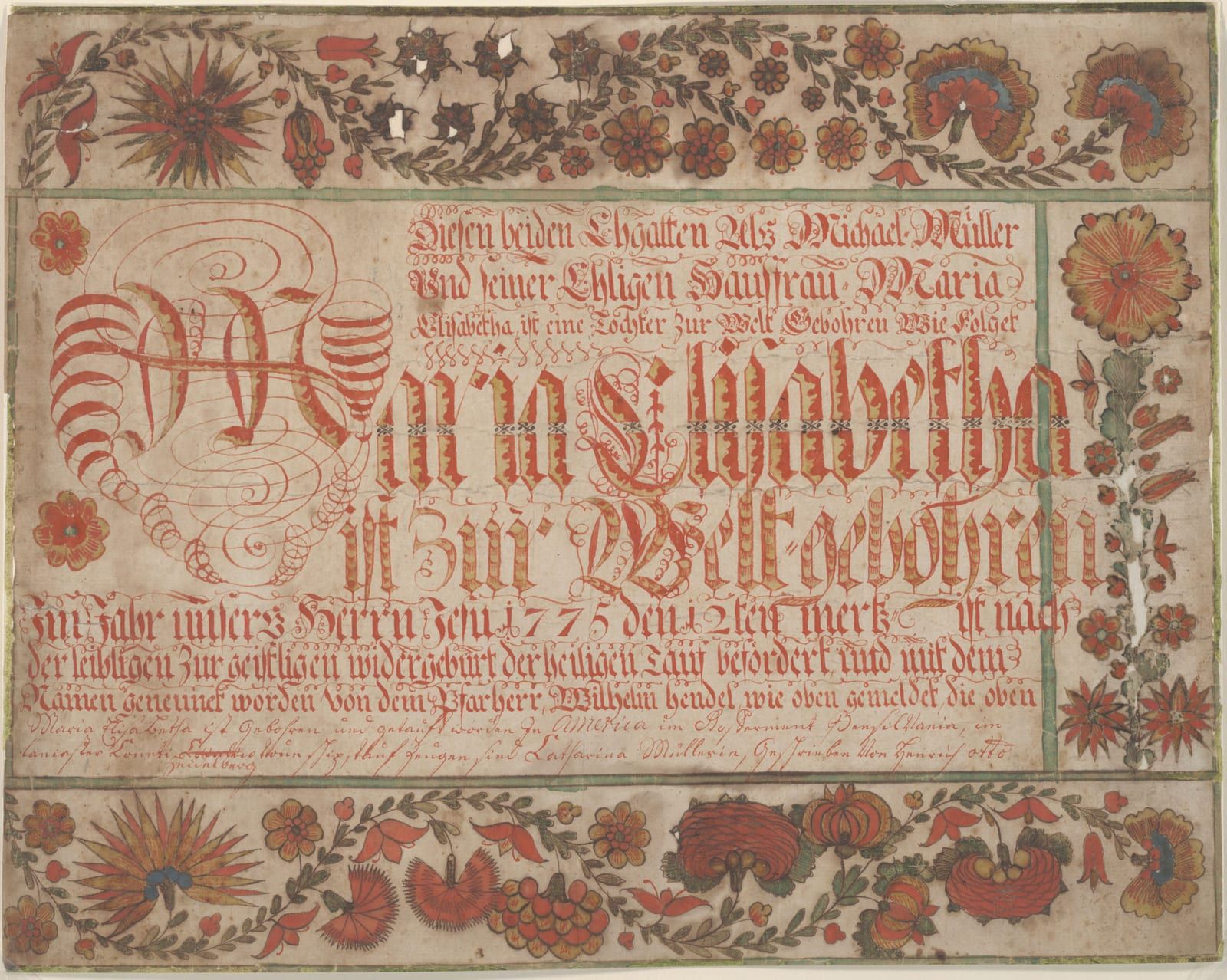
No family ties the valley’s paper and wood together like the Ottos. The family patriarch, Johann Henrich Otto — born February 5, 1733, in Schwartzerden, Germany — arrived in Philadelphia aboard the Edinburgh on October 2, 1753, at age twenty; two years later he advertised that he was prepared to do weaving, giving his home as the Tulpehocken. Like many fraktur artists he was a schoolmaster, and he worked across northern Lancaster County and the Tulpehocken Valley of Berks and Lebanon Counties, his certificates dense with tulips, pomegranates, parrots, and crowns — with elaborate penmanship and a tapering spiral motif following his signature. The fraktur scholar Frederick S. Weiser judged that Otto “was destined to influence all Fraktur more than any other,” his birds and flowers the standard that others copied. By 1790 a Henrich Otto appears in the census of Northumberland County — thought to have been teaching school at St. Peter’s church “on a bluff overlooking the juncture of the Mahoney and Schwaben Creeks,” at the western edge of the valley culture whose furniture would later carry his family’s designs. He is thought to have died before 1800.
Four of his sons — Conrad, Jacob, William, and Daniel Otto — were fraktur artists in their own right, on the evidence of signed work, and several also worked wood: it is precisely this family record, Minardi argues, that supports the theory that some fraktur artists painted furniture too. Two of the four worked in and beside the valley.
William Otto (1761–1841) is the Schuylkill anchor. Baptized near Stouchsburg in Berks County, he moved by the early 1800s “to an area of what is now northern Schuylkill County known as the Hegins Valley” — the old Lower Mahantongo Township. He was a farmer, carpenter, and cabinetmaker who made furniture and coffins, and family tradition preserved a fine piece of valley Gothic: William “used to say that when he heard the sound of the saw and the plane in a dream, that there would be a death in the community within two weeks.” He made and decorated a blanket chest in 1812 for his niece Anamarie Geres — now in the Smithsonian Institution — another in 1814 for John Kesler, and in 1824 a chest of drawers for his son Jonathan, grain-painted and lettered on its drawer panels “Jonathan Otto 1824,” “Mahantongo Taunschip,” “Schuykill Caunty den 17 tag April 1824.” Few pieces of Pennsylvania German furniture anywhere carry their place and date so plainly. Reed judged the Jonathan Otto chest “possibly … the forerunner of” the whole body of the valley’s decorated bureaus; Minardi notes its style differs from the classic green-ground group, yet a fraktur made for William’s grandson carries stamped rosettes identical to those on the furniture — “suggesting,” she writes, “that there may be some connection after all.” When William Otto died intestate in May 1841, leaving a widow and thirteen children, the inventory of his estate read like the valley itself: rye, wheat, corn, oats, and flax in the ground; a clock, desk, and kitchen dresser; a weaver’s loom; a carpenter’s bench and tools.
Daniel Otto (ca. 1770–ca. 1820) — for years known only as the anonymous “Flat Tulip” artist, until his handwriting in a church register unmasked him — was the most prolific of the sons, drawing dozens of certificates in red, green, and yellow, with flowers, birds, lions, crowns, and the occasional mermaid or alligator. The 1800 census places him on the Northumberland side of the valley; around 1818 he moved on to Centre County. His path matters to the furniture story: a well-known painted chest with Adam and Eve on its façade, long attributed to the Mahantongo Valley for its stamped rosettes, shows Centre County traits too — and Minardi suggests it “may not be entirely coincidental” that a fraktur artist moved from the one region to the other.
Who painted the green chests?
Attribution in the Mahantongo Valley is a discipline of hedged verbs, and the honest account keeps them. Reed’s summary stands: scholars have “tentatively” identified John Adam Rebuck Jr. (1763–1835) — with his brother Michael and sons Conrad and Peter as other candidates — as maker of the early chests, and “with reasonable certainty” name Johannes Mayer and the Braun family as principal makers of the later decorated furniture.
The evidence is wonderfully concrete. The only known signed and dated piece of the decorated furniture surfaced when the owner of a chest of drawers emblazoned “Jenner, 1829” removed its drawers and found, on a rail normally hidden, two faint signatures of John Mayer. Distinctive moldings and trim — matched even to woodwork in his own house, which still stands in Upper Mahanoy Township “near the Northumberland–Schuylkill Counties line” — identify the work of Johannes Mayer (1794–1883), carpenter, joiner, and turner; woodworking tools stamped “J. Mayer” have been found. Michael Braun (1772–1851) and his son John (Johannes) Braun (b. 1808), cabinetmakers of Upper Mahanoy Township, are the probable makers of the pieces made for Braun children — Rebecca’s 1828 cupboard, now at the Barnes Foundation; the 1830 kitchen cupboard lettered “Concortia,” in the Philadelphia Museum of Art’s Titus C. Geesey Collection; chests for Andreas and Peter Braun.
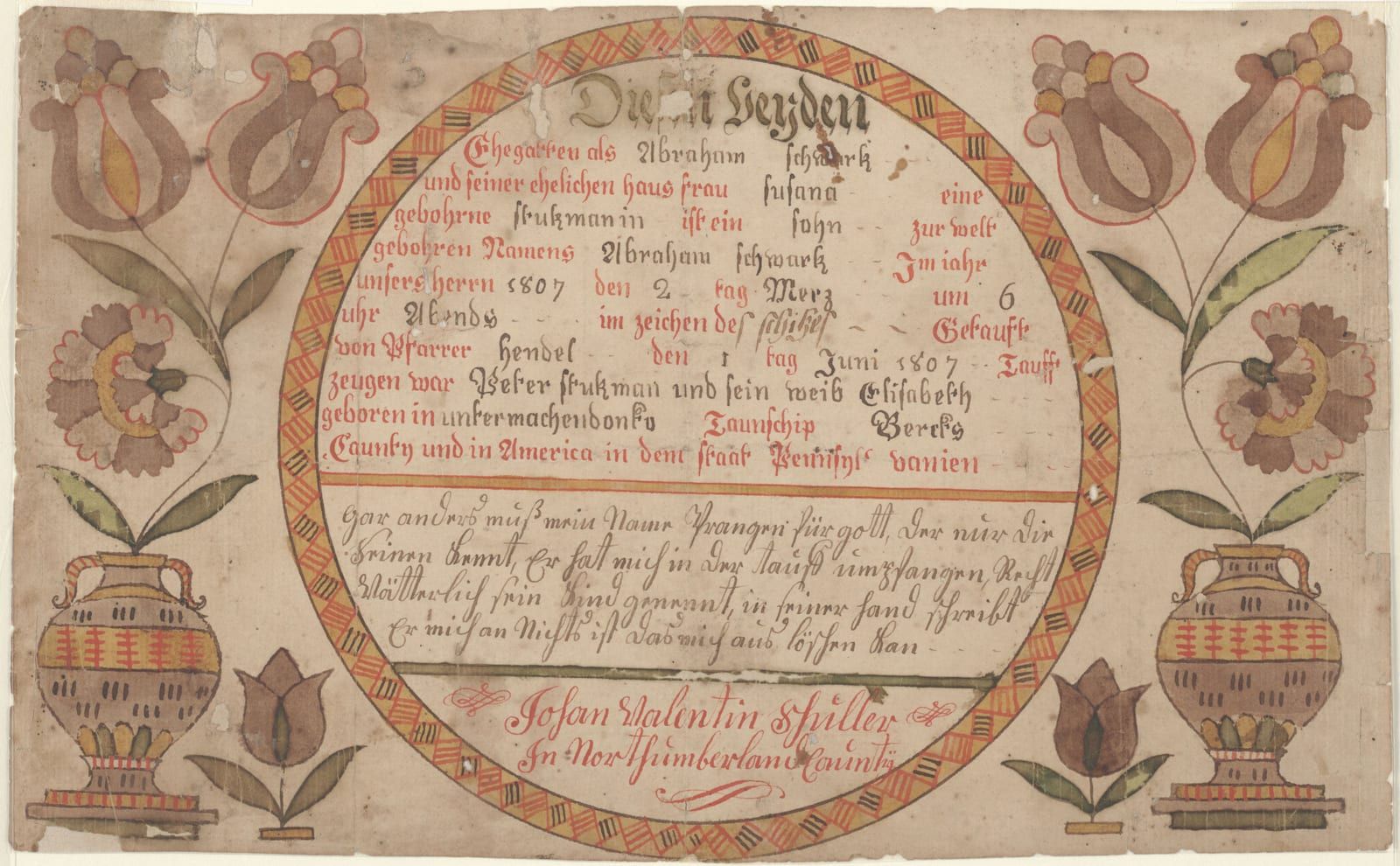
The decorator is another matter — and the scholarship moved under the market’s feet. Reed attributed the decoration of the Braun-family pieces to the fraktur artist Johann Valentin Schuller Jr., on the strength of a Susanna Braun Taufschein signed by Schuller and embellished with angels nearly identical to the cupboards’. Minardi’s 2011 study broke the argument’s dating: the certificate’s printer began work in 1811, not 1827 as Reed believed; the printing dates from about 1813; and Schuller — who grew up in Pine Grove Township, in what is now Schuylkill County, and moved to the Northumberland side of the valley around 1800 — “is thought to have moved to Ohio circa 1815 and died soon after,” with no fraktur known from his hand for children born after 1815. If so, he could not have painted furniture dated 1828 to 1834. Minardi’s conclusion preserves the deeper truth while unseating the name: Schuller’s fraktur “must have served as the design source for another decorator.” Auction catalogs still print the older attribution; the decorator of the valley’s most celebrated pieces remains, strictly speaking, unidentified.
And then there is the desk. At the Winterthur Museum sits a slant-top desk bearing the name Jacob Masser and the date 1834 — in Reed’s words “probably the best known piece of Mahantongo Valley furniture.” Masser (1812–1895), a farmer near Line Mountain on the Northumberland side, “was long considered to be the maker of most of the furniture, but research now tends to refute this”: he was twenty-two in 1834, and the chests of drawers dated earlier can hardly be his. A 1911 county genealogy muddies the water — it remembers him as a carpenter and undertaker who “made considerable furniture of all kinds” — and a chest of drawers dated 1830, also at Winterthur, carries the penciled trace “_____es Masser 84,” which sleuths read as a later owner’s mark from 1884. The plainest reading of the famous desk is the one Reed’s own words already carry — it is “a desk owned by Jacob Masser,” bearing the owner’s name — while its maker goes unnamed. Beyond the named figures, the tax lists show the valley full of farmer-carpenters — one piece is signed “Daniel Kieffer 1836” — and much of its plainer furniture was simply painted and put to work.
The preacher who carved the valley’s motifs in stone
The valley’s most vivid documented artist worked mostly in other media. The Reverend Isaac Faust Stiehly (1800–1869) — born in Heidelberg Township, Berks County; pastor of the Reformed Church in Schuylkill and Northumberland Counties from 1824 to 1869 — lived along the Mahantongo Creek near Klingerstown, in Schuylkill County’s Upper Mahantongo Township. Remembered as “a diamond in the rough, one of the people,” he was also a farmer and millwright who built a grist mill on the creek with his sons, and he walked as much as thirty miles on Sundays to serve congregations that sometimes numbered eight at a time. His parishioners kept Taufscheine lettered in his “distinctive, nearly sculptural script” — and he carved their gravestones. In the churchyard of Salem United Church of Christ at Rough and Ready — the Schuylkill County village where he was the first pastor, and where he is buried — and in cemeteries from Pitman to Hegins to Leck Kill, researchers armed with a journal listing thirty-five of his tombstones have positively identified a dozen and attributed many more: arched stones bearing rosettes, hearts, tulips, and the round compass devices “often seen on the recessed side panels of Mahantongo Valley chests.” Whether Stiehly’s hand ever touched the furniture is exactly the kind of question the valley refuses to answer cheaply. A scherenschnitte — a scissor-cutting, with incised feathering on an eagle’s wings — discovered in 1986 bears his name, the date April 4, 1844, and a dedication to his friend John Mayer; it is not alone — a Stiehly cutwork for Mayer dated 1841, from the Booth collection, was exhibited at Historic Trappe in 2024. Reed reads the friendship as a hint of collaboration “yet undefined.” The families did merge in the end: Stiehly’s son Jared married Mayer’s daughter Elizabeth in 1857 and, by family tradition, apprenticed as a turner under his father-in-law.
A quieter Schuylkill figure completes the circle. Johannes Haas (1814–1856) of Upper Mahantongo Township was a fraktur artist and furniture maker — Stiehly married him to Brigitta DeLong in 1840, lettered his wedding certificate, and carved his gravestone — though no furniture from his shop has been positively identified beyond a spinning wheel.
Rediscovery, and the record books
The valley kept its furniture for a century. Then, in the December 1926 issue of The Magazine Antiques, the Bethlehem dealer A. H. Rice advertised eleven pieces for seventy-three hundred dollars, boasting he had collected them “in Remote Sections of Pennsylvania” — the famous Masser desk and the Peter Braun chest among them. Earlier that year Rice had shown three of the pieces at Philadelphia’s Sesqui-Centennial Exposition. Unable to sell the collection whole, he dispersed it piece by piece — and the dispersal seeded the great collections. George Horace Lorimer’s purchases went ultimately to the Philadelphia Museum of Art; the Metropolitan Museum of Art, the Abby Aldrich Rockefeller Folk Art Center, and the Museum of American Folk Art acquired others. The Met’s own valley piece — a four-drawer chest on a deep green ground, its drawers centered with red-and-yellow tulip sprigs rising from hearts, catalogued as made in Schuylkill County, 1835–40 — came as a gift of Mrs. Robert W. de Forest in 1933; a study for the Pennsylvania German Society, the museum notes, determined its decoration to be unique.
Scholarship followed collecting: Frederick S. Weiser and Mary Hammond-Sullivan’s studies in the 1970s, then Reed’s 1987 “Decorated Furniture of the Mahantongo Valley” exhibition at Bucknell University’s Center Gallery, “the turning point in the scholarly interest.” The market kept score. During the exhibition’s run a chest of drawers brought a record $72,500 at Butterfield & Butterfield in November 1987. In January 1989 a chest of drawers from the Tippett estate tied the world auction record for painted American antique furniture at $203,500 at Weschler’s in Washington. A Deyerle-collection chest of drawers reset the valley record at $211,500 in May 1995; at Sotheby’s on May 23, 2002, a blanket chest brought $295,500 and a four-drawer chest $273,500; and on January 25, 2013, a chest of drawers dated 1829 — the sale’s catalog cover lot, deaccessioned by the Philadelphia Museum of Art — brought $218,500. The market has not gone quiet since: a valley-attributed chest of drawers brought $147,600 at Brunk Auctions in May 2023. Reed’s explanation of the premium is the scholarly one: historians, collectors, and dealers regard this furniture as “the largest body of documented antique American furniture” — “documented” meaning, in his words, that the pieces were made within a small, tight-knit area “in which most of the makers, some of the decorators, and many of the original owners are known.”
The corpus is still growing. At Historic Trappe’s Center for Pennsylvania German Studies — where pieces of the Dietrich American Foundation’s valley collection are on long-term loan — a 2024 exhibition presented a never-published chest from the Knorr family, “a standout” with unusually vibrant color and female figures painted on its sides.
The valley today
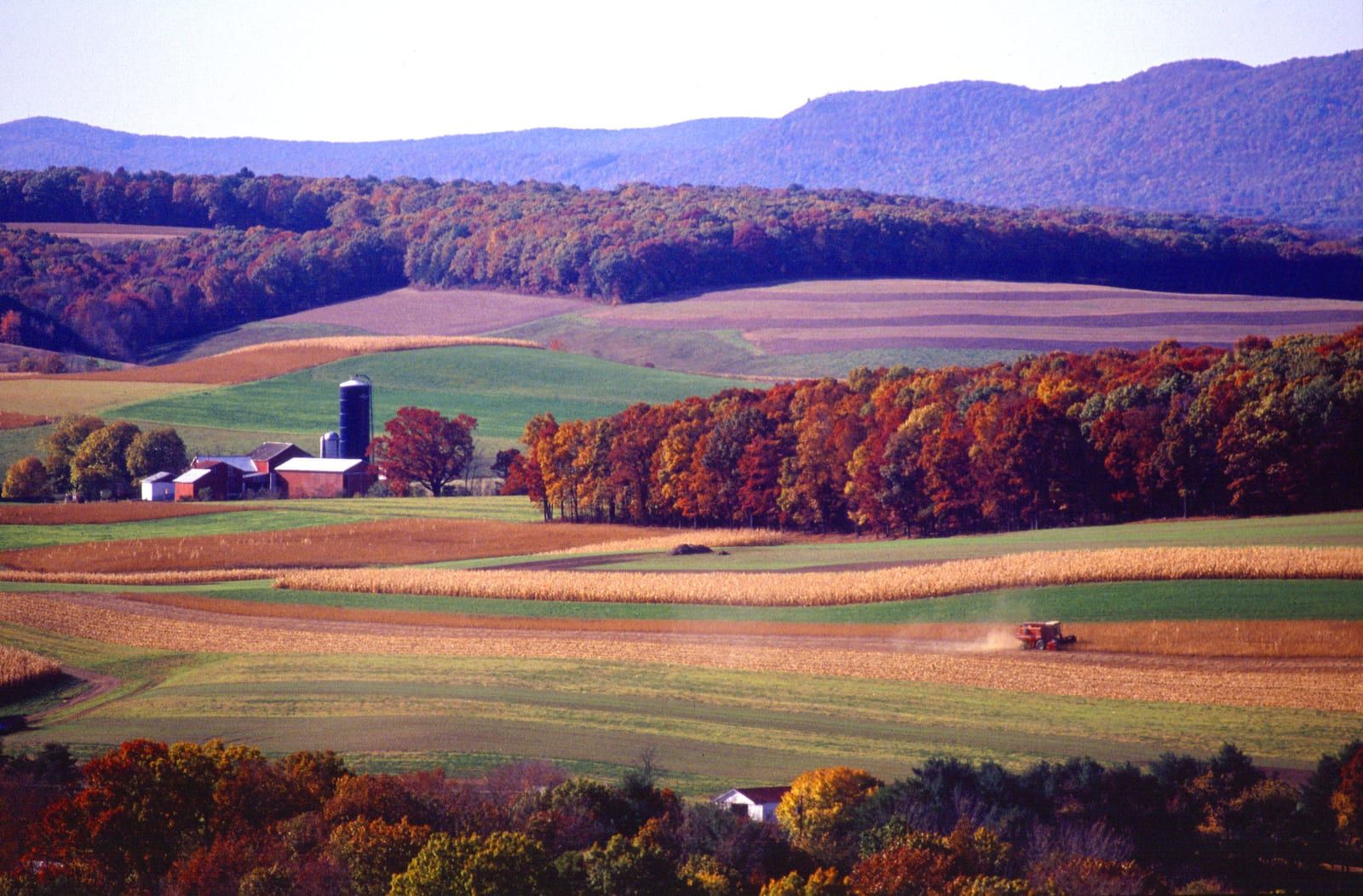
The Mahantongo is still farm country — contour strips of corn and hay between wooded ridges, much as the 1875 atlas drew it. Its Schuylkill townships send their children to the Tri-Valley School District, whose very name records the Hegins and Mahantongo valleys; a family winery grows grapes near Klingerstown in Upper Mahantongo Township; and the Pennsylvania German world that painted the chests survives in the surnames on the mailboxes and in the churchyards where Stiehly’s carved stones still stand. The furniture itself has mostly left — for Winterthur and Philadelphia, New York and Williamsburg — but the record it made stays put: in one green valley the coal county wrote off as “an expense,” farm families painted furniture that America’s great museums now hold among their treasures of folk art.
Sources
- Henry M. Reed, "Finding the Fabulous Furniture of the Mahantongo Valley," Pennsylvania Heritage Magazine, Fall 1995 — the curator of the 1987 Bucknell exhibition on the valley's furniture · 1995
License: reference - Lisa Minardi, "From Millbach to Mahantongo: Fraktur and Furniture of the Pennsylvania Germans," in American Furniture 2011, ed. Luke Beckerdite (Chipstone Foundation) · 2011
License: reference - Lisa Minardi, "Dietrich American Foundation: Furniture and Fraktur of the Mahantongo Valley" (Incollect) · 2020-11-01
License: reference - Madelia Hickman Ring, "Historic Trappe — Valley Culture: Constructing Identity Along the Great Wagon Road," Antiques and The Arts Weekly, October 21, 2024 · 2024-10-21
License: publisher - "Sotheby's Americana," Maine Antique Digest, April 2013 — the January 25–26, 2013 New York sale, with the Mahantongo cover lot and the May 23, 2002 comparisons · 2013
License: publisher - Sotheby's, Important Americana, lot 407 — paint-decorated chest of drawers, Mahantongo Valley, dated 1829; provenance Philadelphia Museum of Art (1994-20-44) · 2013
License: reference - Brunk Auctions, "Collection of Jean and Jim Barrow" post-sale press release, May 20, 2023 — lot 44, the Mahantango-attributed polychromed chest of drawers · 2023-05-20
License: reference - Munsell, History of Schuylkill County (1881) — the 1811 county-erection act naming Upper and Lower Mahantongo Townships, the township chapters, and the Miners' Journal of January 30, 1841 · 1881
License: public-domain - The Metropolitan Museum of Art — chest of drawers, 1835–40, made in Schuylkill County, Pennsylvania (34.100.10, gift of Mrs. Robert W. de Forest, 1933); Open Access
License: reference - Free Library of Philadelphia, Rare Book Department — Taufschein for Abraham Schwartz, born 1807 in Lower Mahantango Township, "Berks [now Schuylkill]" County, lettered by Johann Valentin Schuller (frk01073)
License: reference - Free Library of Philadelphia, Rare Book Department — Taufschein for Salome Schäfer by the "Mahantongo Valley Artist" (frk00029)
License: reference - Free Library of Philadelphia, Rare Book Department — Taufschein for Maria Elisabetha Müller by Henrich Otto, ca. 1775 (frk00053)
License: reference - Wikipedia — Mahantongo (the creek–mountain–valley culture area and the Lenape etymology)
License: CC-BY-SA-4.0 - Wikipedia — Mahantango Creek (course, counties, and tributaries)
License: CC-BY-SA-4.0
Frequently asked
- What is Mahantongo Valley folk art?
- The painted furniture and fraktur of the Pennsylvania German farm families of the Mahantongo Valley, which straddles the Schuylkill–Northumberland county line. The dated furniture runs from 1798 to 1841 in two groups: seventeen known early dower chests with restrained grain-painting, and a later body of about sixty-three vividly painted chests, chests of drawers, desks, and cupboards whose angels, birds, deer, praying children, and stamped rosettes were copied from fraktur — the same decorated certificates the valley's families hung at home.
- Is the tradition Schuylkill County's or Northumberland County's?
- Both, honestly. The valley is one culture across a county line. The best-documented workshop families of the classic painted group — the Rebucks, Mayers, and Brauns — worked on the Northumberland side, which was also home to Jacob Masser, the farmer whose name the famous Winterthur desk bears as its owner. The Schuylkill side, the historic Upper and Lower Mahantongo Townships, supplies the fraktur-artist thread: William Otto, the preacher-carver Isaac Faust Stiehly, and Johannes Haas — plus furniture such as the 1824 chest of drawers inscribed "Mahantongo Taunschip, Schuykill Caunty," and the chest of drawers the Metropolitan Museum of Art catalogs as made in Schuylkill County.
- Who actually made and painted the furniture?
- Attribution is per-piece and, for the decoration, unresolved. Only one signed and dated piece of the decorated furniture is known — a chest of drawers that carries the date 1829 and two hidden signatures of John Mayer. Scholars tentatively credit the early chests to John Adam Rebuck Jr., and with more confidence name Johannes Mayer and the Braun family as principal makers of the later group. Henry Reed proposed the fraktur artist Johann Valentin Schuller Jr. as the decorator; Lisa Minardi's 2011 study showed Schuller likely left the region around 1815 and died soon after, so his fraktur "must have served as the design source for another decorator" — whose name is still unknown.
- What is the famous Masser desk?
- A slant-top desk at the Winterthur Museum bearing Jacob Masser's name and the date 1834 — in Henry Reed's words, "probably the best known piece of Mahantongo Valley furniture." Masser was long considered the maker of most of the valley's furniture, but research now tends to refute that: he was only twenty-two in 1834, and the earlier chests of drawers cannot plausibly be his. Reed himself describes it as "a desk owned by Jacob Masser," bearing his name — the maker goes unnamed.
- Why does this furniture bring such high prices?
- Rarity plus documentation. Reed wrote that historians, collectors, and dealers consider the valley's furniture "the largest body of documented antique American furniture" — documented in the sense that the pieces were made within one small, tight-knit area "in which most of the makers, some of the decorators, and many of the original owners are known." At auction, a chest of drawers tied the world record for painted American antique furniture at $203,500 in 1989; a blanket chest brought $295,500 at Sotheby's in 2002; the chest of drawers deaccessioned by the Philadelphia Museum of Art brought $218,500 in January 2013; and a valley-attributed chest of drawers brought $147,600 at Brunk Auctions in May 2023.
- Where can I see Mahantongo Valley pieces?
- In some of America's premier collections: the Winterthur Museum (the Masser desk), the Philadelphia Museum of Art (including the 1830 "Concortia" kitchen cupboard in the Titus C. Geesey Collection), the Metropolitan Museum of Art, the Barnes Foundation (the 1828 Rebecca Braun cupboard), the Smithsonian Institution (William Otto's 1812 chest), the Abby Aldrich Rockefeller Folk Art Museum at Colonial Williamsburg, and the American Folk Art Museum. Pieces of the Dietrich American Foundation are on long-term loan at Historic Trappe's Center for Pennsylvania German Studies.