Industrial Buildings · Built 1887–1888
The Tilt Silk Mill
The Tilt Silk Mill at 303 North Twelfth Street, Pottsville — a four-storey brick silk factory of 1887–88, built for a Paterson, New Jersey company and financed by public subscription, worked until 1979 and now a self-storage complex.
Listen to this article · 9 min
0:009:11
Read by a synthetic voice, generated from the text of this article. Hear the whole archive on the Listen page.
The four-storey brick Tilt Silk Mill stands at 303 North Twelfth Street in Pottsville, at the corner of Twelfth Street and Laurel Boulevard. It was built in 1887–1888 as a silk factory for the Phoenix Silk Manufacturing Company of Paterson, New Jersey — and Pottsville paid for it, the town’s citizens subscribing more than a hundred thousand dollars to raise the building on the ground of Anthracite Park, the borough’s baseball field. Operations began on July 16, 1888. The mill worked here for more than ninety years, employing close to a thousand hands at its peak, until it closed in 1979; since the mid-1980s the building has stood in commercial use, and it now houses an auto-rental and self-storage business at Twelfth and Laurel.
The ball ground on Twelfth Street
Before the mill there was a ball field. Anthracite Park was the home ground of the Pottsville baseball club: the Pottsville Republican has the team playing there as it organized in the spring of 1885, and still crossing bats on the grounds in the summer of 1886. When the town set out to land a silk mill two years later, the park was what it offered up. The location was named plainly enough on May 31, 1887 — “the location of the silk mill will be at Anthracite Park” — and confirmed again three weeks later, when the stakes were driven on the spot.
One thread in the record is not settled. A fortnight before the site was announced, a Palo Alto man named J. W. O’Connor offered $10,000 toward “the proposed silk mill to be erected on the Haywood estate,” and the mass-meeting report of May 17 uses the same name. Whether Anthracite Park stood on the Haywood estate or was a competing parcel that won out, the located record does not say, and this profile does not guess.
”We’ve got the silk mill”
The building was a civic undertaking, financed by the town rather than the company. At a mass meeting on the evening of May 16, 1887 — reported the next day — the Board of Trade laid out the terms: Pottsville would subscribe $85,000 to $100,000 to erect the building; the Phoenix Silk Manufacturing Company would install some $200,000 of machinery, then execute a mortgage on the plant and guarantee the subscribers a return of four to four and a half per cent. The paper was emphatic that the scheme “did not involve the gift or contribution of money” — it was “an investment or loan, which would be amply secured.” Walter S. Sheafer called the meeting to order; Burd S. Patterson, secretary of the Board of Trade, carried much of the work; and the subscription list — some seventy names long, with the Yuengling name at its head — went round the town’s banks and businessmen. A telegram from Philadelphia added George R. Kaercher’s thousand dollars and a $3,000 pledge from a Mr. Corbin.
Pottsville was not alone in the running. The mill was a prize contested across the region — a competition a later account placed among Hazleton, Allentown, and Pottsville — and the local paper fought for it in print. Ashland’s own correspondent conceded on June 4 that “Ashland didn’t secure the promise of the silk mill,” and through the summer the Republican traded blows with the Hazleton press, complaining on July 18 that “the Hazleton papers continue to lie about the institution with all the vehemence at their command.” On May 31 the committee brought back the news, in the words the paper printed from its secretary: “We’ve got the silk mill.”
The contract, the architect, and the ground
The papers were executed on June 2, 1887. They fixed the interest to subscribers at four per cent — the earlier meeting had floated “four to four and a half” — set the lot at 600 by 350 feet adjoining the People’s Railway depot, and required the building to be finished by December 1, 1887. The plans were the work of an architect the Republican named Jacoby, of Allentown; the construction superintendent was Louis Soleliac, lately of the Adelaide Mills at Allentown — one of several threads tying the new mill to the older silk district of the Lehigh Valley. The architect’s given name is a small unsettled point in the record: within three weeks the same paper printed his initials three different ways — L. B., L. F., and L. S. Jacoby — so only the surname and the city can be stated with confidence.
On June 15 the Republican printed a rough sketch of the architect’s foundation plan across its front page, its oil room, boiler house, and stack labelled — an early public look at the building thirteen months before it opened. Six days later, on June 21, the siting was made formal: Burd S. Patterson drove the stakes on his thirtieth birthday, with the architect and the surveyor Andrew Cochran. It was settled that the main building would rise four storeys, and the enterprise took the name it would keep — the Tilt Silk Mill Company, for its president Albert Tilt, with Joseph W. Congdon as vice-president, both arriving from Allentown that evening.
The building work went to a local man. “A Pottsville mechanic secured the first contract on the new silk mill,” the Republican noted on June 24, and on the morning of June 27 “ground for the foundation of the new silk mill was broken by Contractor Auman.” For all the ceremony of the stakes, the work ran well past its schedule: the contract had called for completion by December 1, 1887, and the mill did not begin operations until the following July — roughly seven months later.
The mill opens, 1888
Operations began on Monday, July 16, 1888. The Pottsville Republican of that day announced it under the head “The Silk Mill,” with the note “Operations Commenced To-Day”: “work was commenced in the Tilt silk mill this morning.” It was, the paper wrote, “a cause for pride and congratulation” for the more than three hundred townspeople who had put up better than a hundred thousand dollars to secure it. Some later accounts — including the current owner’s website and a local historical-society post — give July 17; the contemporaneous daily, printed on the day itself, is the earlier record, and the reports that follow it describe the plant only beginning to fill that week.
The mill’s first workers were overwhelmingly young women. “Hundreds of young girls have applied for work at the silk mill,” the paper reported on July 19; the first hands were taken on in classes of thirty and taught by thirty experienced women brought down from Allentown, the force to be “increased gradually.” The plant was still finding its feet: on July 20 Superintendent Harris promised the citizens a day to “view the mysteries of the interior,” though “at present everything about the place is more or less in confusion.”
Beyond the mill walls the effect was immediate. Within days of the opening the Republican was pointing to Allentown’s experience and predicting a wave of new houses, and the Schuylkill Real Estate Title Insurance and Trust Company — later the Schuylkill Trust Company, whose downtown tower of 1925 still stands — was advertising home loans directly to “silk mill operatives and others,” with building lots offered “on Laurel St. near silk mill.” The factory reshaped its corner of the borough as much by the houses it drew as by the silk it made.
The working mill
The mill’s middle decades are the thinnest part of its documented life, but the record does not go silent. A Republican historical column, reprinting a notice of December 1910, has the Tilt Silk Mill preparing to run “full handed” in the coming year for the first time in three — a plain trace of the short time the textile trade had worked in the years just before. And the plant was still at work well into the twentieth century: in October 1933 it placed a paid notice ordering all its employees to take their place in Pottsville’s National Recovery Administration parade, which by itself sets aside the occasional claim that the mill had closed in the 1920s. In that same parade the Onyx Blouse Company marched separately, as a distinct Pottsville industry.
The building’s size is reported inconsistently, and the figures are best left as their sources give them: a 1985 advertisement put the whole at 127,000 square feet, a 2003 newspaper feature at 144,000, and the county assessment records the surviving main block as a four-storey brick building. All three can be true of a complex that grew and shrank across a century, and none is worth averaging into a false precision.
Closing and after
The mill’s long working life at Twelfth and Laurel came to an end in 1979. A 2003 Republican & Herald feature on the county’s manufacturing decline records the closure and remembers the mill going “from employing nearly 1,000 people at peak production to just a handful” in the same building — the peak figure this profile follows, in preference to the larger numbers sometimes given.
The building did not stay empty for long. By August 1985 Ed Keese had opened a car-rental and self-storage business in it — Ed’s U Save Auto Rental and Ed’s U Store — at Twelfth and Laurel; a notice that month recorded 24,000 of the building’s 127,000 square feet then given over to storage. That commercial life has continued: as of 2026 the mill houses Ed’s USA Auto Rentals, with self-storage, at 303 North Twelfth Street — a silk factory that Pottsville built for itself, still standing and still in use nearly a hundred and forty years after the town gave up its ball field to raise it.
Timeline
Each entry is graded by how firmly it is sourced — confirmed against a primary page image or an official record, corroborated by an authoritative secondary source, or probable. Weaker leads are left off.
Anthracite Park · to 1887
- May 1, 1885
The ball ground on Twelfth Street
Anthracite Park, the ground the mill would later fill, is the Pottsville club's baseball field; an impromptu match is played there as the town organizes its team.
Winning and building the mill · 1887
- May 17, 1887
The town subscribes to build a mill
At a mass meeting the Board of Trade lays the Phoenix Silk Manufacturing Company's terms before the town: Pottsville would subscribe $85,000 to $100,000 to erect the building, the company would install some $200,000 of machinery and give a mortgage guaranteeing four to four and a half per cent to the subscribers. About seventy citizens are named.
- May 31, 1887
"We've Got the Silk Mill"
The committee brings back word that Pottsville has won the mill, and the site is settled: Anthracite Park, the town's baseball grounds.
- June 2, 1887
The contract is executed
The company's officers — Tilt, Congdon and Soleliac — execute the papers with the Board of Trade committee. The interest is fixed at four per cent, the lot at 600 by 350 feet adjoining the People's Railway depot, the building due by December 1, 1887; the architect is named as Jacoby of Allentown and the superintendent as Louis Soleliac, late of the Adelaide Mills at Allentown.
- June 21, 1887
Stakes driven; the Tilt Silk Mill Company
Board of Trade secretary Burd S. Patterson drives the stakes on the Anthracite Park site on his thirtieth birthday, with the architect Jacoby and the surveyor Andrew Cochran. The main building is settled at four storeys, and the enterprise takes the name the Tilt Silk Mill Company, for its president Albert Tilt; Joseph W. Congdon is vice-president.
- June 27, 1887
Ground broken by Contractor Auman
Ground for the mill's foundation is broken by a Pottsville contractor named Auman.
The mill opens · 1888
- July 16, 1888
Operations commenced
"Operations Commenced To-Day," the Pottsville Republican reports on Monday, July 16 — work has begun in the Tilt silk mill, built with more than a hundred thousand dollars subscribed by over three hundred townspeople.
- July 19, 1888
Hundreds of applicants; the Allentown trainers
Hundreds of young women apply for work; the first operatives are taken on in classes of thirty and trained by thirty experienced women brought from Allentown.
The working mill · 1888–1979
- December 1910
Back to full time after three lean years Corroborated
A Pottsville Republican historical column, reprinting a December 1910 notice, records that the Tilt Silk Mill was to run "full handed" in the coming year — its first full-time orders in three years.
Pottsville Republican "75 Years Ago" column, Dec. 23, 1985, reprinting Dec. 1910 (Newspapers.com)
- October 1933
Still running
The mill is still at work: a paid notice runs October 16–18, 1933 ordering all its employees to take part in Pottsville's National Recovery Administration parade — against later accounts that place the mill's closing in the 1920s.
Closing and after · 1979–present
- 1979
The mill closes Corroborated
The mill closes in 1979. A 2003 Republican & Herald feature on the county's manufacturing decline records the closure and puts the mill's peak workforce at "nearly 1,000."
- August 1985
A self-storage conversion
Ed Keese opens a car-rental and self-storage business — Ed's U Save Auto Rental and Ed's U Store — in the building at Twelfth and Laurel; a contemporaneous notice records 24,000 of its 127,000 square feet then in storage use.
From the archive
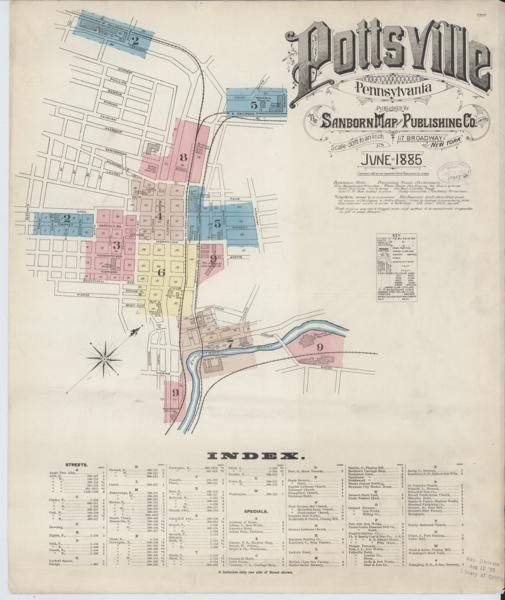
Historic maps and photographs from the Schuylkill Hub archive, each available as an archival print.
Sources
- "Base Ball" — Anthracite Park as the Pottsville club's ground, Pottsville Republican, May 1, 1885, p. 1 (via Newspapers.com) · 1885-05-01
License: publisher - "Base Ball" — a game at Anthracite Park the summer before the mill campaign — Pottsville Republican, Aug. 7, 1886, p. 4 (via Newspapers.com) · 1886-08-07
License: publisher - The citizens' subscription meeting (the $85,000–$100,000 building, the company's $200,000 of machinery, the mortgage and the four-to-four-and-a-half-per-cent return; ~70 subscribers) — Pottsville Republican, May 17, 1887, p. 4 (via Newspapers.com) · 1887-05-17
License: publisher - "We've Got the Silk Mill" (the deal closed; the site named as Anthracite Park) — Pottsville Republican, May 31, 1887, p. 1 (via Newspapers.com) · 1887-05-31
License: publisher - The contract executed — architect Jacoby of Allentown, superintendent Louis Soleliac of the Adelaide Mills, four per cent interest, a 600-by-350-foot lot by the People's Railway depot, completion due Dec. 1, 1887 — Pottsville Republican, June 2, 1887, p. 1 (via Newspapers.com) · 1887-06-02
License: publisher - Ashland's correspondence column — "Ashland didn't secure the promise of the silk mill" — Pottsville Republican, June 4, 1887, p. 1 (via Newspapers.com) · 1887-06-04
License: publisher - "Foundation Plan of Pottsville's New Silk Mill (Rough Sketch from Architect's Drawing)" — the oil room, boiler house, and stack labelled — Pottsville Republican, June 15, 1887, p. 1 (via Newspapers.com) · 1887-06-15
License: publisher - "Appropriate Celebration" — the stakes driven by Burd S. Patterson with the surveyor Andrew Cochran; four storeys settled; the name the Tilt Silk Mill Company adopted; Albert Tilt president, Joseph W. Congdon vice-president — Pottsville Republican, June 21, 1887, p. 4 (via Newspapers.com) · 1887-06-21
License: publisher - "A Pottsville mechanic secured the first contract on the new silk mill" (editorial) — Pottsville Republican, June 24, 1887, p. 2 (via Newspapers.com) · 1887-06-24
License: publisher - Ground broken for the foundation by Contractor Auman — Pottsville Republican, June 27, 1887, p. 4 (via Newspapers.com) · 1887-06-27
License: publisher - "The Silk Mill" — foundation work progressing; the inter-town rivalry ("the Hazleton papers continue to lie about the institution") — Pottsville Republican, July 18, 1887, p. 1 (via Newspapers.com) · 1887-07-18
License: publisher - "The Silk Mill — Operations Commenced To-Day" (over 300 subscribers; more than $100,000 raised) — Pottsville Republican, July 16, 1888, p. 4 (via Newspapers.com) · 1888-07-16
License: publisher - "How to Get a Home" — a mill-driven building boom, on the Allentown model — Pottsville Republican, July 16, 1888, p. 1 (via Newspapers.com) · 1888-07-16
License: publisher - "How to Secure a Home" — mortgages advertised to "silk mill operatives and others"; "Lots on Laurel St. near silk mill" — Pottsville Republican, July 18, 1888, p. 4 (via Newspapers.com) · 1888-07-18
License: publisher - "The Silk Mill" — hundreds of young women apply; classes of thirty trained by thirty Allentown women — Pottsville Republican, July 19, 1888, p. 4 (via Newspapers.com) · 1888-07-19
License: publisher - "To See the Silk Mill" — Superintendent Harris and the promised public tour; "everything about the place is more or less in confusion" — Pottsville Republican, July 20, 1888, p. 4 (via Newspapers.com) · 1888-07-20
License: publisher - "75 Years Ago To-day" column, reprinting a December 1910 notice that the Tilt Silk Mill would run "full handed" after three years of short time — Pottsville Republican, Dec. 23, 1985, p. 5 (via Newspapers.com) · 1985-12-23
License: publisher - N.R.A. parade notice — the Tilt Silk Mill ordering its employees to march (ad key adv-o16-17-18) — Pottsville Republican, Oct. 18, 1933, p. 1 (via Newspapers.com) · 1933-10-18
License: publisher - The N.R.A. parade reported — the Onyx Blouse Company marching as a separate Pottsville industry — Pottsville Republican, Oct. 20, 1933, p. 2 (via Newspapers.com) · 1933-10-20
License: publisher - "The slate steps at the former Tilt Silk Mill … before it closed in 1979"; the mill "went from employing nearly 1,000 people at peak production"; the Hazleton–Allentown–Pottsville competition — Republican & Herald, Feb. 8, 2003, p. 6 (via Newspapers.com) · 2003-02-08
License: publisher - "Ed's U Save Auto Rental / Ed's U Store" — the mid-1980s conversion at 12th & Laurel; 24,000 of 127,000 square feet then in storage use (reader advertisement) — Pottsville Republican, Aug. 6, 1985, p. 9 (via Newspapers.com) · 1985-08-06
License: publisher - Ed's USA Auto Rentals — official site (303 North Twelfth Street, Pottsville; auto rental and self-storage; current operation, checked 2026)
License: publisher
Frequently asked
- What is the Tilt Silk Mill?
- The Tilt Silk Mill is the four-storey brick silk factory at 303 North Twelfth Street in Pottsville, built in 1887–88 for the Phoenix Silk Manufacturing Company of Paterson, New Jersey, and paid for by public subscription. It operated until 1979; since the mid-1980s the building has been in commercial use, and it now houses an auto-rental and self-storage business at Twelfth and Laurel.
- When did the Tilt Silk Mill open?
- Operations began on Monday, July 16, 1888, when — as the Pottsville Republican reported that day — "work was commenced in the Tilt silk mill this morning." Some later accounts, including the current owner's website and a local historical-society post, give July 17; the contemporaneous daily paper, published on the day itself, is the earlier record.
- Who paid for the Tilt Silk Mill, and who built it?
- Pottsville paid for it. At a mass meeting in May 1887 the town's citizens subscribed some $85,000 to $100,000 to erect the building, while the Phoenix Silk Manufacturing Company supplied about $200,000 of machinery and gave a mortgage guaranteeing four per cent to the subscribers. The foundation was broken by a Pottsville contractor named Auman in June 1887.
- Who designed the Tilt Silk Mill?
- The architect was named Jacoby, of Allentown, in the Pottsville Republican's construction reports of 1887. The paper printed his initials three different ways within three weeks (L. B., L. F., and L. S.), so only the surname and the city are firm. The mill's construction superintendent was Louis Soleliac, formerly of the Adelaide Mills at Allentown.
- Why is it called the Tilt Silk Mill and not the Phoenix Silk Mill?
- The enterprise took the name the Tilt Silk Mill Company when its site was staked out on June 21, 1887, for its president, Albert Tilt; Joseph W. Congdon was vice-president. "Phoenix Silk" — the name used during the 1887 negotiations for the Paterson parent company — disappears from the Pottsville press after that, and the mill was known locally as the Tilt silk mill from its opening.
- When did the Tilt Silk Mill close?
- The mill closed in 1979. Contrary to some accounts that place the closing in the 1920s, the mill was still running in 1933 — it ordered its workers to march in Pottsville's National Recovery Administration parade that October — and a 2003 Republican & Herald feature dates the closure to 1979 and puts peak employment at "nearly 1,000."
- What stood on the site before the mill?
- Anthracite Park, Pottsville's baseball grounds. The field was still hosting games in the summer of 1886, and the town gave it up to secure the silk mill, whose location was announced as Anthracite Park on May 31, 1887.
- What is in the Tilt Silk Mill building now?
- Since the mid-1980s the building has been in commercial use. In August 1985 Ed Keese opened a car-rental and self-storage business there at Twelfth and Laurel; as of 2026 the site operates as Ed's USA Auto Rentals, with self-storage, at 303 North Twelfth Street.