Banks · Built 1927
The Miners National Bank Building
The Miners National Bank at 120 South Centre Street, Pottsville — a 1927 Colonial-revival banking temple by Uffinger, Foster & Bookwalter, on the site of John Haviland's 1830 cast-iron front; now the hotel The Miners 1928.
Listen to this article · 6 min
0:005:40
Read by a synthetic voice, generated from the text of this article. Hear the whole archive on the Listen page.
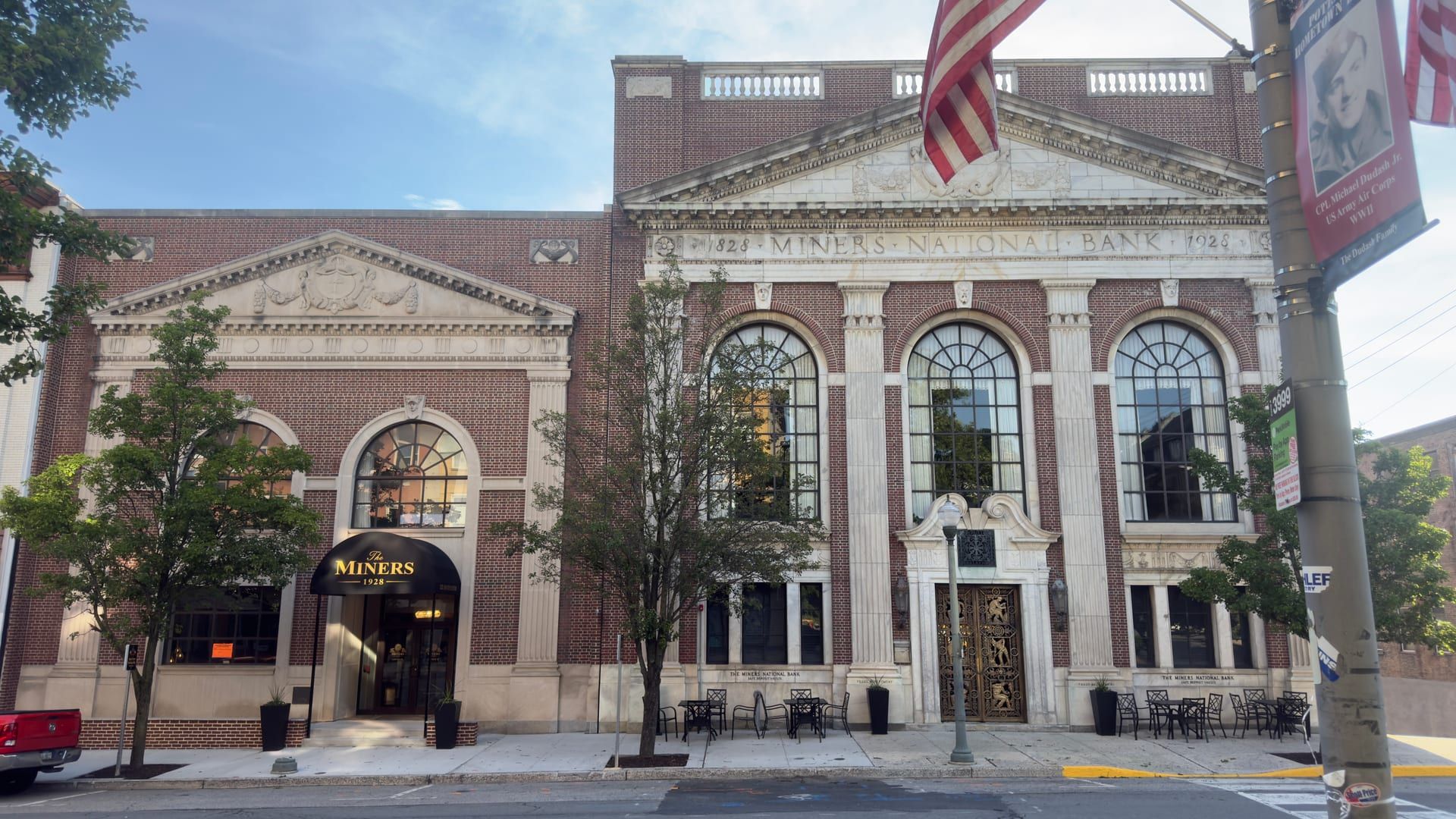
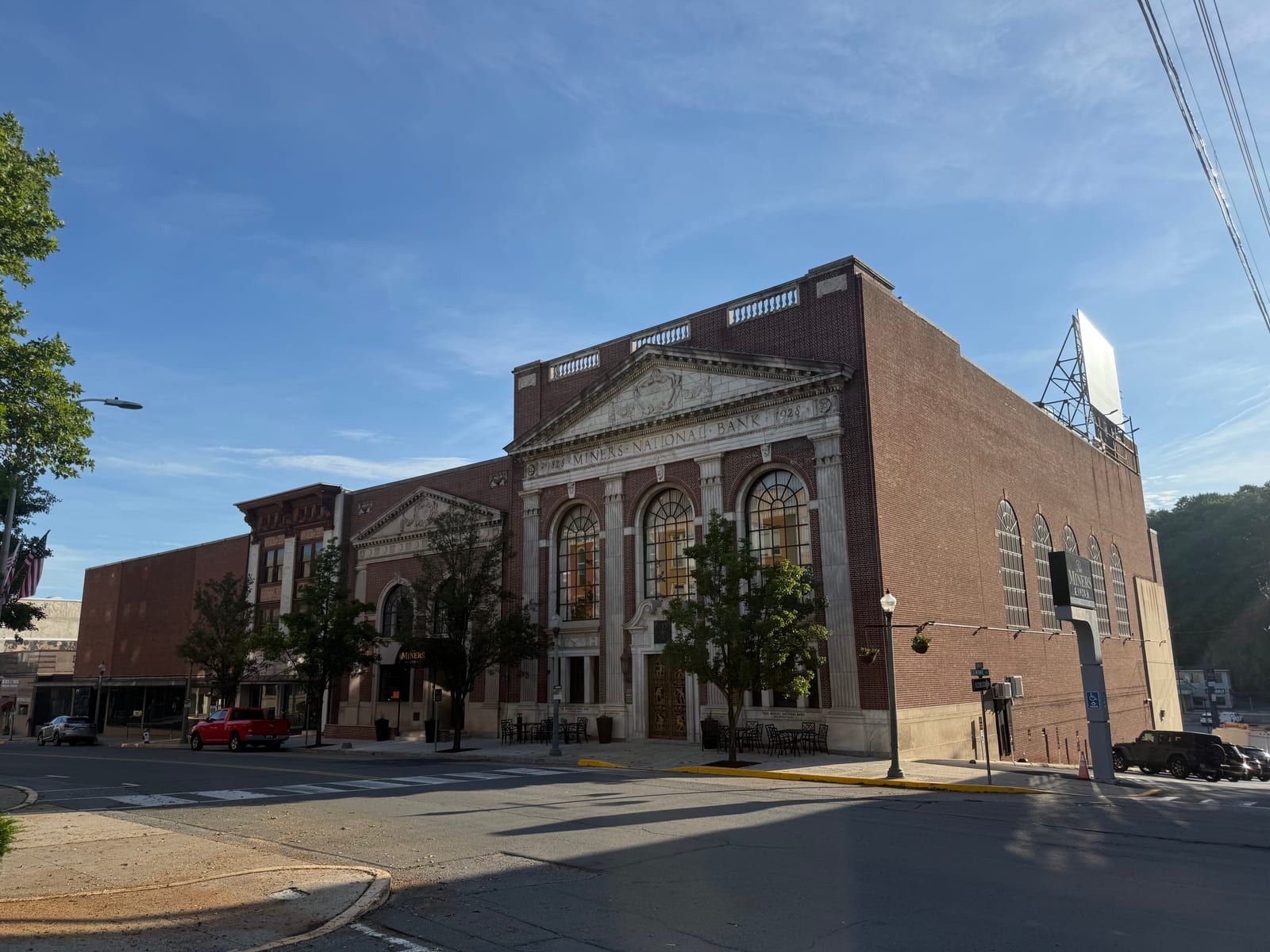
The Colonial-revival banking house at 120 South Centre Street — addressed today as 121 South Progress Avenue, and now the boutique hotel The Miners 1928 — opened in 1927 as the home of the Miners National Bank of Pottsville. It is a building with two histories: the 1927 marble-and-brick temple that stands today, and the pioneering cast-iron-fronted bank of 1830 it replaced on the same ground.
The bank of 1828
The Miners’ Bank of Pottsville was chartered on February 7, 1828, when Governor John Andrew Shulze approved an act of the Pennsylvania legislature (No. 44 of the 1827–28 session) incorporating a bank at Pottsville with capital of up to $200,000 and a charter to run until 1840. It was among the town’s very first institutions — its charter predated Pottsville’s own incorporation as a borough (February 19, 1828) by twelve days, and D. G. Yuengling would not brew his first beer until the following year. Banking began on October 28, 1828, in a rented building at the southeast corner of Centre and Norwegian streets; the first piece of business was discounting a note for John Plumer of Bloomsburg. The first president was Francis B. Nichols, remembered at his death in 1847 as a War of 1812 midshipman wounded aboard the USS Chesapeake and a grandson of Michael Hillegas, the first Treasurer of the United States.
John Haviland’s iron front (1830)
By 1830 the young bank was building, and what rose on this site was, for its day, extraordinary. “The whole front,” the Miners’ Journal reported, was “to be of cast iron plates,” with iron substituted for wood “for all the perishable parts of the building” — a method that “has never before, we believe, been introduced into our country.” The work was “under the superintendence of Mr. Haviland” — the Philadelphia architect John Haviland, designer of Eastern State Penitentiary. The item was reprinted in the Philadelphia press within days. A cast-iron building front was a genuine novelty in 1830, and the architectural historian Matthew Baigell, examining Haviland’s Pottsville work in a 1967 study, counted the Miners’ Bank among the two he judged of importance to American architectural history. The bank’s early years were dramatic in other ways: a false report in 1830 that it had stopped payment — which the press attributed to the rival Harrisburg Bank — had given way by November to a four-percent dividend. Haviland’s iron-fronted building served the bank until it was pulled down in 1926 to make way for the present one.
A banking temple of 1927
By the 1920s the bank had outgrown Haviland’s building. The banking house that stands today was designed by the New York firm Uffinger, Foster & Bookwalter — successors to Mowbray & Uffinger, the bank-building specialists who had lately designed Pottsville’s Schuylkill Trust building — a firm named as the architects both in the bank’s opening-day newspaper advertisements of November 1927 and in the building’s National Register nomination. In September 1926 the board awarded the construction contract to New York’s George A. Fuller Co. and the vault to the Mosler Safe Co. of Hamilton, Ohio; the old bank was demolished that October by the New Philadelphia contractor P. S. Canfield. What replaced it was a Colonial-revival banking house of red Harvard brick and white Georgia marble — “white pilasters support[ing] an elaborate marble entablature and pediment,” a marble head of Mercury on each side of the façade and Pluto, “god of the lower world and giver of the wealth in mines,” above the door. Inside, the main banking room rose fifty-five feet to a polychrome vaulted ceiling lit by twelve chandeliers, walled in French limestone and floored in Roman travertine “with insets of colored marble.” The vault door — thirty-six tons, twenty inches of solid tool-proof steel, twenty-four four-inch bolts, four time locks — was “so delicately poised on a heavy crane hinge that a child can swing it.” In the marble doorway hung “wrought bronze grill doors, depicting the coal mining industry,” modelled by Peters & Erdmann and executed by the General Bronze Corporation, the firm built around John Polachek’s bronze works.
Opening day, 1927
The new bank opened for public inspection on Friday, November 4, 1927, from one to ten in the evening; an orchestra played among baskets of flowers sent by the city’s other banks. On a walnut table in the center of the floor lay the bank’s original 1830 keys, “clumsy but efficient,” lent for the occasion by the Schuylkill County Historical Society — now itself housed in a former grammar school a few blocks north. Business began the following Monday, November 7; its first depositor was six-year-old Laura Elizabeth Ulmer, granddaughter of the bank’s president (whose opinion, the paper noted, “was not solicited in the matter”). Overhead, the pediment carried two dates, “1828” and “1928” — the year the Miners’ Bank was chartered and, cut a year early, its centennial.
From bank to hotel
The Miners National Bank kept its name into the 1990s; renamed Heritage National Bank in 1995, it merged into Berks County Bank in 1999, then into Sovereign in 2002 and Santander in 2013 — a branch operating in the building throughout, the pediment’s “1828–1928” still overhead. In 1985 the city renamed the railroad street along the building’s rear “Progress Avenue,” which is how the old bank came by its 121 South Progress address. The branch closed around 2023, and the building has since been redeveloped as The Miners 1928 — a boutique hotel, event venue, and spa that keeps the bank’s centennial year for its name.
Timeline
Each entry is graded by how firmly it is sourced — confirmed against a primary page image or an official record, corroborated by an authoritative secondary source, or probable. Weaker leads are left off.
The Miners' Bank · 1828–1926
- February 7, 1828
The bank is chartered
Governor Shulze approves the act incorporating the Miners' Bank of Pottsville (No. 44 of the 1827–28 session) — capital up to $200,000, thirteen directors, a charter to run until 1840.
- October 28, 1828
Banking begins Corroborated
The bank opens in a rented building at the southeast corner of Centre and Norwegian streets; its first transaction is discounting a note for John Plumer of Bloomsburg. Francis B. Nichols is first president.
Zerbey, Pottsville Republican, Nov. 4, 1933 (Newspapers.com)
- 1830–31
Haviland's cast-iron front
A new banking house rises on this site, "the whole front ... of cast iron plates" — a method the Miners' Journal reported had "never before, we believe, been introduced into our country," superintended by the Philadelphia architect John Haviland.
Miners' Journal via the United States Gazette, June 15, 1830 (Newspapers.com)
- November 1830
A dividend after a false rumor
After a false report that the bank had stopped payment — which the contemporary press attributed to the rival Harrisburg Bank — the Miners' Bank declares a 4% dividend for the half-year.
- December 13, 1864
It becomes a national bank Corroborated
The Miners' Bank takes a national charter (No. 649) with $500,000 of paid-in capital; over 1864–1935 it issues some $9.6 million in national bank notes.
The 1927 banking house
- September 1926
Contracts awarded
The board awards the building contract to New York's George A. Fuller Co. and the vault to the Mosler Safe Co. of Ohio; the Pottsville Republican reports that "Architects Mowbray and Uffinger will draw up the plans."
"Contracts of Bank Awarded," Pottsville Republican, Sept. 23, 1926 (Newspapers.com)
- October 1926
The 1830 building comes down Corroborated
Haviland's iron-fronted bank is demolished by the New Philadelphia contractor P. S. Canfield to clear the site for the new building; the Zerbey history dates the start to October 6.
Pottsville Republican, Nov. 3, 1927; Zerbey serial, Nov. 4, 1933 (Newspapers.com)
- November 4, 1927
The new bank opens
The Colonial-revival banking house at 120 South Centre Street opens for public inspection, 1–10 p.m.; business begins the following Monday, when six-year-old Laura Elizabeth Ulmer is the first depositor. The Schuylkill County Historical Society lends the bank's original 1830 keys for display.
- 1928
The bank's centennial
The marble pediment carries the dates "1828" and "1928" — the year the Miners' Bank was chartered and, cut a year early, its hundredth year.
Pottsville Republican, Nov. 3, 1927 & Nov. 29, 1928 (Newspapers.com)
Bank to hotel · 1985–present
- December 10, 1985
Railroad Street becomes Progress Avenue
City Council renames the street along the building's rear, giving the old bank its later 121 South Progress Avenue address.
"Railroad Street yields to 'Progress'," Pottsville Republican, Dec. 11, 1985 (Newspapers.com)
- 1995–2013
A chain of mergers Corroborated
Renamed Heritage National Bank in 1995, the institution passes into Berks County Bank (1999), Sovereign (2002), and Santander (2013), a branch operating in the building throughout.
- 2026
The Miners 1928 opens Corroborated
After the branch closes, the building is redeveloped as the boutique hotel, event venue, and spa The Miners 1928 — keeping the bank's centennial year as its name — and opens to the public in 2026. Two ground-floor venues are open to all: the Company Store Café and Lounge 28, a cocktail bar whose top is carved from the original bank counters.
The Miners 1928 (theminershotel1928.com), 'Now Open'; verified 2026-07-05
From the archive
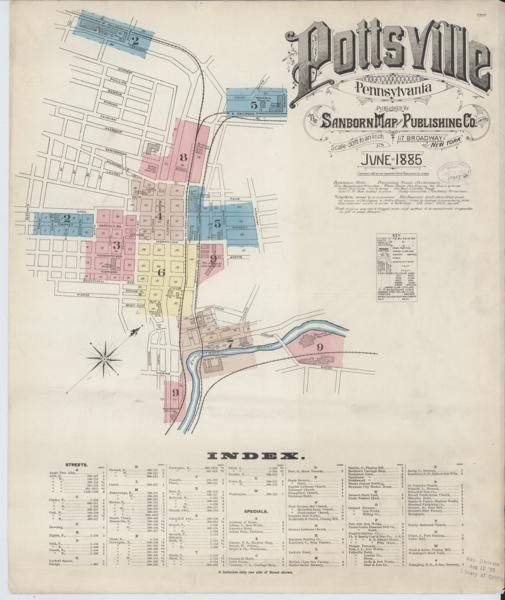
Historic maps and photographs from the Schuylkill Hub archive, each available as an archival print.
Sources
- Laws of Pennsylvania, 1827–28 — Act No. 44, the charter of the Miners' Bank of Pottsville · 1828-02-07
License: public-domain - Miners National Bank opening section — Pottsville Republican, Nov. 3–5, 1927, incl. the architects' advertisements (via Newspapers.com) · 1927-11-03
License: publisher - "Contracts of Bank Awarded" — Pottsville Republican, Sept. 23, 1926 (via Newspapers.com) · 1926-09-23
License: publisher - "Iron Sills" — the Miners' Journal on the 1830 cast-iron front, reprinted in the United States Gazette, June 15, 1830 (via Newspapers.com) · 1830-06-15
License: publisher - Matthew Baigell, "John Haviland in Pottsville," Journal of the Society of Architectural Historians 26.4 (Dec. 1967), pp. 307–309
License: reference - "Bronze Entrance Doors, Miners' National Bank" — The Metal Arts, v.1 no.2 (Dec. 1928), p. 119 (HathiTrust) · 1928-12
License: public-domain - W. W. Munsell & Co., History of Schuylkill County, Pa. (1881) — The Miners' Bank
License: public-domain - Joseph H. Zerbey, "Miners Bank Over 100 Years Old" — Pottsville Republican, Nov. 4, 1933 (via Newspapers.com) · 1933-11-04
License: publisher - Pottsville Downtown Historic District — National Register nomination (1982), inventory survey no. 52 ("Miner's Bank, 120 S. Centre Street ... Uffinger, Foster and Bookswalter") · 1982
License: public-domain - Miners National Bank, Pottsville, PA (Charter 649) — Bank Note History
License: reference - John Haviland; Mowbray & Uffinger — Wikipedia
License: CC-BY-SA-4.0
Frequently asked
- Who designed the Miners National Bank building?
- The New York firm Uffinger, Foster & Bookwalter — the successors to the bank-building specialists Mowbray & Uffinger — designed the 1927 building. The firm is named as the architects in the bank's opening-day newspaper advertisements and in the building's National Register nomination. The general contractor was the George A. Fuller Co. of New York, and the vault was built by the Mosler Safe Co. of Ohio.
- When did the building open?
- The Miners National Bank opened its new banking house at 120 South Centre Street for public inspection on Friday, November 4, 1927, and for business the following Monday. The "1828" and "1928" carved on the pediment are the year the bank was chartered and its centennial.
- What stood on the site before the 1927 building?
- The bank's earlier home — a banking house of 1830–31 with a cast-iron front, superintended by the Philadelphia architect John Haviland — stood here until it was demolished in 1926 to make way for the present building. The Miners' Journal reported at the time that its cast-iron front used a method that had "never before, we believe, been introduced into our country."
- Who made the bronze entrance doors?
- The mining-scene entrance doors are bronze, modelled by Peters & Erdmann and executed by the General Bronze Corporation — the firm built around John Polachek's bronze works — as documented in the trade journal The Metal Arts in 1928.
- Can you visit the building?
- Yes — the former bank is now the boutique hotel The Miners 1928, at 120 South Centre Street (also addressed 121 South Progress Avenue) in downtown Pottsville. It opened in 2026, and two ground-floor venues are open to the public: the Company Store Café and Lounge 28, a cocktail bar built on the original bank counters.