17 documented taxa of class Amphibia recorded in Schuylkill County, Pennsylvania — by iNaturalist research-grade records as of 2026-06-18 — with detailed accounts of the most notable, signature, and introduced species.
How this list is sourced. County presence is anchored to
records filtered to Schuylkill County — iNaturalist research-grade
observations (place 1470).
Observation counts are an effort-biased signal of recording activity as of
2026-06-18, not a census. Biology and identification draw on state
and museum authorities; per-species links go to Wikipedia for cross-reference
only.
Conservation ranks here are relayed from NatureServe / iNaturalist and are not definitive Pennsylvania ranks — confirm against the Pennsylvania Natural Heritage Program (PNHP) before relying on them.
Detailed accounts
17 of the 17 documented taxa are
profiled in detail below — the most-recorded, signature, introduced, and
notable species. The complete checklist follows.
Eastern Newt
Notophthalmus viridescens — Salamandridae
Native
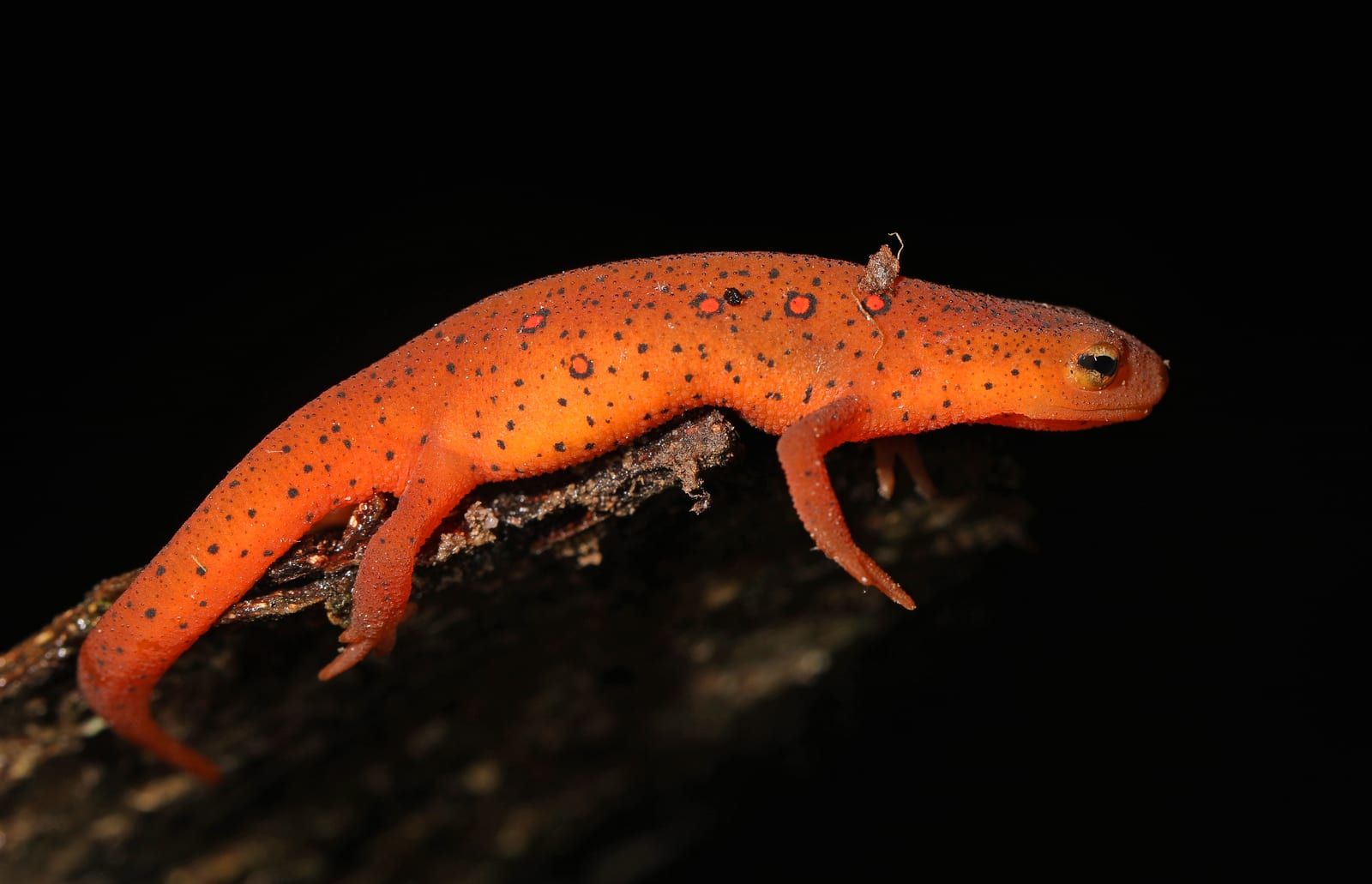
Eastern newt (Notophthalmus viridescens), in its terrestrial red-eft stage. Photo: Judy Gallagher / CC BY 2.0, via Wikimedia Commons
Also known as
red-spotted newt; the terrestrial juvenile stage is the "red eft."
Description & ID
adults aquatic, olive-green with red spots ringed in black and a yellow belly; the juvenile "red eft" is bright orange-red and terrestrial. A distinctive three-stage life history (aquatic larva, terrestrial eft, aquatic adult).
Habitat
ponds, marshes, and slow water as adults; efts wander moist deciduous forest floors for several years before returning to water.
County status
present and abundant; 150 research-grade iNaturalist records — the most-recorded amphibian in the county [S1]. The conspicuous orange eft is frequently photographed.
Conservation status
native; secure. No special status. (confirm against PNHP)
Notes
skin toxins (tetrodotoxin-like) deter predators, especially in the eft stage; eats invertebrates and amphibian eggs. Long-lived for an amphibian.
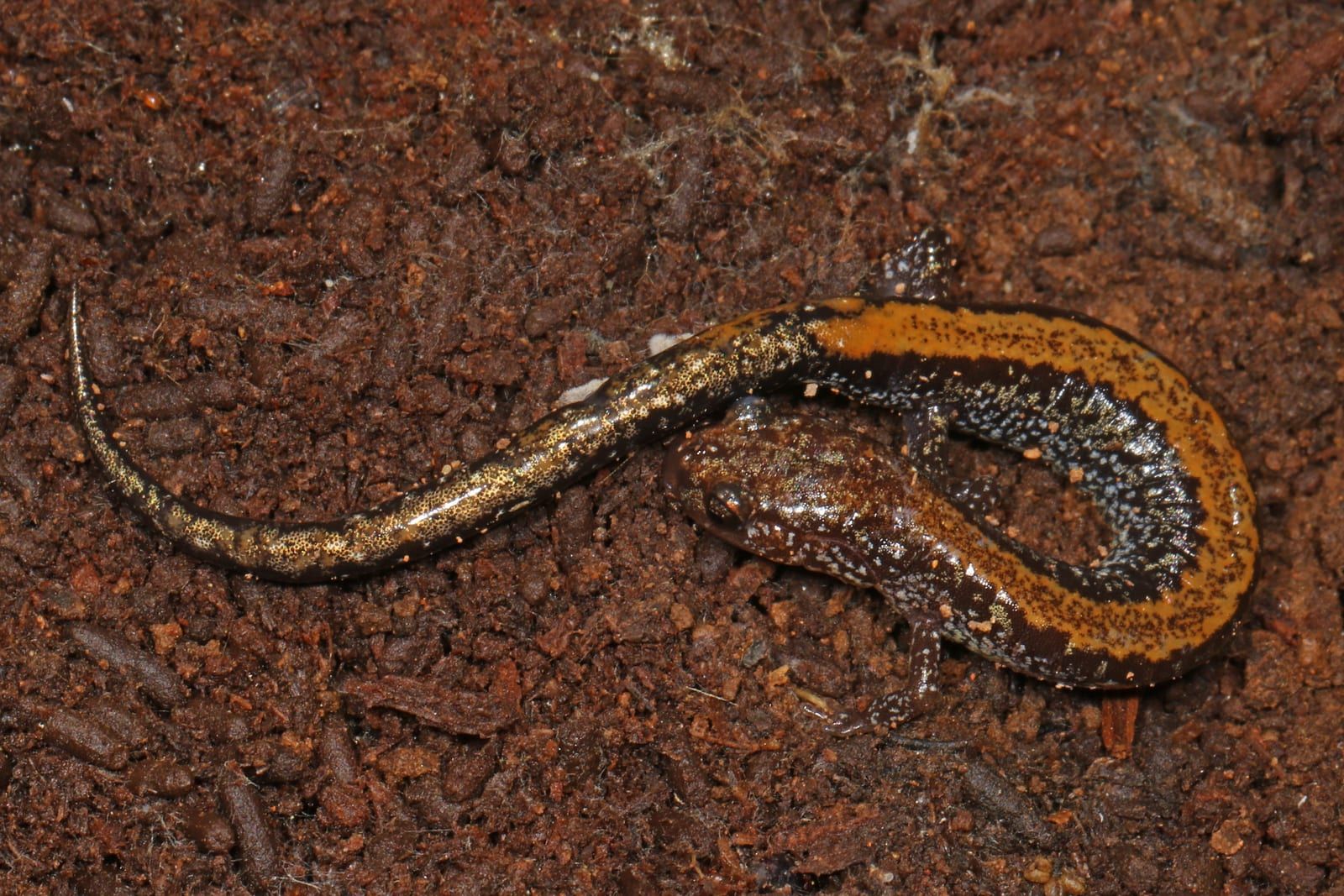
Eastern red-backed salamander (Plethodon cinereus), the striped 'redback' morph. Photo: Judy Gallagher / CC BY 2.0, via Wikimedia Commons
Description & ID
small, slender, lungless salamander; typically a straight red-orange dorsal stripe on a dark body, though a stripeless "lead-backed" morph also occurs.
Habitat
moist deciduous and mixed forest floors, under logs, bark, and rocks; entirely terrestrial and lungless — breathes through its skin.
County status
present and abundant; 84 research-grade iNaturalist records [S1] — one of the most numerous vertebrates in eastern forests despite its small size.
Conservation status
native; secure. (confirm against PNHP)
Notes
lays eggs on land (no aquatic larval stage); a major component of forest-floor biomass and a key predator of small invertebrates. Strong indicator of healthy, moist forest.
medium-sized, glossy black salamander flecked with silvery-white spots; secretes a thick, sticky, glue-like skin mucus when handled (the source of its name).
Habitat
moist wooded slopes, ravines, and shale banks; under rocks, logs, and in burrows. Entirely terrestrial.
County status
present; 21 research-grade iNaturalist records [S1].
Conservation status
native; secure. (confirm against PNHP)
Notes
lungless, with direct development (no aquatic larva). The sticky secretion is difficult to wash off and deters predators.
stout-bodied brown salamander with a pale line from the eye to the angle of the jaw and a keeled, laterally compressed tail; hind legs noticeably larger than forelegs.
Habitat
seeps, springs, and the splash zones of small woodland streams; under rocks and leaf litter at the water's edge.
County status
present; 20 research-grade iNaturalist records [S1].
Conservation status
native; secure. (confirm against PNHP)
Notes
lungless; strong jumper that flips away when disturbed. Sensitive to siltation and stream degradation.
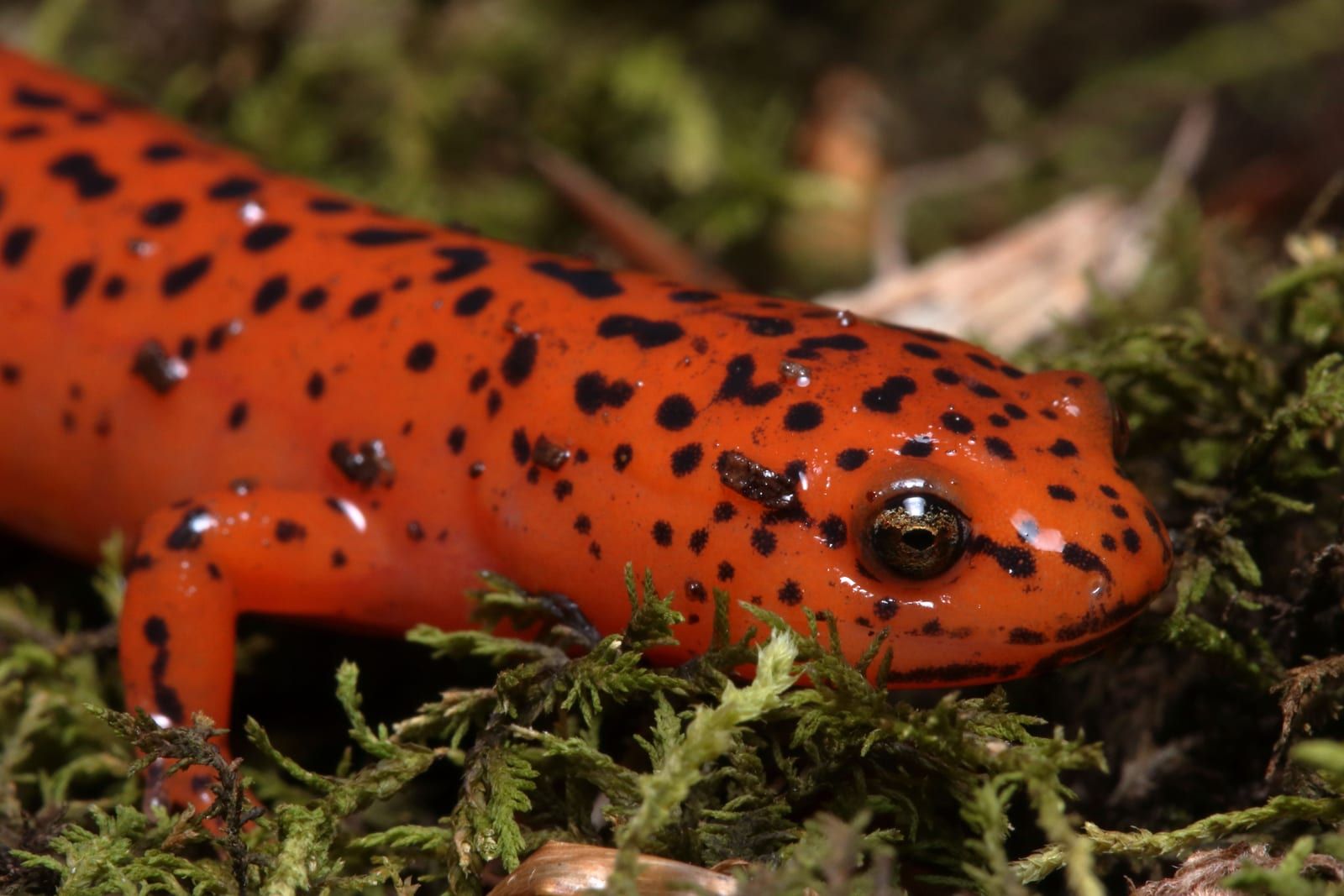
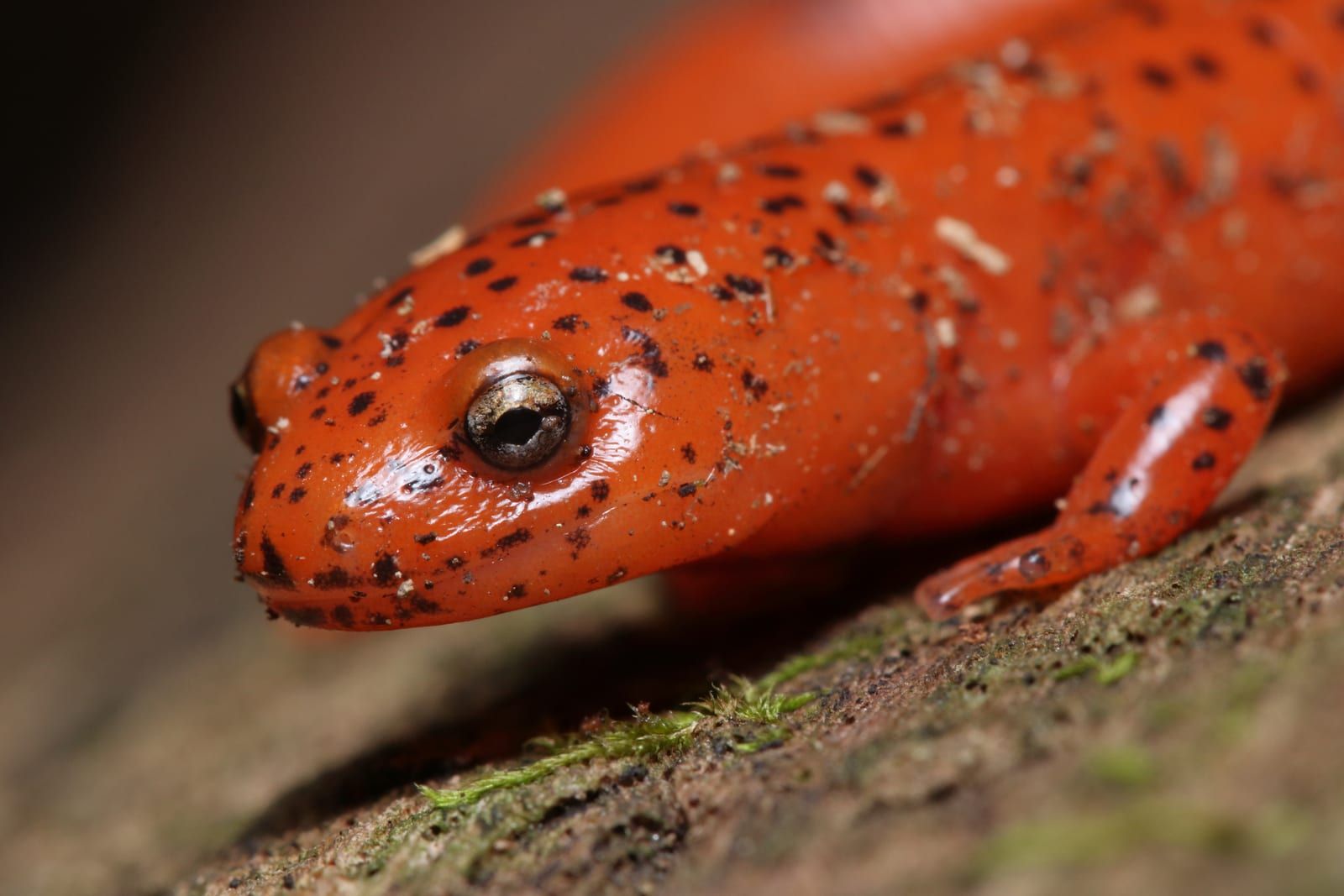
Red salamander (Pseudotriton ruber) on moss. Photo: Riley Stanton / CC BY-SA 4.0, via Wikimedia CommonsRed salamander (Pseudotriton ruber), a close portrait. Photo: Riley Stanton / CC BY-SA 4.0, via Wikimedia Commons
Description & ID
stocky, bright red to red-orange salamander densely peppered with small black spots; yellowish eyes. Color fades to purplish-brown with age.
Habitat
clear springs, seeps, and streamsides in forested areas; often found under cover near cold running water.
County status
present; 20 research-grade iNaturalist records [S1].
Conservation status
native; secure. (confirm against PNHP)
Notes
lungless. Its bright coloration may mimic the toxic red eft stage of the Eastern Newt (Batesian/Müllerian mimicry). Eats invertebrates and smaller salamanders.
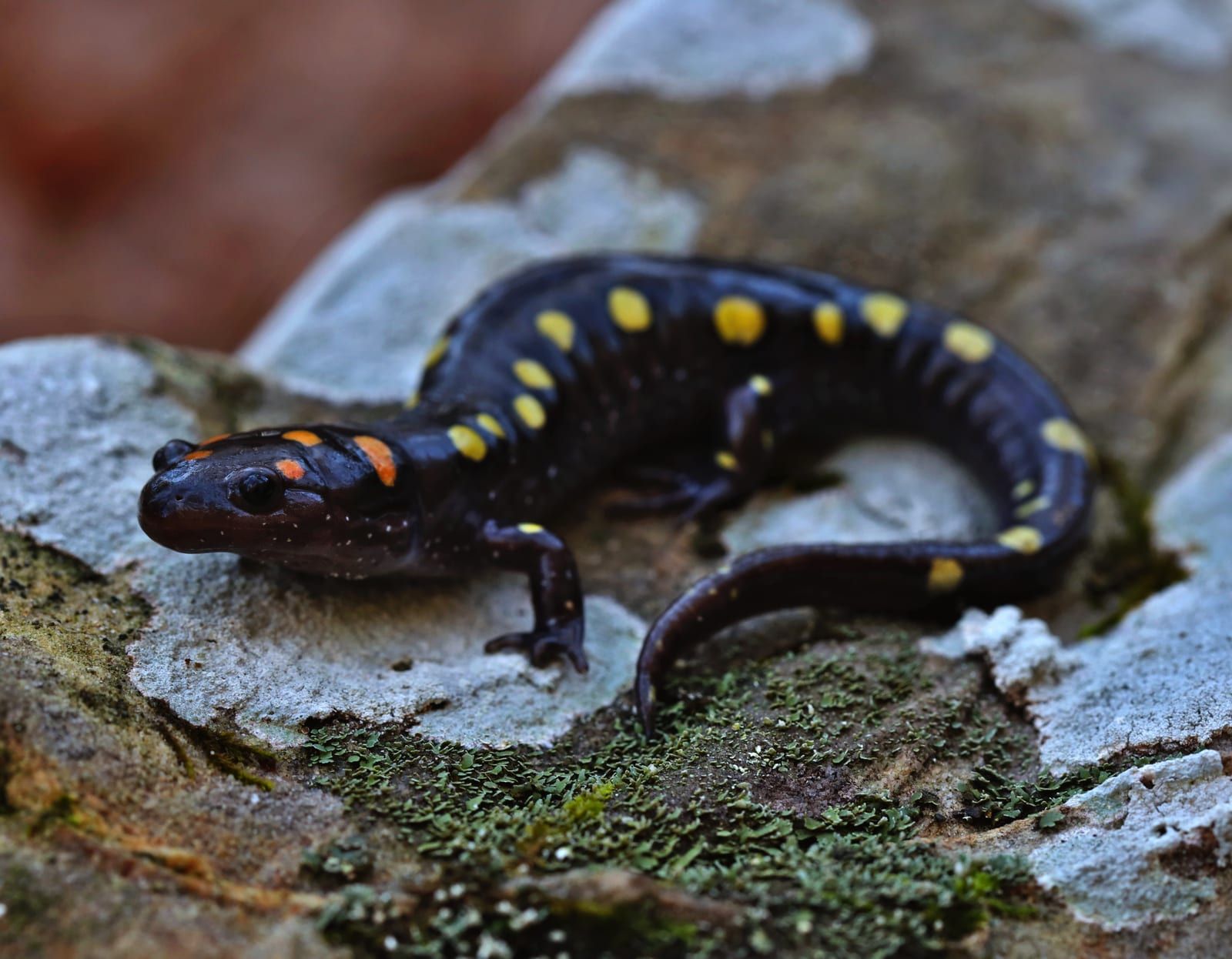
Spotted salamander (Ambystoma maculatum). Photo: Peter Paplanus / CC BY 2.0, via Wikimedia Commons
Description & ID
large, robust mole salamander, black to bluish-black with two irregular rows of round yellow (sometimes orange near the head) spots; stout body and broad head.
Habitat
mature deciduous forest with vernal (fishless) breeding pools; spends most of the year underground in burrows, emerging on rainy early-spring nights to breed.
County status
present; 17 research-grade iNaturalist records [S1] — under-recorded because of its fossorial, briefly visible breeding habits.
Conservation status
native; PA NatureServe S4 (apparently secure) [S1][S9]. (confirm against PNHP)
Notes
famous for explosive, synchronized vernal-pool breeding migrations; eggs may host a symbiotic green alga. Dependent on intact forest and vernal pools — vulnerable to road mortality during migrations.
slender yellow to orange salamander with a very long tail (often more than half the total length) marked with dark vertical bars or "dumbbell" patterns along the sides.
Habitat
shaded streams, springs, seeps, and the entrances of caves and mines; favors shale and limestone areas. Anthracite-region rock crevices and adits provide suitable cover.
County status
present; 7 research-grade iNaturalist records [S1].
Conservation status
native; secure. (confirm against PNHP)
Notes
lungless; often climbs damp rock faces. Associated with cool, stable underground microhabitats.
large, robust salamander, salmon to reddish-brown with a light line bordered below by dark pigment running from the eye to the nostril; cloudy mottling on the back.
Habitat
cold, clean, well-oxygenated springs, seeps, and headwater streams in forested terrain; highly dependent on pristine water.
County status
present; 2 research-grade iNaturalist records [S1] — uncommon and easily overlooked in its cold-water habitat.
Conservation status
native; secure in PA, but locally sensitive — a strong indicator of high water quality. (confirm against PNHP)
Notes
lungless; a top predator among stream salamanders, eating invertebrates and other salamanders. Decline signals stream degradation.
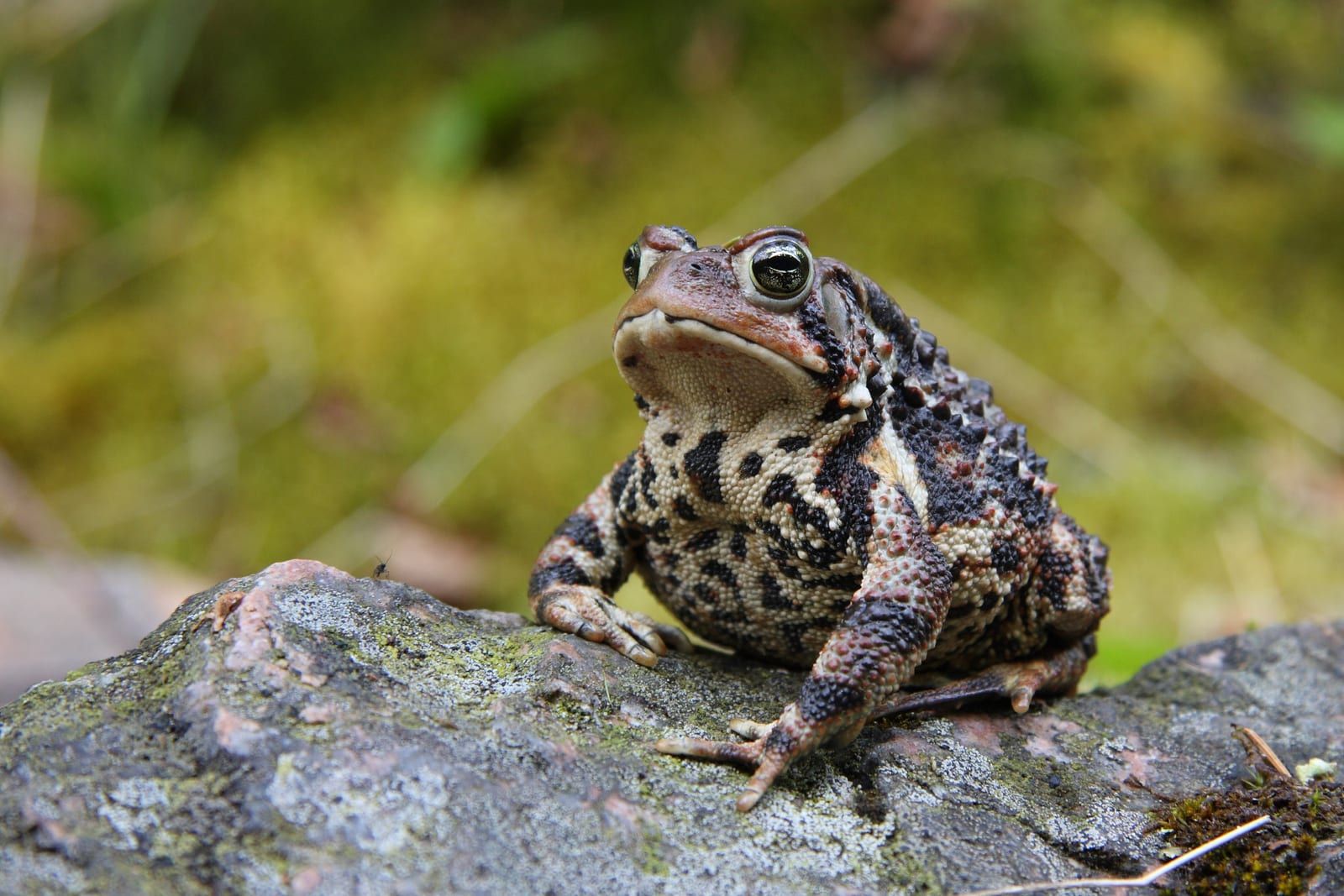
American toad (Anaxyrus americanus). Photo: Cephas / CC BY-SA 3.0, via Wikimedia Commons
Description & ID
stout, warty toad, brown to brick-red or olive, with enlarged paratoid glands behind the eyes and often one or two warts per dark dorsal spot; cranial crests do not touch the paratoids.
Habitat
nearly everywhere — forests, fields, gardens, and yards; breeds in shallow ponds, ditches, and pools in spring.
County status
present and abundant; 144 research-grade iNaturalist records — the most-recorded anuran in the county [S1].
Conservation status
native; secure. (confirm against PNHP)
Notes
long, musical trill in spring; toxic paratoid secretions deter predators. Beneficial consumer of insects and slugs. The very similar Fowler's Toad (A. fowleri) occurs in PA and may be present locally but is not confirmed by county research-grade records.
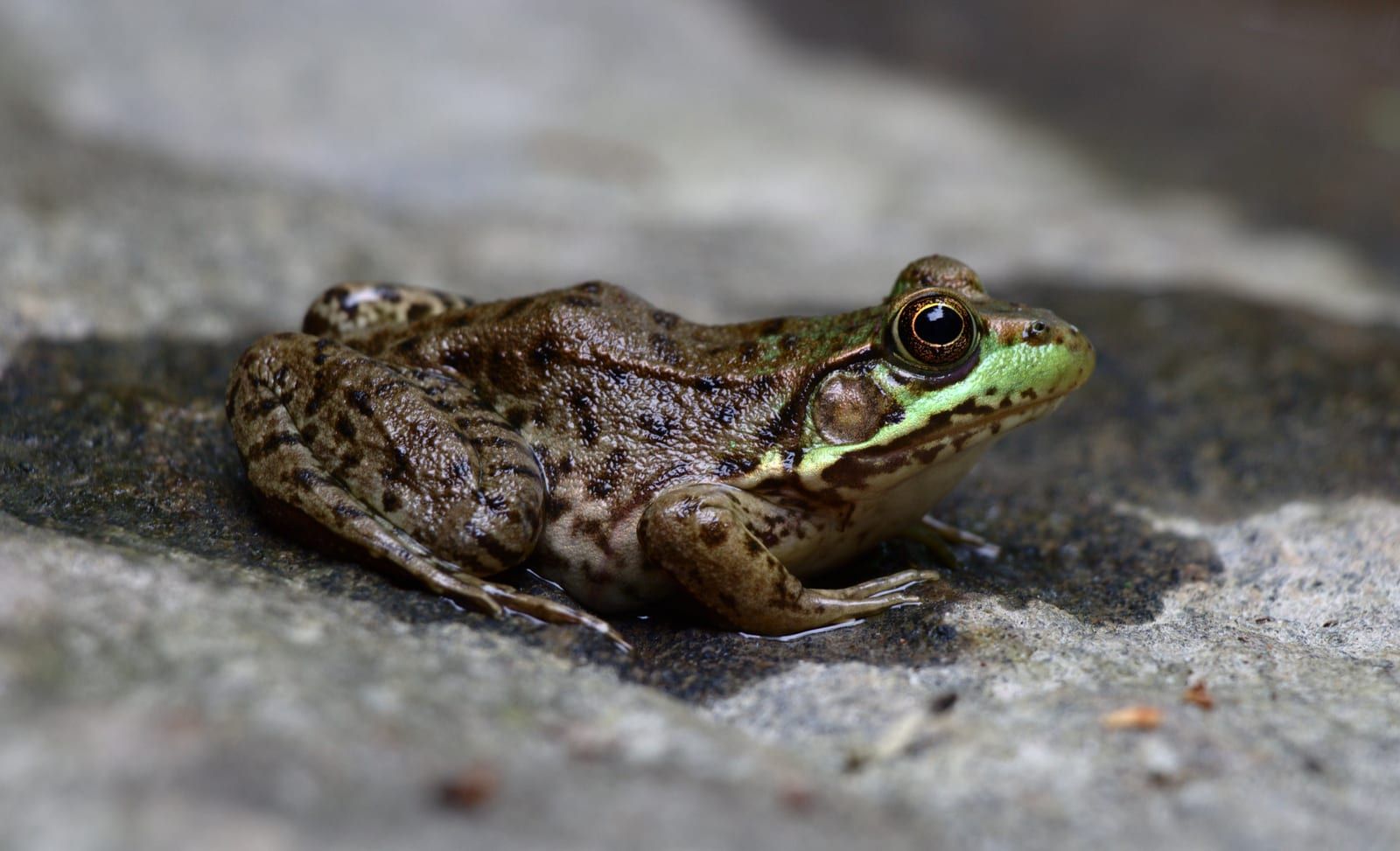
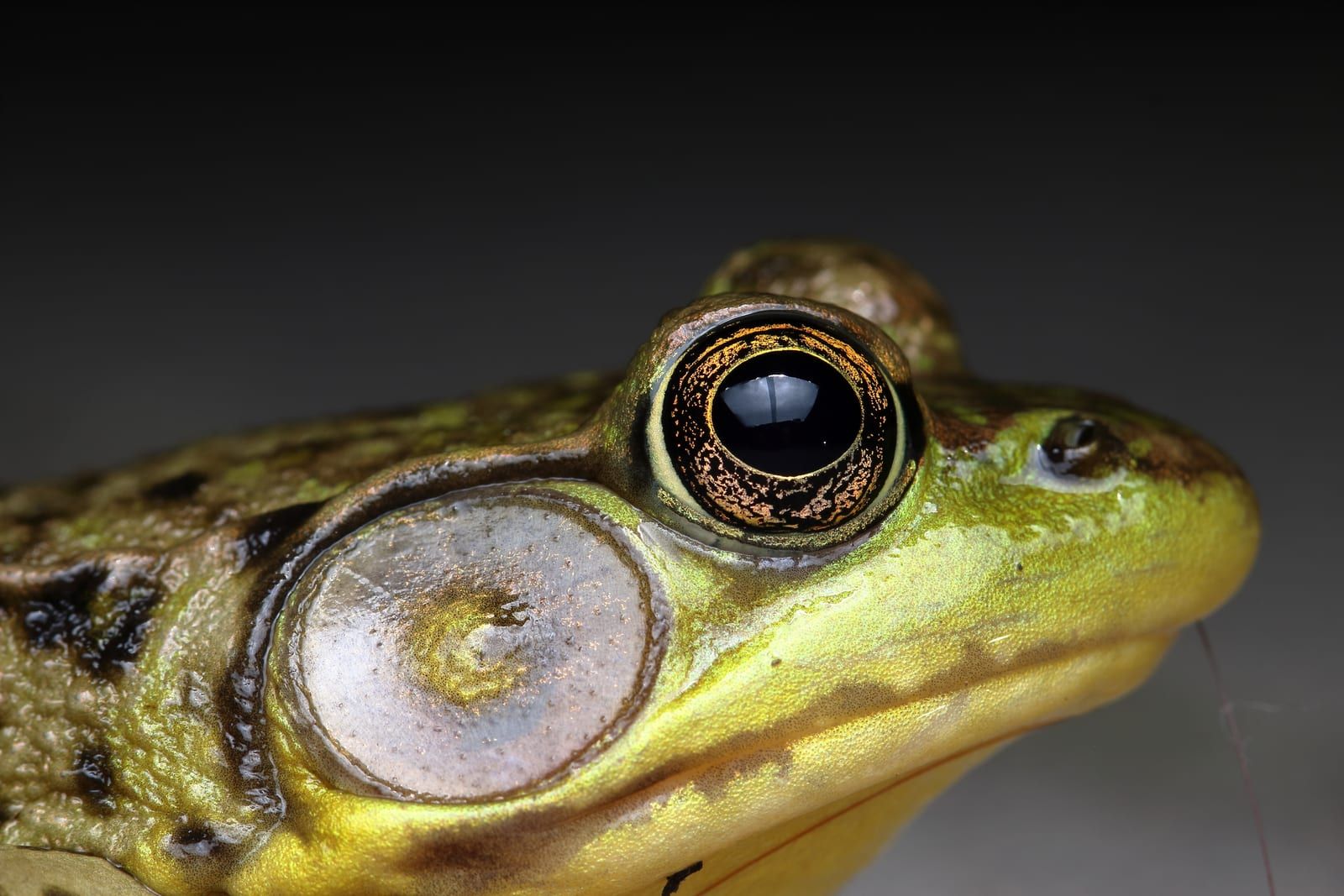
Green frog (Lithobates clamitans), with dorsolateral ridges down its back. Photo: Michael J. Bennett / CC BY-SA 3.0, via Wikimedia CommonsGreen frog (Lithobates clamitans), a head study. Photo: Riley Stanton / CC BY-SA 4.0, via Wikimedia Commons
Description & ID
medium-large green to brownish frog with prominent dorsolateral ridges (folds running partway down the back) — distinguishing it from the bullfrog, which lacks them. Males have a yellow throat and a large tympanum.
Habitat
edges of ponds, lakes, streams, and wetlands; rarely far from permanent water.
County status
present and common; 41 research-grade iNaturalist records [S1].
Conservation status
native; secure. (confirm against PNHP)
Notes
call resembles a loose banjo string ("gunk"). Eats invertebrates and small vertebrates; among the most frequently encountered frogs at the water's edge.
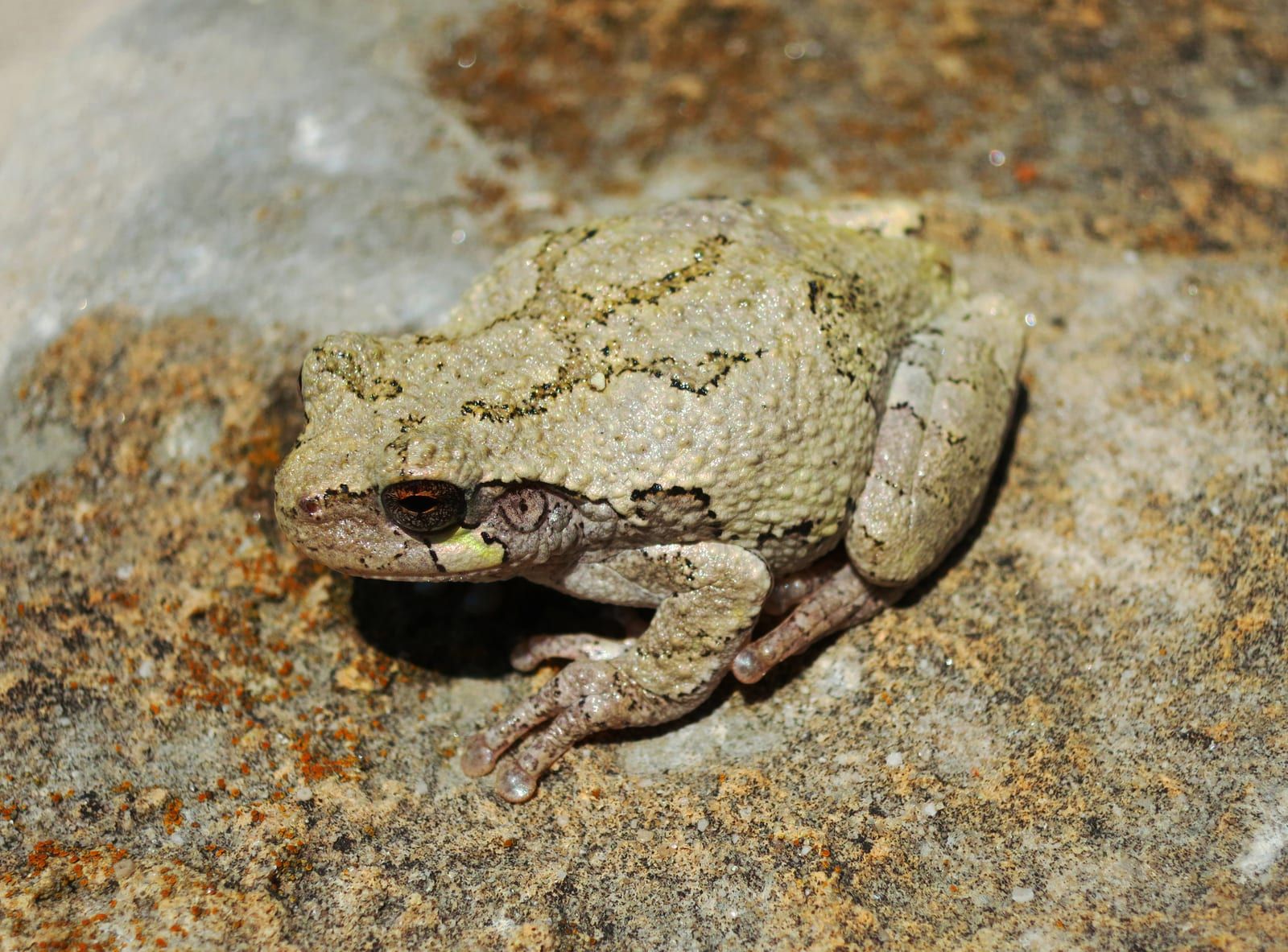
small, warty treefrog that changes color from gray to green to match its background; bright yellow-orange flash markings on the inner thighs and large toe pads. Essentially identical in appearance to Cope's Gray Treefrog (D. chrysoscelis), separable mainly by call.
Habitat
wooded areas near water; an arboreal frog that descends to breed in ponds and wetlands.
County status
present; 25 research-grade iNaturalist records [S1].
Conservation status
native; PA NatureServe S4 (apparently secure) [S1][S9]. (confirm against PNHP)
Notes
loud, resonant trill on warm spring and summer nights; a tetraploid species. Toe pads allow climbing on bark and leaves.
medium frog with two parallel rows of squarish, dark, chocolate-brown blotches down the back between dorsolateral ridges; bright yellow-orange wash on the concealed inner thighs.
Habitat
cool, clear streams, springs, bogs, and meadows; tolerant of cooler water than most ranid frogs and sometimes found in cave entrances.
County status
present; 24 research-grade iNaturalist records [S1].
Conservation status
native; secure. (confirm against PNHP)
Notes
skin secretions are toxic and can sicken predators and other frogs held with it — often avoided by snakes. The only native frog whose skin toxins are strongly noxious. Distinguished from the Leopard Frog by its squarish, paired spots.
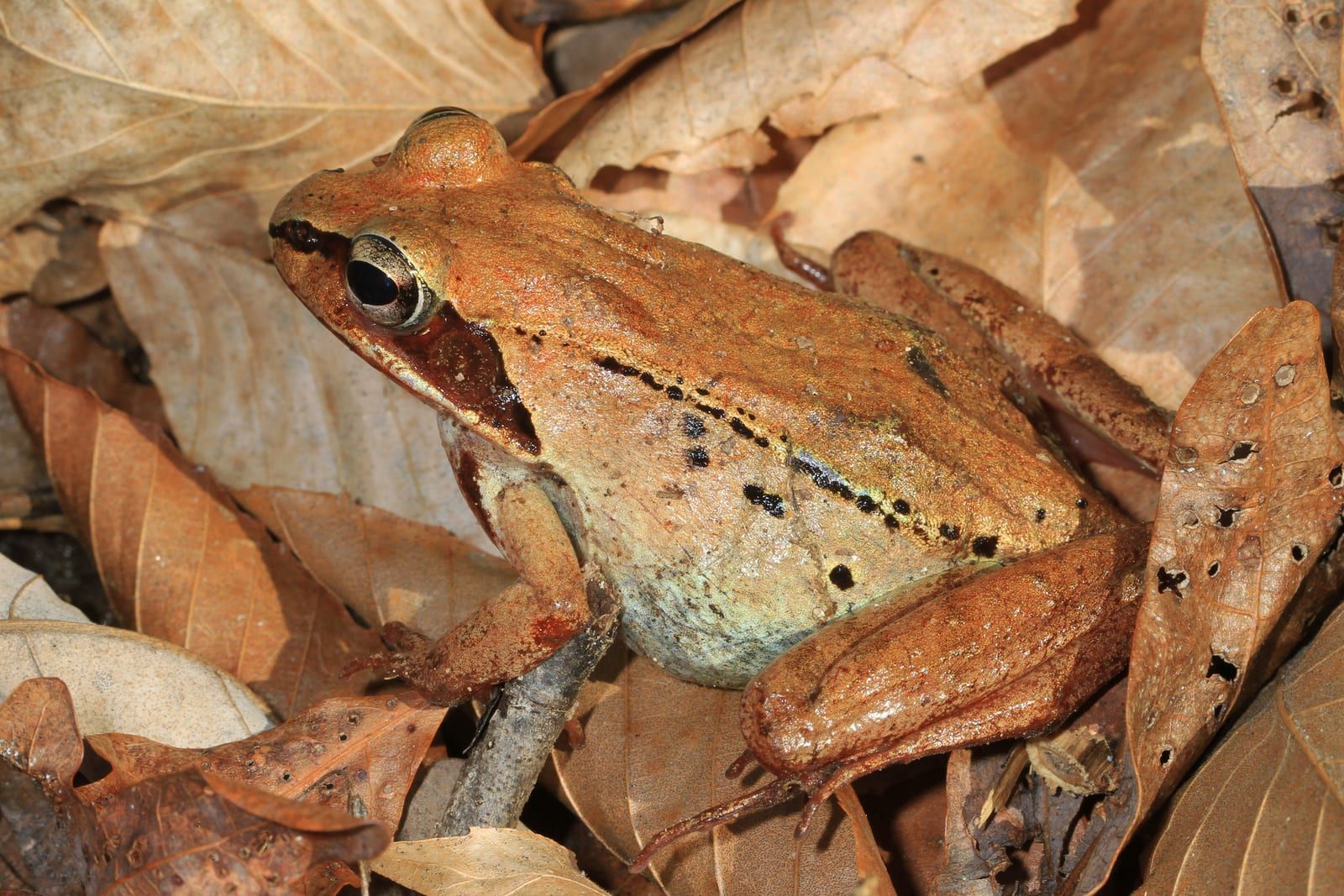
Wood frog (Lithobates sylvaticus), showing its dark eye mask. Photo: Judy Gallagher / CC BY 2.0, via Wikimedia Commons
Description & ID
slender brown to tan frog with a distinctive dark "robber's mask" through the eye and prominent dorsolateral ridges.
Habitat
moist deciduous woodlands; breeds explosively in fishless vernal pools very early in spring, then disperses into the forest.
County status
present; 24 research-grade iNaturalist records [S1].
Conservation status
native; secure. (confirm against PNHP)
Notes
remarkably freeze-tolerant — survives winter partly frozen by producing glucose cryoprotectants. One of the first frogs to call in spring (a duck-like clucking chorus). A vernal-pool obligate, dependent on intact forest.
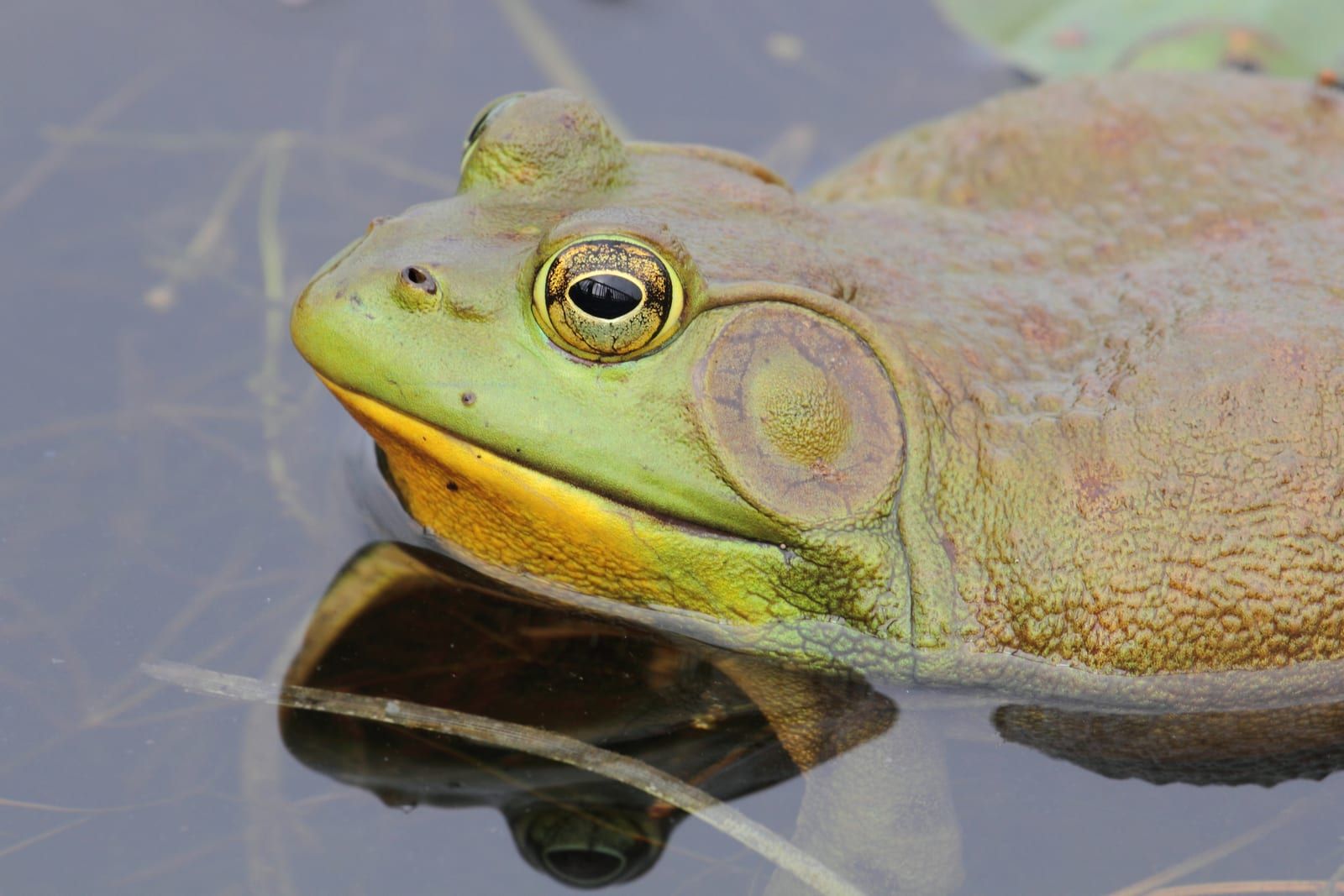
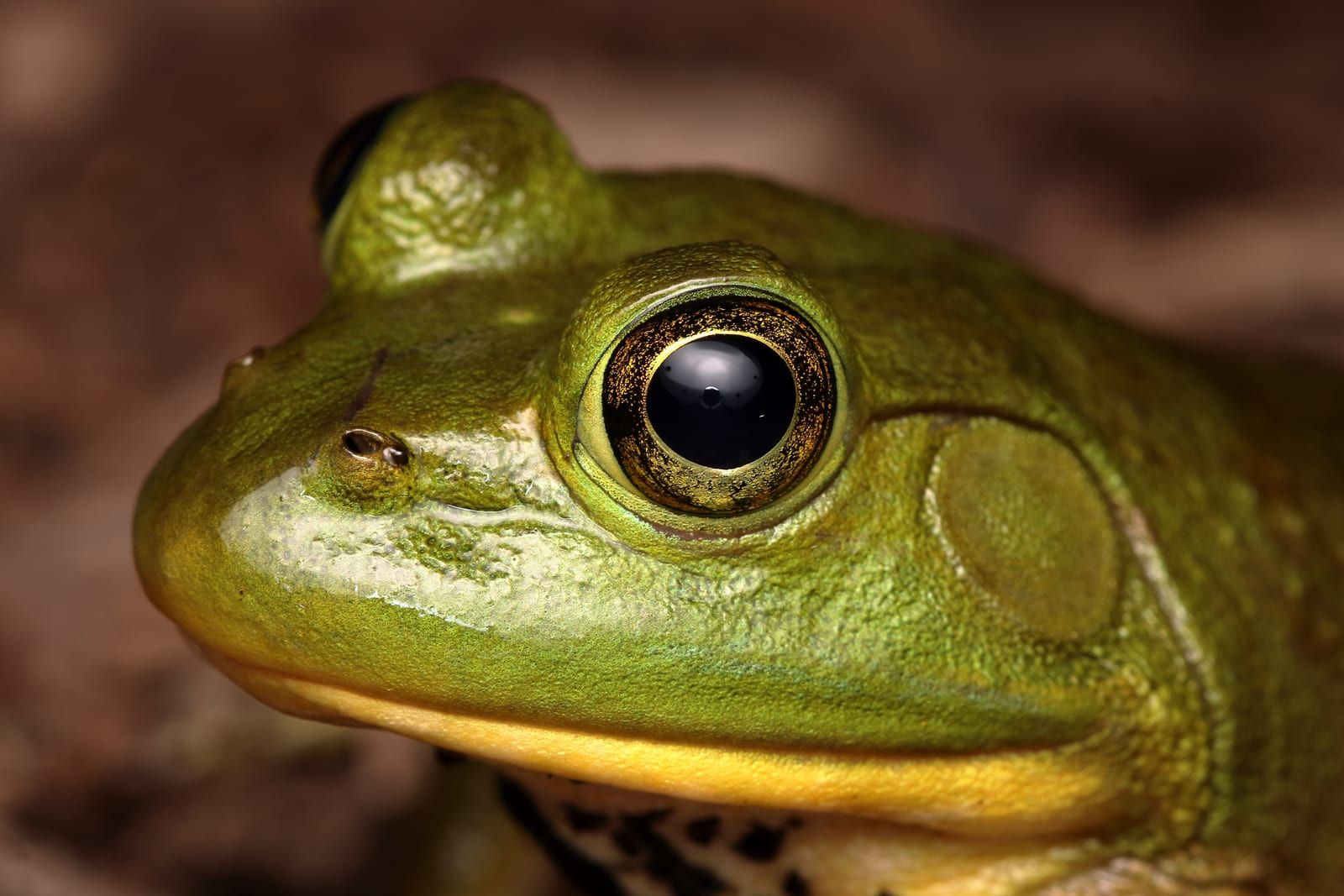
American bullfrog (Lithobates catesbeianus) at the water's surface. Photo: Cephas / CC BY-SA 3.0, via Wikimedia CommonsAmerican bullfrog (Lithobates catesbeianus), a head portrait. Photo: Riley Stanton / CC BY-SA 4.0, via Wikimedia Commons
Description & ID
the largest frog in North America; green to brownish, lacking dorsolateral ridges (a fold curves around the large tympanum instead). Males have a tympanum larger than the eye.
Habitat
permanent ponds, lakes, and slow water with abundant vegetation; needs large, warm, permanent waterbodies.
County status
present; 15 research-grade iNaturalist records [S1].
Conservation status
native (to the eastern US and PA); secure. Note: introduced and invasive in the western US, but native here. (confirm against PNHP)
Notes
deep, resonant "jug-o-rum" call. A voracious ambush predator that eats insects, fish, other frogs, and even small birds; tadpoles overwinter one or more years before metamorphosing.
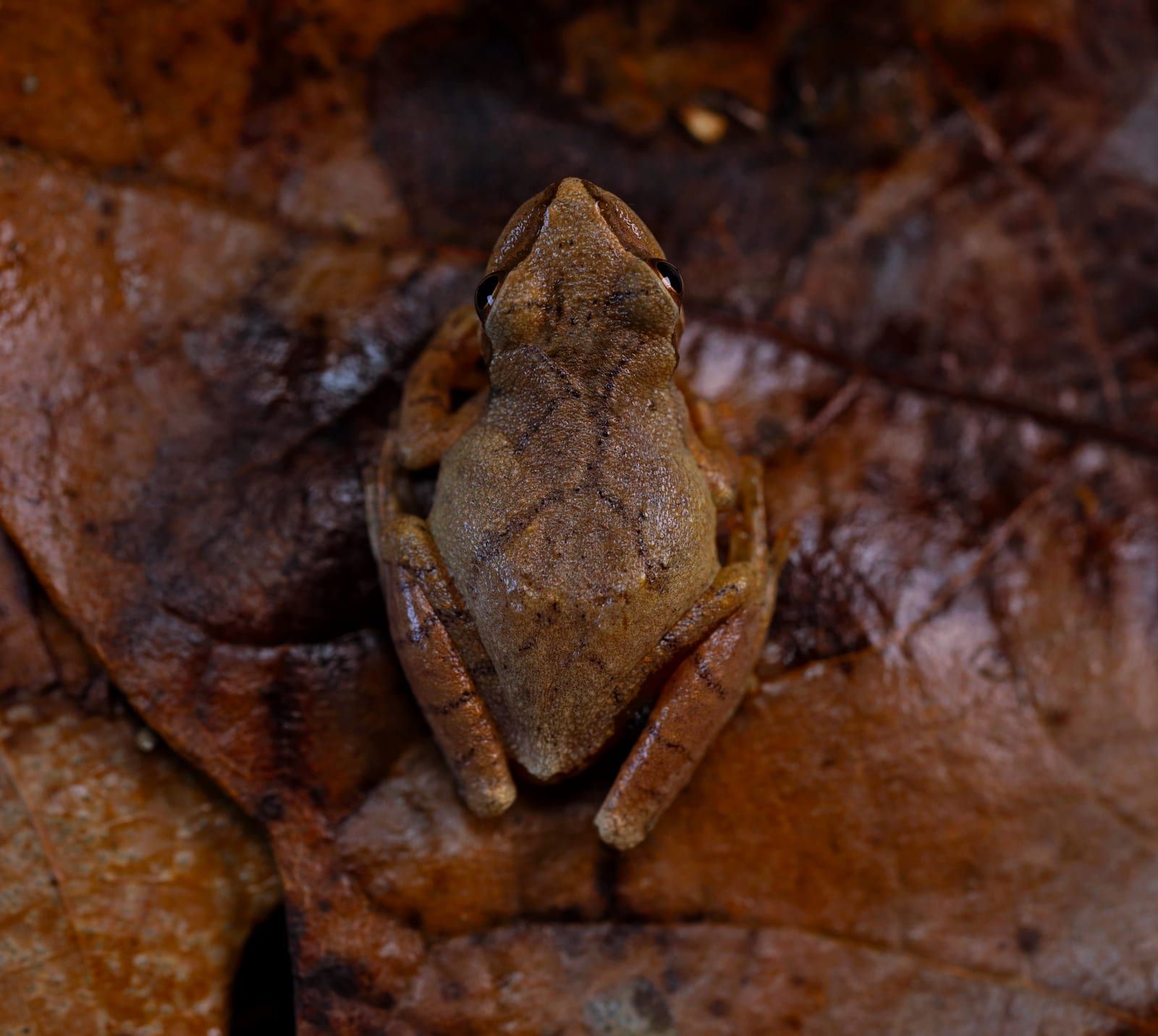
Spring peeper (Pseudacris crucifer), marked with its namesake dorsal X. Photo: Peter Paplanus / CC BY 2.0, via Wikimedia Commons
Description & ID
tiny tan to brown treefrog with a dark X-shaped mark on the back; small toe pads.
Habitat
wooded areas near temporary and permanent water; breeds in ponds, marshes, and vernal pools.
County status
present; 7 research-grade iNaturalist records [S1] — under-recorded relative to abundance, as it is heard far more often than seen.
Conservation status
native; secure. (confirm against PNHP)
Notes
the high, piping "peep" chorus is one of the iconic sounds of early spring across the county. Despite being abundant, its small size and nocturnal calling make it hard to photograph.
large treefrog with very large toe pads and warty skin; native to Cuba and the Caribbean, invasive in Florida.
County status
1 research-grade iNaturalist record [S1], introduced/incidental — almost certainly a hitchhiker on shipped tropical plants rather than an established population (the species cannot overwinter in Pennsylvania's climate).
Conservation status
non-native; not established. (confirm against PNHP)
Notes
recorded for completeness; not part of the county's native fauna. In its invasive range it preys on native frogs.
These species plausibly occur in the county's habitats but lack a
county-level record as of 2026-06-18. They are candidates, not
county records — listed so the checklist's silence on them is not
mistaken for confirmed absence, and excluded from the counts and the dataset
above. Confirmation should cite a county-level record.
Northern Leopard Frog (Lithobates pipiens) — both occur in PA and may be present; Cope's is separable from the Gray Treefrog mainly by call.
Cope's Gray Treefrog (Dryophytes chrysoscelis) — both occur in PA and may be present; Cope's is separable from the Gray Treefrog mainly by call.
Fowler's Toad (Anaxyrus fowleri) — a PA toad of sandier, more open habitats; easily confused with the American Toad.
Marbled Salamander (Ambystoma opacum) — the Jefferson/Blue-spotted complex — mole salamanders of vernal pools expected in the region.
Jefferson Salamander (Ambystoma jeffersonianum) — the Jefferson/Blue-spotted complex — mole salamanders of vernal pools expected in the region.
Four-toed Salamander (Hemidactylium scutatum) — a sphagnum-seep specialist of conservation interest.
We use cookies for analytics and, when advertising is active, to show
ads. You can accept or decline non-essential cookies, and change your
mind anytime. See our Cookie Policy.
Opt-out request honored. We detected your browser's
Global Privacy Control signal and turned off advertising data sharing.