Nicholas Biddle (c. 1796–1876)
Listen to this article · 2 min
0:002:28
Read by a synthetic voice, generated from the text of this article. Hear the whole archive on the Listen page.
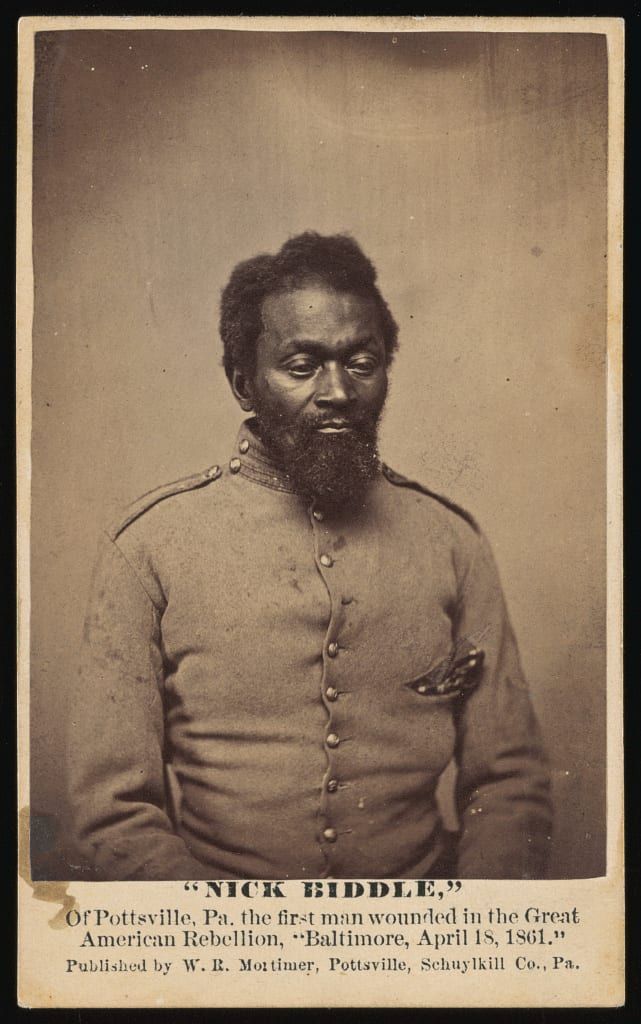
Pottsville’s African American ‘First Defender’ — by tradition the first to shed blood for the Union, and a man the country he marched for then refused a pension. Markers: verified · confirmed · corrects a common error · open/caution.
Nicholas Biddle was struck down by a secessionist mob in Baltimore on April 18, 1861, while marching with the Pennsylvania militia companies — the “First Defenders” — that were first to reach Washington after Fort Sumter. The sight of a Black man in uniform enraged the crowd; a hurled brick opened a wound in his head. By tradition he was the first man to shed blood for the Union, and the claim is worth telling — but as tradition: the first U.S. military death was Private Daniel Hough, killed at Fort Sumter four days earlier, and the careful historian’s phrasing is that “many of the Pennsylvanians present that day believed” Biddle was first.
Born into slavery in Delaware about 1796, Biddle escaped and eventually reached Pottsville, where by 1840 he had attached himself to the town’s militia, serving as orderly to Captain James Wren of the Washington Artillery, whose members issued him a uniform. When Lincoln called for troops, the Pottsville companies were sworn into U.S. service at Harrisburg on April 18, 1861 — all of them except Biddle, who as a Black man was legally barred from mustering into the Army. He marched anyway, in uniform.
A correction worth keeping straight: the president who took notice of the wounded Biddle the next day, April 19, was Abraham Lincoln, not Buchanan, who had left office in March. Any “Buchanan met Biddle” account is an error.
Because he had never legally mustered in, Biddle was denied a federal pension despite his wound — institutional discrimination with lifelong consequences. He did odd jobs until rheumatism disabled him, and died in his Pottsville home on August 2, 1876, with “not a penny to his name.” Surviving First Defenders paid for his funeral and a tombstone, and a procession led him to the colored burying ground beside Bethel A.M.E. Church. (The original tombstone has since been destroyed by vandals.) His likeness survives in a carte-de-visite by Pottsville photographer W. R. Mortimer, held at the Library of Congress; a bronze plaque on Pottsville’s Civil War Soldiers’ Monument, dedicated on the 90th anniversary in 1951, names “the First Defenders and Nicholas Biddle.”
His fuller story sits within the African Americans of Schuylkill County profile.
Sources
- John D. Hoptak — 'Nicholas Biddle: The Civil War's First Blood' (HistoryNet)
License: publisherThe foundational 2008 research on Biddle; carries the Wren-orderly role, the pension denial, the Aug 2 1876 death, and the careful 'many believed' framing of the first-blood tradition. Facts here are summarized, not reproduced.
- Jake Wynn — 'Nicholas Biddle' (Wynning History)
License: reference - Historical Marker Database — First Defenders & Nicholas Biddle monument, Pottsville
License: reference - Library of Congress — 'Nick Biddle' carte-de-visite by W. R. Mortimer
License: public-domain - Irish Central — Daniel Hough, first U.S. military death of the Civil War
License: publisher
Frequently asked
- Who was Nicholas Biddle?
- An African American man, born into slavery in Delaware about 1796, who escaped and reached Pottsville and attached himself to the town's militia. Marching with Pennsylvania's 'First Defenders,' he was struck by a brick thrown by a secessionist mob in Baltimore on April 18, 1861 — by tradition the first man to shed blood for the Union. He died in Pottsville in 1876.
- Was Nicholas Biddle 'the first man to shed blood' in the Civil War?
- By tradition, yes — but it should be stated as tradition. The historian John D. Hoptak frames it as what 'many of the Pennsylvanians present that day believed.' The first U.S. military death was Private Daniel Hough at Fort Sumter on April 14, 1861, four days earlier. The accurate language is 'widely credited' or 'by tradition the first to shed blood' — first blood by mob violence in transit, not the first death.
- Is this the same Nicholas Biddle as the banker?
- No. The financier Nicholas Biddle, president of the Second Bank of the United States, was a different and unrelated man who died in 1844. Tradition holds that the First Defender may have taken the financier's name, but they are distinct people.