New immigration (1880s–1920s)
Hungarians, Russians, Tyroleans & Smaller Groups of Schuylkill County, Pennsylvania
Listen to this article · 9 min
0:008:40
Read by a synthetic voice, generated from the text of this article. Hear the whole archive on the Listen page.
The county’s smaller and most-overlooked new-immigration threads — Hungarians, ethnic Russians, the distinct Tyroleans, Syrians/Lebanese — and the documented Czech “negative.” Several of these are centered just over the Luzerne line; the profile flags every boundary issue and is candid about thin evidence. Markers: verified · confirmed · corrects a common error · open/caution.
Overview
Beyond the large groups, Schuylkill County’s new immigration included several smaller threads that deserve their own accounting — partly because they are genuinely interesting, partly because they have so often been folded into other groups or simply overlooked. Four of them cluster, geographically, around the Hazleton–Freeland–McAdoo corner where Schuylkill, Luzerne, and the coal economy meet (McAdoo itself sits in Kline Township, Schuylkill County, hard against the Luzerne line), and this profile is careful throughout to distinguish in-county fact from the denser settlements just across the border. It also confirms one negative — the near-absence of Czechs — and explains why.
Hungarians (Magyars)
The Hungarian thread runs strongest not through a parish but through a fraternal society of national importance born on the county’s doorstep. The Verhovay Aid Association — later the William Penn Association — was founded on February 21, 1886, in Hazleton, by thirteen Hungarian coal miners, and chartered that December, to provide the sick, death, and survivor benefits that did not otherwise exist “at a period… when insurance of any sort was still in the far away future.” It grew into “the largest, wealthiest and most successful of all the Hungarian American fraternal organizations,” with hundreds of chapters before moving its home office to Pittsburgh in 1926. That a pillar of the entire Hungarian-American fraternal world was founded among anthracite miners on the Schuylkill–Luzerne border is the defining Hungarian fact for the region.
Magyar miners were part of the same 1880s–WWI wave that filled the coal towns, and they were prominent in the era’s labor unrest — at one 1897 meeting near McAdoo “an estimated 9,000 striking workers, ‘mostly Hungarians and Italians,’ gathered” to await management’s response. Like other Hungarians, they split confessionally between Roman Catholic and Reformed (Calvinist) (plus Lutherans and Jews) — the Catholic/Calvinist divide being a defining feature of Magyar-American life.
A correction worth noting: the record lists a “St. Stephen (Hungarian) parish, McAdoo (1900).” Closer research refined this: the entry sits on the Schuylkill County diocesan (PA-GenWeb / Diocese of Allentown) roster as a distinct McAdoo parish — so it is not simply a confusion with the well-known St. Stephen Magyar parish in McKeesport (Allegheny County, 1899/1900). But no independent source corroborates it: surveys of McAdoo’s churches name only the Irish, Ukrainian/Rusyn, Polish, and Russian Orthodox parishes, and the surviving Catholic parishes there consolidated into All Saints Parish with no Hungarian predecessor mentioned. The likeliest reading is a genuine but very small/short-lived early Hungarian congregation that left almost no footprint. It can only be confirmed by the Diocese of Allentown archives (or the All Saints Parish, McAdoo, office).
Sources: William Penn Association — “Our History”; Wikipedia — William Penn Association; CSU Cleveland — “The Great Immigration (1870–1920)” (Hungarian Americans); Abandoned Online — St. Stephen Magyar Church, McKeesport; City Journal — “Borough of Churches” (McAdoo).
”Russians” — a Carpatho-Rusyn label more than an ethnicity
The county’s “Russian” presence is, almost entirely, a matter of identity labeling rather than ethnicity. As the Carpatho-Rusyns & Ukrainians profile establishes, the Russian Orthodox parishes and Russophile societies of Schuylkill County were built overwhelmingly by Carpatho-Rusyns, especially Lemkos, who called themselves “Russian.” The evidence is direct: in Shenandoah-area naturalization papers of 1932–41, immigrants from Rusyn villages “for the most part… filled in the blank marked ‘race’ with ‘Russian’ (primarily those from the Lemko Region).”
The institutions bear this out. Holy Ghost Russian Orthodox Church, Shenandoah (1916) was formed by “a handful of Lemko Rusyn families and some immigrants from the Russian Empire” who left St. Michael’s Greek Catholic — part of the broader “return to Orthodoxy” that drew an estimated 25,000 Rusyns by 1914. The Russian Brotherhood Organization, founded at Mahanoy City on July 1, 1900 “by a group of Galician and Carpatho-Rusyn miners” to “stand for the principle of Russian identity,” was a Russophile-Rusyn body — four of its six original national officers were from Shenandoah, and its membership was “overwhelmingly from the Lemko Region.”
The bottom line: genuine ethnic Great Russians (subjects of the Tsar proper) were a tiny minority in the county — a small appendage to a Lemko/Rusyn core that expressed itself, religiously and fraternally, as “Russian.” When the county’s record says “Russian,” it almost always means Carpatho-Rusyn.
Sources: Richard Custer — “St. Michael’s Church of Shenandoah” (rusynsofpa); OCA — Russian Brotherhood Organization of the USA; RBO — History/Mission; HSP — RBO records finding aid.
Tyroleans (Trentini) — Italian-speaking, Austrian-counted, distinct
The Tyroleans (Trentini) are the cleanest “distinct group” story among the smaller threads — Italian-speaking people from the Dolomites who, because their alpine homeland was Austrian until 1919, “listed themselves as Austrian on census records” and “called themselves Tyroleans,” with “their own language and culture” and a dialect “not generally understood by those who lived outside of Trentino.” There may be 25,000–35,000 descendants of Trentini in Pennsylvania today. They are properly distinguished from the (mostly southern) Italians of the Italian profile.
Their densest American settlement was just over the line in Luzerne County (Hazleton, Freeland, Lattimer) and Northumberland (Mount Carmel), and their religious monument is the Our Lady of Mount Carmel parish in Hazleton — “the first and only Roman Catholic Tyrolean parish in the United States,” founded in 1905 (some sources say 1897), which held its last mass in 2009. But the Bolognani immigrant roster documents genuine Trentino families within Schuylkill County — in Minersville (Rizzi, Recla, Dolzani, Leonardi, Mendini), Pottsville (Biasi, Fronza, DePaoli, Delmarco, Borga, Tolotti), St. Clair (Gilli), Coaldale (Recla, Brentari), Tamaqua (Datres), and Port Carbon (Purin) — confirming an in-county Tyrolean presence alongside the larger Luzerne cluster. Their Italian-sounding surnames and Austrian census records are precisely why the county’s “Italy-born” counts undercount its ethnic Italians.
Sources: PA-GenWeb (Luzerne) — “The Tyroleans of Northeastern Pennsylvania” (Bolognani list); Genetti Family Genealogy — “Mt. Carmel Church Centennial 1905–2005”; Trentino Genealogy — “Ethnicity vs. Cultural Identity”.
Syrians / Lebanese
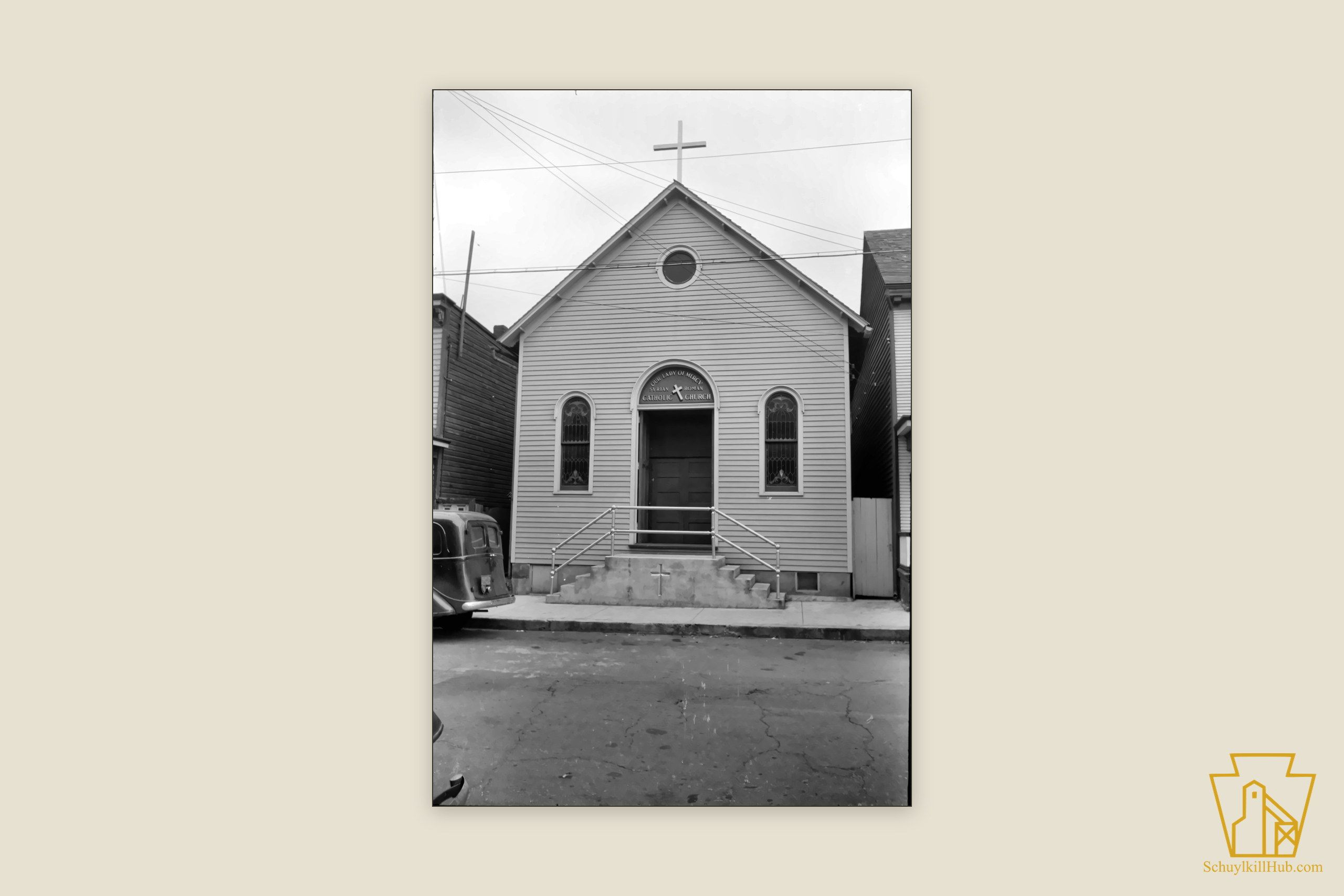
The Syrian/Lebanese presence was real but thin: the 1920 census recorded 183 Syria-born residents in the county — a scatter of families, not a labor colony. They followed the well-documented national peddler-to-merchant trajectory: beginning as door-to-door peddlers and “quickly prospering, becoming prominent merchants,” opening dry-goods stores and groceries in towns and mining camps. Their faiths were the Eastern Christian ones — Maronite Catholic, Melkite (Greek) Catholic, and Antiochian Orthodox — and, as with the Greeks, no Syrian/Lebanese parish is documented within Schuylkill County.
The regional anchor lay just beyond the county, in the Maronite parishes of Wilkes-Barre and Scranton (St. Ann Maronite, Scranton, founded 1903, drawing settlers chiefly from Ehden in North Lebanon — “one of the earliest Lebanese communities in America”); Wilkes-Barre’s early Syrian-Lebanese merchants, guided by the Fayour brothers, came largely from Hadeth El-Jebbe. Honest caveat: no named in-county Syrian/Lebanese family or business surfaced in this research; confirming any would require the 1907 county biography volumes, the 1917 Mahanoy/Pottsville business directories, or the 1920 census manuscripts. The 183 figure is from the published census nativity tables.
Sources: CNEWA / ONE Magazine — “Home Away from Home: Maronites in the United States”; Khayrallah Center (NC State) — “Complicating the Lebanese Peddler Myth”; Saint Ann Maronite Church, Scranton — history.
The Czech “negative” — and why
The near-absence of Czechs (Bohemians) from Schuylkill County is a documented finding, not a gap — and the reason is instructive. Czech immigration overwhelmingly bypassed the anthracite region: Czechs “from the very beginning preferred the cities, with Chicago, St. Louis, New York, and Cleveland having large Bohemian ‘colonies’,” and a major wave took up Midwestern farmland “widely available at low prices.” Being on average more literate and skilled than the Slavic groups who flooded the mines, they chose farms and big industrial cities over the coal patches. By explicit contrast, it was the Slovaks — not the Czechs — who “became industrial workers… the greatest numbers in the anthracite coal region.”
The numbers confirm it: only 44 Bohemia-born residents in the 1900 county census. The larger 2,182 “Czechoslovakia”-born of 1920 were overwhelmingly Slovaks, an artifact of the post-1918 country name that lumped Czechs and Slovaks together (see the Slovaks profile). The county’s “Czechoslovak” census figure is, in truth, a Slovak story wearing a Czech-sounding label.
Sources: Encyclopedia of Chicago — “Czechs and Bohemians”; “The Czechoslovaks in the United States” (Wikisource); Library of Congress — “Czechs in America: A Chronology”.
Open questions
- Confirm or rule out the McAdoo St. Stephen (Hungarian) parish via Diocese of Allentown/Scranton records, and document any Hungarian Reformed congregation in the McAdoo/Kline Township area.
- Identify any named ethnic-Russian (as opposed to Rusyn) families in the county.
- A fuller in-county Tyrolean family/settlement history (the New Boston settlement near Mahanoy City; the Bolognani families’ descendants).
- Named Syrian/Lebanese families and businesses in the county (1907 biography volumes, 1917 business directories, 1920 census manuscripts).
- Confirmation of the 183 Syria-born (1920) and 44 Bohemia-born (1900) figures against the published 1900 and 1920 census nativity tables.
From the archive
Historic maps and photographs from the Schuylkill Hub archive, each available as an archival print.
Sources
- William Penn Association — 'Our History'
License: reference - Wikipedia — William Penn Association
License: CC-BY-SA-4.0 - CSU Cleveland — 'The Great Immigration (1870–1920)' (Hungarian Americans)
License: reference - Abandoned Online — St. Stephen Magyar Church, McKeesport
License: reference - City Journal — 'Borough of Churches' (McAdoo)
License: publisher - Richard Custer — 'St. Michael's Church of Shenandoah' (rusynsofpa)
License: reference - OCA — Russian Brotherhood Organization of the USA
License: reference - RBO — History/Mission
License: reference - HSP — RBO records finding aid
License: reference - PA-GenWeb (Luzerne) — 'The Tyroleans of Northeastern Pennsylvania' (Bolognani list)
License: reference - Genetti Family Genealogy — 'Mt. Carmel Church Centennial 1905–2005'
License: reference - Trentino Genealogy — 'Ethnicity vs. Cultural Identity'
License: reference - CNEWA / ONE Magazine — 'Home Away from Home: Maronites in the United States'
License: reference - Khayrallah Center (NC State) — 'Complicating the Lebanese Peddler Myth'
License: reference - Saint Ann Maronite Church, Scranton — history
License: reference - Encyclopedia of Chicago — 'Czechs and Bohemians'
License: reference - 'The Czechoslovaks in the United States' (Wikisource)
License: public-domain - Library of Congress — 'Czechs in America: A Chronology'
License: reference
Frequently asked
- Was there a Hungarian parish in Schuylkill County?
- A 'St. Stephen (Hungarian) parish, McAdoo (1900)' appears in the record. It sits on the Schuylkill County diocesan (PA-GenWeb / Diocese of Allentown) roster as a distinct McAdoo parish, but no independent source corroborates it — surveys of McAdoo's churches name only the Irish, Ukrainian/Rusyn, Polish, and Russian Orthodox parishes. The likeliest reading is a genuine but very small or short-lived early Hungarian congregation; it can only be confirmed by the Diocese of Allentown archives.
- Why does the county's record say 'Russian' when the people were mostly Rusyn?
- The 'Russian' presence was largely a matter of identity labeling rather than ethnicity. The Russian Orthodox parishes and Russophile societies were built overwhelmingly by Carpatho-Rusyns, especially Lemkos, who called themselves 'Russian' — in Shenandoah-area naturalization papers of 1932–41, immigrants from Rusyn villages mostly filled in 'race' as 'Russian.' Genuine ethnic Great Russians were a tiny minority.
- Were there Czechs in the anthracite coal towns?
- Almost none — a documented finding, not a gap. Czechs preferred big cities and Midwestern farmland; the 1900 county census recorded only 44 Bohemia-born residents. The larger 2,182 'Czechoslovakia'-born of 1920 were overwhelmingly Slovaks, an artifact of the post-1918 country name.
Related
Towns: McAdoo